AAWSAP DIRD, State of the Art and Evolution of High-Energy Lasers, March 2010
DOW-UAP-D137 · page 24 of 31
Text
This text came with the file. It may have mistakes. When the text and the image disagree, the image is right.
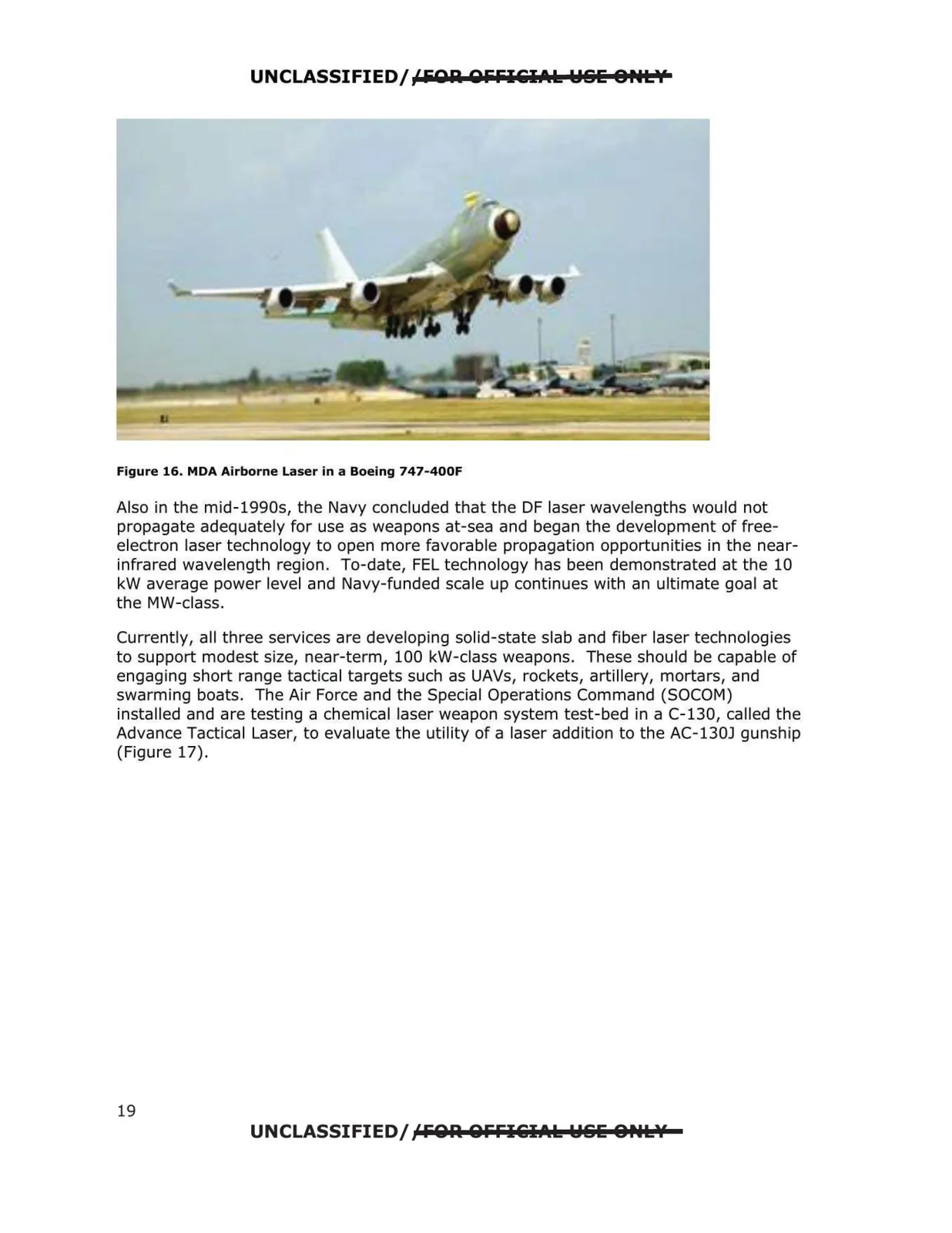
UNCLASSIFIED/fFOA OFFl&I.t.k YSE &P•tv Figure 16. MDA Airborne Laser in a Boeing 747-400F Also in the mid-1990s, the Navy concluded that the DF laser wavelengths would not propagate adequately for use as weapons at-sea and began the development of free electron laser technology to open more favorable propagation opportunities in the near infrared wavelength region. To-date, FEL technology has been demonstrated at the 10 kW average power level and Navy-funded scale up continues with an ultimate goal at the MW-class. Currently, all three services are developing solid-state slab and fiber laser technologies to support modest size, near-term, 100 kW-class weapons. These should be capable of engaging short range tactical targets such as UAVs, rockets, artillery, mortars, and swarming boats. The Air Force and the Special Operations Command (SOCOM) installed and are testing a chemical laser weapon system test-bed in a C-130, called the Advance Tactical Laser, to evaluate the utility of a laser addition to the AC-130] gunship (Figure 17). UNCLASSIFIED/fFOA QFFI&I.t.k YSE 8,.L\f 19