AAWSAP DIRD, State of the Art and Evolution of High-Energy Lasers, March 2010
DOW-UAP-D137 · page 9 of 31
Text
This text came with the file. It may have mistakes. When the text and the image disagree, the image is right.
UNCLASSIFIED/ fFOA OFFl&I.t.k YSE &P•tv
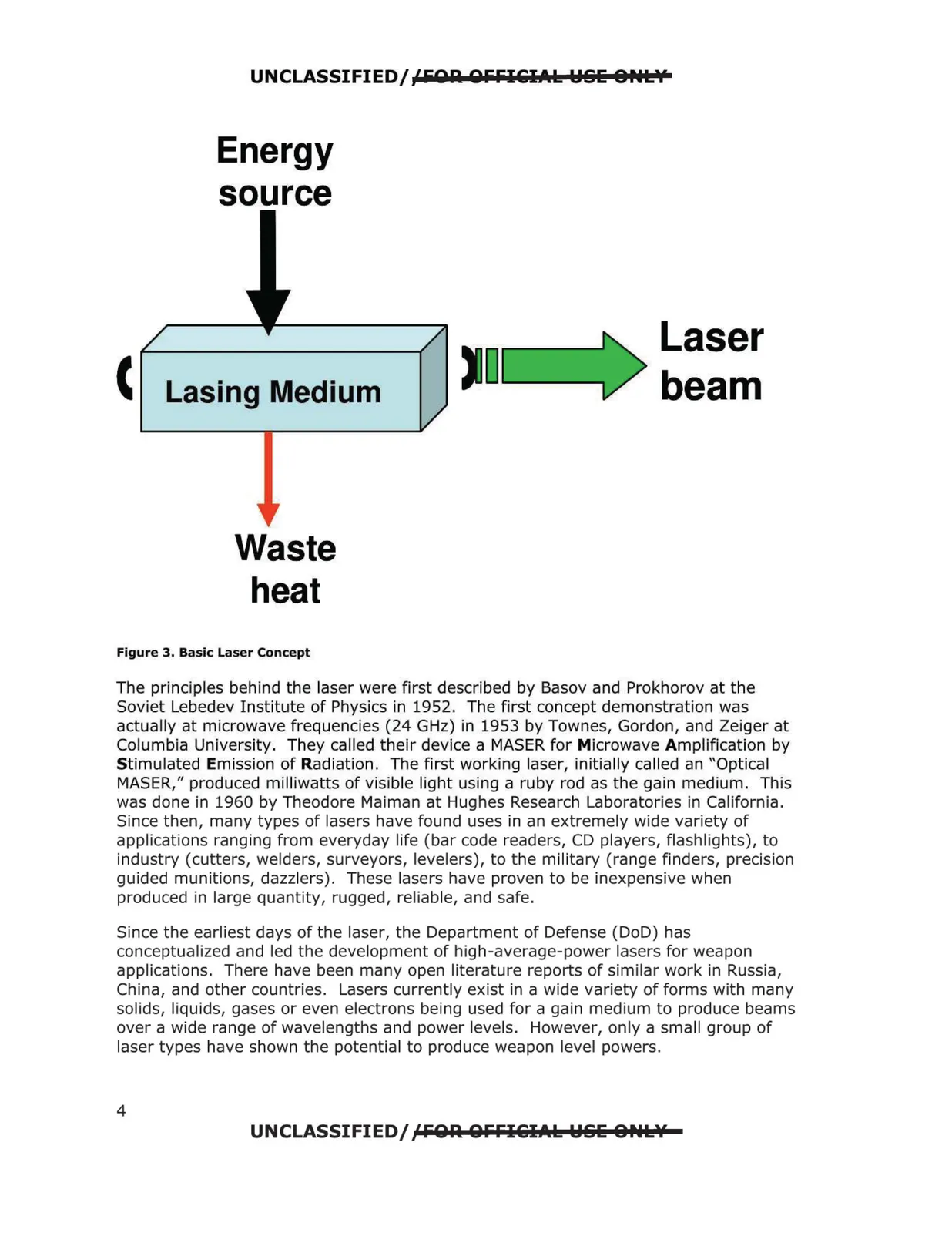
Energy
source
( Lasing Medium
Laser
beam
Waste
heat
Figure 3. Basic Laser Concept
The principles behind the laser were first described by Basov and Prokhorov at the
Soviet Lebedev Institute of Physics in 1952. The first concept demonstration was
actually at microwave frequencies (24 GHz) in 1953 by Townes, Gordon, and Zeiger at
Columbia University. They called their device a MASER for Microwave Amplification by
Stimulated Emission of Radiation. The first working laser, initially called an "Optical
MASER," produced milliwatts of visible light using a ruby rod as the gain medium. This
was done in 1960 by Theodore Maiman at Hughes Research Laboratories in California.
Since then, many types of lasers have found uses in an extremely wide variety of
applications ranging from everyday life (bar code readers, CD players, flashlights), to
industry (cutters, welders, surveyors, levelers), to the military (range finders, precision
guided munitions, dazzlers). These lasers have proven to be inexpensive when
produced in large quantity, rugged, reliable, and safe.
Since the earliest days of the laser, the Department of Defense (DoD) has
conceptualized and led the development of high-average-power lasers for weapon
applications. There have been many open literature reports of similar work in Russia,
China, and other countries. Lasers currently exist in a wide variety of forms with many
solids, liquids, gases or even electrons being used for a gain medium to produce beams
over a wide ra nge of wavelengths and power levels. However, only a small group of
laser types have shown the potential to produce weapon level powers.
UNCLASSIFIED/ fFOA QFFI&I.t.k Y&E 8,.L\f
4