AAWSAP DIRD, Warp Drive, Dark Energy, and the Manipulation of Extra Dimensions, April 2010
DOW-UAP-D138 · page 10 of 33
Text
This text came with the file. It may have mistakes. When the text and the image disagree, the image is right.
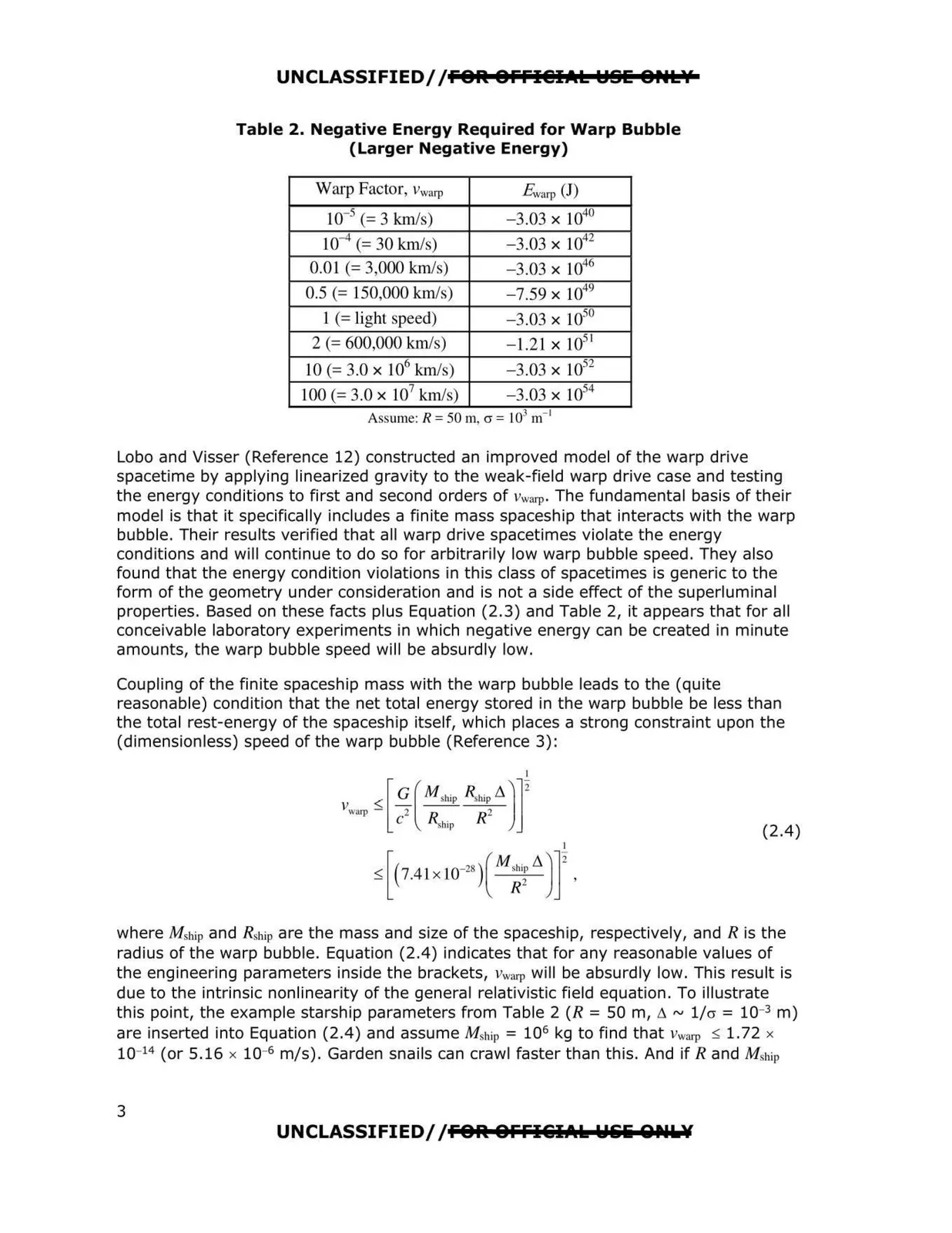
UNCLASSIFIED//F8R 8FFIOl:AL WSE 8HL\f Table 2. Negative Energy Required for Warp Bubble (Larger Negative Energy) Warp Factor, Vwarp Ewarp (J) 105 (= 3 km/s) - 3.03 X 1040 10-4 (= 30 km/s) - 3.03 X 1042 0.01 (= 3,000 km/s) - 3.03 X 1046 0.5 (= 150,000 km/s) -7.59 X 1049 1 ( = light speed) - 3.03 X 1050 2 (= 600,000 km/s) - 1.21 X 1051 10 (= 3.0 X 10⁶ km/s) - 3.03 X 1052 100 (= 3.0 x 10⁷ km/s) - 3.03 X 1054 Assume: R = 50 m cr = 103 m- 1 Lobo and Visser (Reference 12) constructed an improved model of the warp drive spacetime by applying linearized gravity to the weak-field warp drive case and testing the energy conditions to first and second orders of Vwarp , The fundamental basis of their model is that it specifically includes a finite mass spaceship that interacts with the warp bubble. Their results verified that all warp drive spacetimes violate the energy conditions and will continue to do so for arbitrarily low warp bubble speed. They also found that the energy condition violations in this class of spacetimes is generic to the form of the geometry under consideration and is not a side effect of the superluminal properties. Based on these facts plus Equation (2.3) and Table 2, it appears that for all conceivable laboratory experiments in which negative energy can be created in minute amounts, the warp bubble speed will be absurdly low. Coupling of the finite spaceship mass with the warp bubble leads to the (quite reasonable) condition that the net total energy stored in the warp bubble be less than the total rest-energy of the spaceship itself, which places a strong constraint upon the (dimensionless) speed of the warp bubble (Reference 3) : < [2__ ( M .hip R , hip ti J]i v,.,.rp- 2 2 C R.hip R (2.4) where M ship and R ship are the mass and size of the spaceship, respectively, and R is the radius of the warp bubble. Equation (2.4) indicates that for any reasonable values of the engineering parameters inside the brackets, Vwarp will be absurdly low. This result is due to the intrinsic nonlinearity of the general relativistic field equation. To illustrate this point, the example starship parameters from Table 2 (R = 50 m, ~ 1/cr = 10-3 m) are inserted into Equation (2.4) and assume M ship = 106 kg to find that Vwarp ~ 1.72 x 10⁻¹⁴ (or 5. 16 x 10-6 m/s). Garden snails can crawl faster than this. And if Rand M ship UNCLASSIFIED//F8R 8FFl6lal.tL W&i O~ILY 3