AAWSAP DIRD, Warp Drive, Dark Energy, and the Manipulation of Extra Dimensions, April 2010
DOW-UAP-D138 · page 11 of 33
Text
This text came with the file. It may have mistakes. When the text and the image disagree, the image is right.
UNCLASSIFIED//P61t OfflOl.tltL WSli &••LY
are kept constant, then t... = 3.37 x 1024 m (or 3.57 x 10⁸ light-years) in order for Vwarp :::;
1, wh ich is an unrealistic requirement on the warp bubble design.
Because this energy requirement is so phenomenally high one finds it of paramount
importance to explore new ideas in the field of warp drive technology. What now follows
is a pedagogically rich review of the novel warp drive concept that we have been
developing since 2005.
3. The Cosmological Constant
Einstein is famous for a multitude of achievements in the field of physics. Arguably his
most notable contribution is the General Theory of Relativity, a geometric description of
gravitation whose fundamental idea relates the matter and the energy content of the
universe to the geometry of spacetime. Simply put, the presence of matter and energy
causes spacetime to curve, and this curvature controls how matter and energy move
through spacetime. General relativity has been the prevailing theory of gravitation since
1915 and thus far has unambiguously passed observational and experimental tests. It
remains an active area of research and technology is still being developed to test
certain features of the theory. Gravitational waves, for example, are one prediction
from GR; however, technology is only now reaching the stage of maturity to allow for
the detection of these waves.
3 .1 EINSTEIN'S EQUATION AND THE INTRODUCTION OF/\
Upon completion of GR, Einstein applied his theory to the entire universe. He firmly
believed in Mach's principle, and the only way to satisfy this was to assume that space
is globally closed and that the metric tensor should be determined uniquely from the
energy-momentum tensor (Reference 13). He also assumed that the universe was
static, which was a reasonable assumption at the time because observational
astronomy had not advanced to a level that contradicted this paradigm. In 1917, when
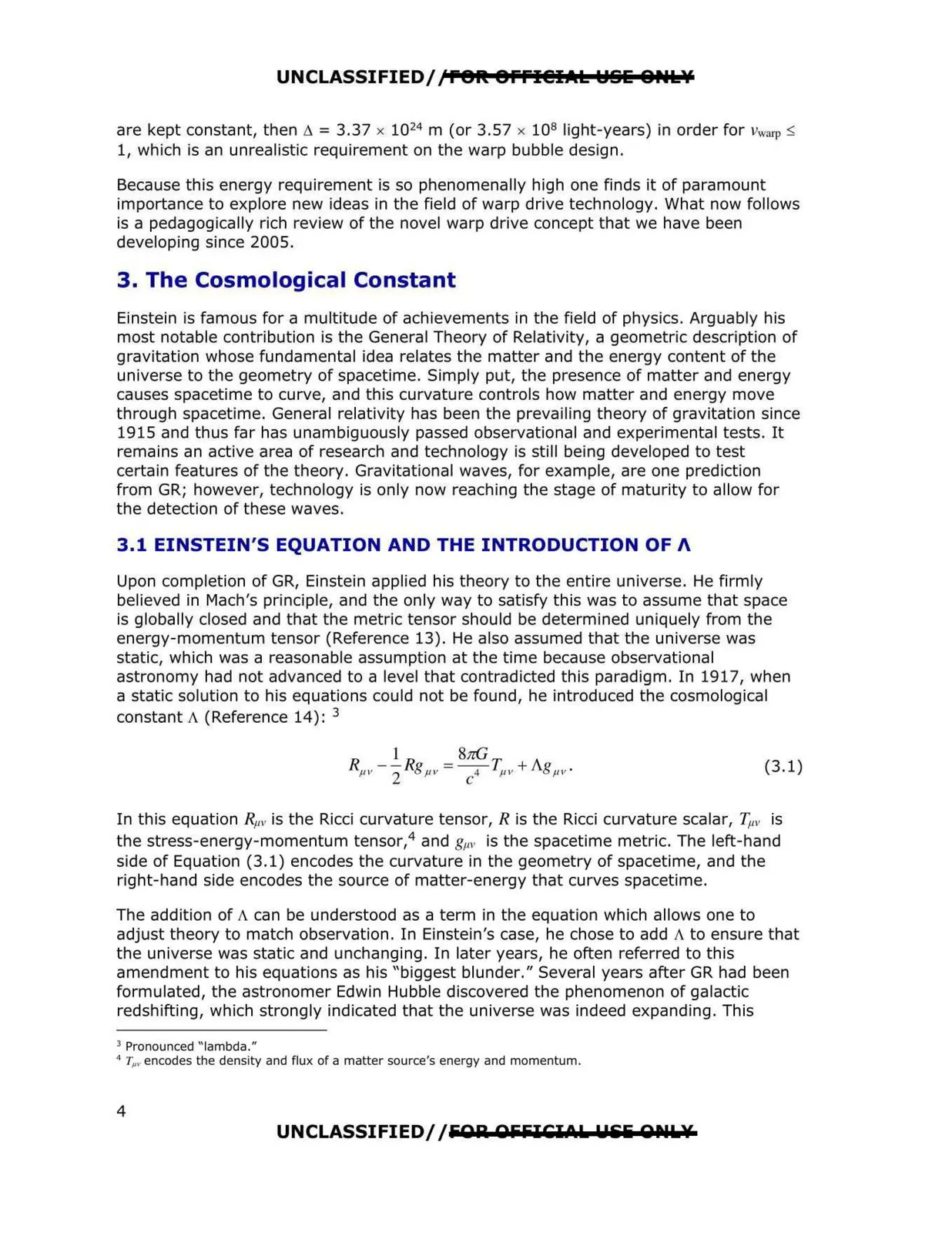
a static solution to his equations could not be found, he introduced the cosmological
constant A (Reference 14): 3
I
8nG
RI"' - 2Rgpv = 7
~,v+ Agµv ·
(3.1)
In this equation Rµv is the Ricci curvature tensor, R is the Ricci curvature scalar, Tµv is
the stress-energy-momentum tensor,4 and gJI" is the spacetime metric. The left-hand
side of Equation (3.1) encodes the curvature in the geometry of spacetime, and the
right-hand side encodes the source of matter-energy that curves spacetime.
The addition of A can be understood as a term in the equation which allows one to
adjust theory to match observation. In Einstein's case, he chose to add A to ensure that
the universe was static and unchanging. In later years, he often referred to this
amendment to his equations as his "biggest blunder." Several years after GR had been
formulated, the astronomer Edwin Hubble discovered the phenomenon of galactic
redshifting, which strongly indicated that the universe was indeed expanding. This
3 Pronounced "lambda."
4 Tµ,·encodes the density and flux of a matter source's energy and momentum.
4
UNCLASSIFIED//FOlil OFFICIO L W&i O•ILY