AAWSAP DIRD, Warp Drive, Dark Energy, and the Manipulation of Extra Dimensions, April 2010
DOW-UAP-D138 · page 16 of 33
Text
This text came with the file. It may have mistakes. When the text and the image disagree, the image is right.
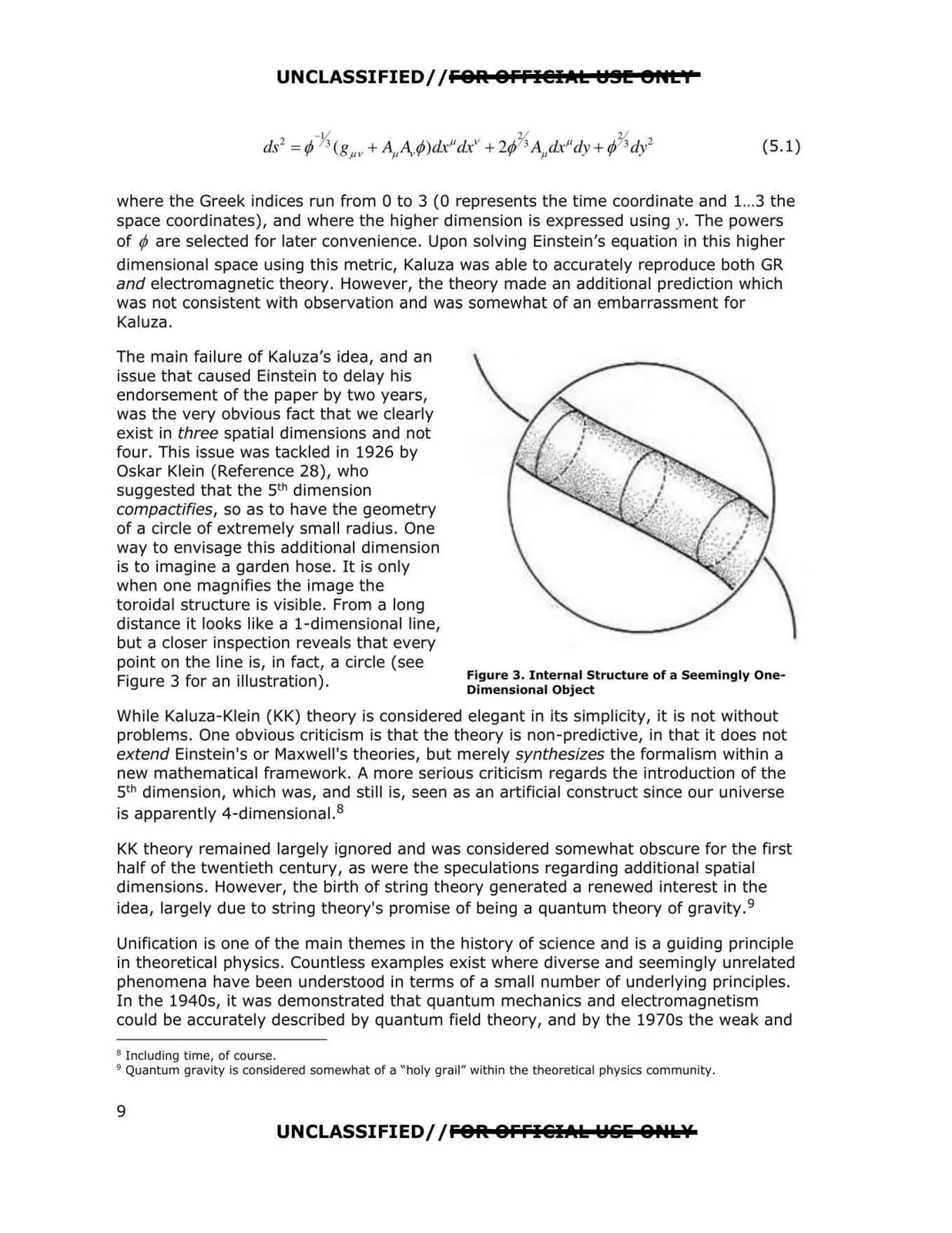
UNCLASSIFIED//FOR 8FFIOIJIIL l:t!II!! e••t I (5.1) where the Greek indices run from O to 3 (0 represents the time coordinate and 1...3 the space coordinates), and where the higher dimension is expressed using y. The powers of ¢ are selected for later convenience. Upon solving Einstein's equation in this higher dimensional space using this metric, Kaluza was able to accurately reproduce both GR and electromagnetic theory. However, the theory made an additional prediction which was not consistent with observation and was somewhat of an embarrassment for Kaluza. The main failure of Kaluza's idea, and an issue that caused Einstein to delay his endorsement of the paper by two years, was the very obvious fact that we clearly exist in three spatial dimensions and not four. This issue was tackled in 1926 by Oskar Klein (Reference 28), who suggested that the 5th dimension compactifies, so as to have the geometry of a circle of extremely small radius. One way to envisage this additional dimension is to imagine a garden hose. It is only when one magnifies the image the toroidal structure is visible. From a long distance it looks like a 1-dimensional line, but a closer inspection reveals that every point on the line is, in fact, a circle (see Figure 3. Internal Structure of a Seemingly One Figure 3 for an illustration). Dimensional Object While Kaluza-Klein (KK) theory is considered elegant in its simplicity, it is not without problems. One obvious criticism is that the theory is non-predictive, in that it does not extend Einstein's or Maxwell's theories, but merely synthesizes the formalism within a new mathematical framework. A more serious criticism regards the introduction of the 5th dimension, which was, and still is, seen as an artificial construct since our universe is apparently 4-dimensional. 8 KK theory remained largely ignored and was considered somewhat obscure for the first half of the twentieth century, as were the speculations regarding additional spatial dimensions. However, the birth of string theory generated a renewed interest in the idea, largely due to string theory's promise of being a quantum theory of gravity. 9 Unification is one of the main themes in the history of science and is a guiding principle in theoretical physics. Countless examples exist where diverse and seemingly unrelated phenomena have been understood in terms of a small number of underlying principles. In the 1940s, it was demonstrated that quantum mechanics and electromagnetism could be accurately described by quantum field theory, and by the 1970s the weak and 8 Including time, of course. 9 Quantum gravity is considered somewhat of a "holy grail" within the theoretical physics community. 9 UNCLASSIFIED//FOR 8FFl611'1L W&lii &••LY