AAWSAP DIRD, Warp Drive, Dark Energy, and the Manipulation of Extra Dimensions, April 2010
DOW-UAP-D138 · page 17 of 33
Text
This text came with the file. It may have mistakes. When the text and the image disagree, the image is right.
UNCLASSIFIED//P61t 6ffl@IIIIL HS£ 8HL\S
strong nuclear forces could also be described using QFT. The full theory, called the
Standard Model of particle physics, is arguably the most successful physical theory to
date.
Despite the successes of the Standard Model, incorporating gravitational interactions
using the methods of QFT has proven to be one of the most challenging problems facing
theoretical physics today. String theory is currently the best candidate for a quantum
theory of gravity (Reference 29). The divergences associated with point particle
gravitational interactions are removed in string theory via the extended nature of the
string. A review of string theory falls far outside the scope of this paper; however, the
theory contains numerous compelling features that deserve mention here. One of the
most discussed aspects of string theory is its prediction that additional dimensions of
space exist, and are indeed required for string theory to work. One of the predictions of
string theory is that these additional dimensions are extremely small, on the order of
10-35 m. However, there are also popular models which attempt to explain certain
aspects of nature that involve large extra dimensions which we will briefly introduce.
5.2 LARGE EXTRA DIMENSIONS
Models with large extra dimensions have enjoyed a revived interest in physics. This
began with the Arkani-Hamed, Dimopoulos, and Dvali (ADD) proposal to lower the
quantum gravity scale to the 10 to 100 TeV scale 10 (accessible to the next generation
of particle accelerators) by embedding the Standard Model fields in a 3+1 dimensional
brane existing in a higher dimensional bulk spacetime (Reference 30, 31). Gravity is
free to propagate in the bulk, which effectively dilutes its strength. This idea was
inspired by M-theory, where it was recognized that the scale of quantum gravity could
be lowered from the Planck energy scale to the Grand Unification Theory (GUT) energy
scale (Reference 32-35). 11 The assumptions underlying the ADD model are:
•
n-extra dimensions compactified on a torus with volume V,, = (2nr)'1 .
•
Standard Model fields are localized to the brane.
•
Gravity can propagate in the bulk.
•
There is no cosmological constant in the bulk or on the boundary.
•
The brane is stiff.
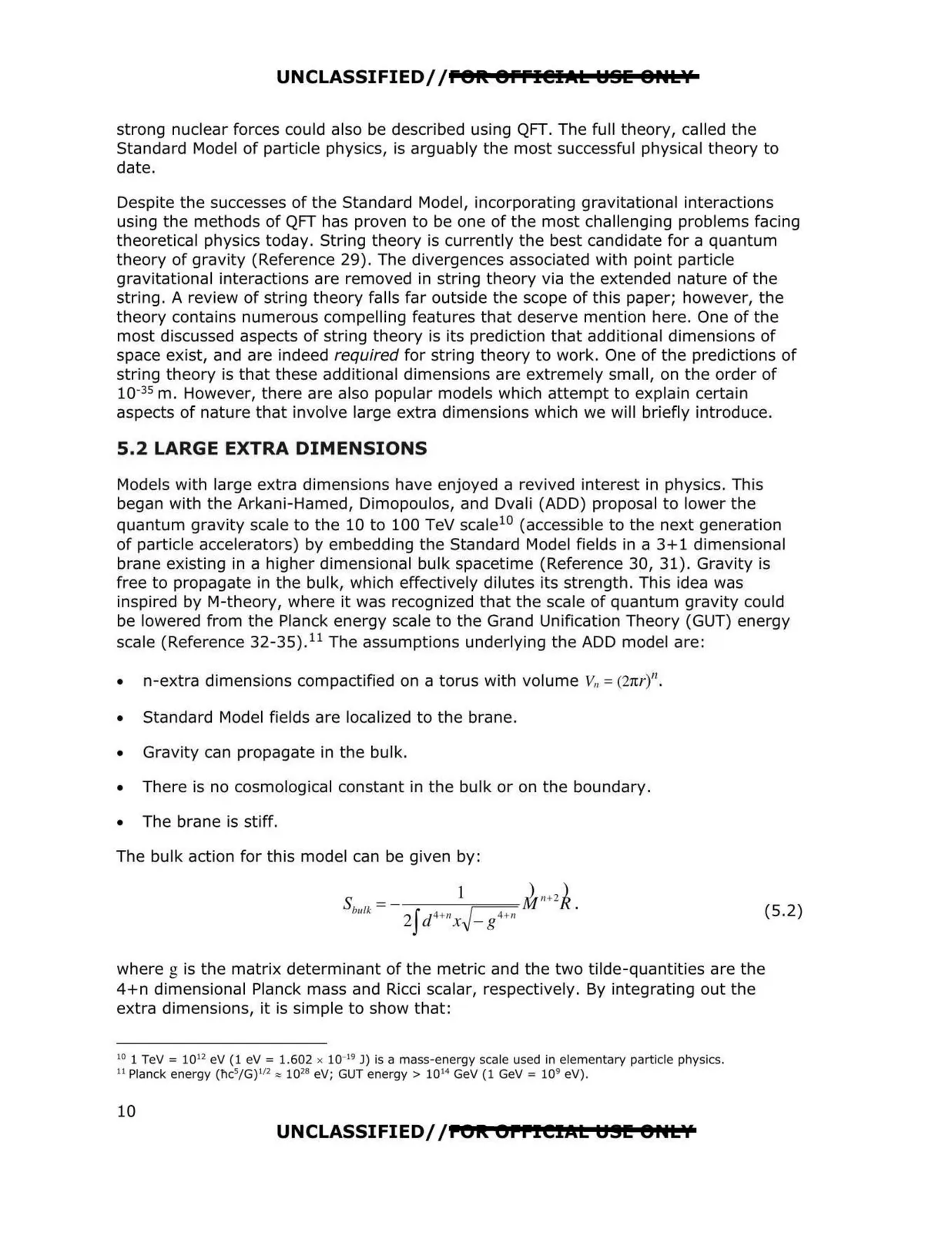
The bulk action for this model can be given by:
(5.2)
where g is the matrix determinant of the metric and the two tilde-quantities are the
4+n dimensional Planck mass and Ricci scalar, respectively. By integrating out the
extra dimensions, it is simple to show that:
10 1 TeV = 1012 eV (1 eV = 1.602 x 10- 19 J) is a mass-energy scale used in elementary particle physics.
11 Planck energy (flc5/G) 112 " 1028 eV; GUT energy > 1014 GeV (1 GeV = 109 eV).
10
UNCLASSIFIED/;roR OPFICIJ!ct tJ9I! e,~tv