AAWSAP DIRD, Warp Drive, Dark Energy, and the Manipulation of Extra Dimensions, April 2010
DOW-UAP-D138 · page 28 of 33
Text
This text came with the file. It may have mistakes. When the text and the image disagree, the image is right.
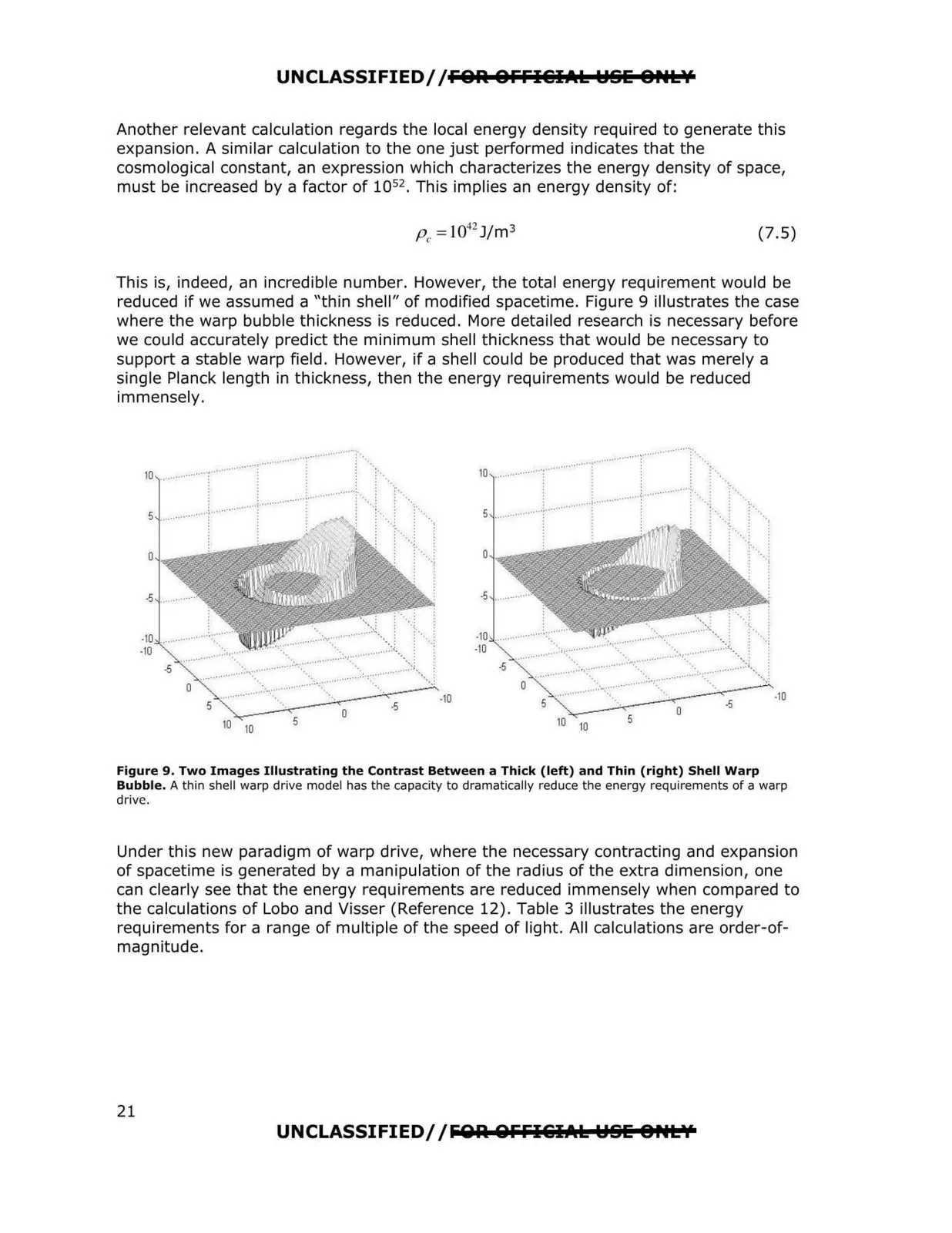
UNCLASSIFIED//FQR QFFIOl:wL HSE QHL\f Another relevant calculation regards the local energy density required to generate this expansion. A similar calculation to the one just performed indicates that the cosmological constant, an expression which characterizes the energy density of space, must be increased by a factor of 1052• This implies an energy density of: (7.5) This is, indeed, an incredible number. However, the total energy requirement would be reduced if we assumed a "thin shell" of modified spacetime. Figure 9 illustrates the case where the warp bubble thickness is reduced. More detailed research is necessary before we cou ld accurately predict the minimum shell thickness that would be necessary to support a stable warp field. However, if a shell could be produced that was merely a single Planck length in thickness, then the energy requirements would be reduced immensely. 10 ·····:·········•"'"' ' '·••' ' --~-"' ,. ' ' . , .... .. 0 -5 Figure 9. Two Images Illustrating the Contrast Between a Thick (left) and Thin (right) Shell Warp Bubble. A thin shell warp drive model has the capacity to dramatically reduce the energy requirements of a warp drive. Under this new paradigm of warp drive, where the necessary contracting and expansion of spacetime is generated by a manipulation of the radius of the extra dimension, one can clearly see that the energy requirements are reduced immensely when compared to the calculations of Lobo and Visser (Reference 12). Table 3 illustrates the energy requirements for a range of multiple of the speed of light. All ca lculations are order-of magnitude. UNCLASSIFIED//FOA orr101.•1L WSE 8HLY 21