AAWSAP DIRD, Warp Drive, Dark Energy, and the Manipulation of Extra Dimensions, April 2010
DOW-UAP-D138 · page 29 of 33
Text
This text came with the file. It may have mistakes. When the text and the image disagree, the image is right.
UNCLASSIFIED//POI\ OPPICIIIIL tt!II! 8HL\S
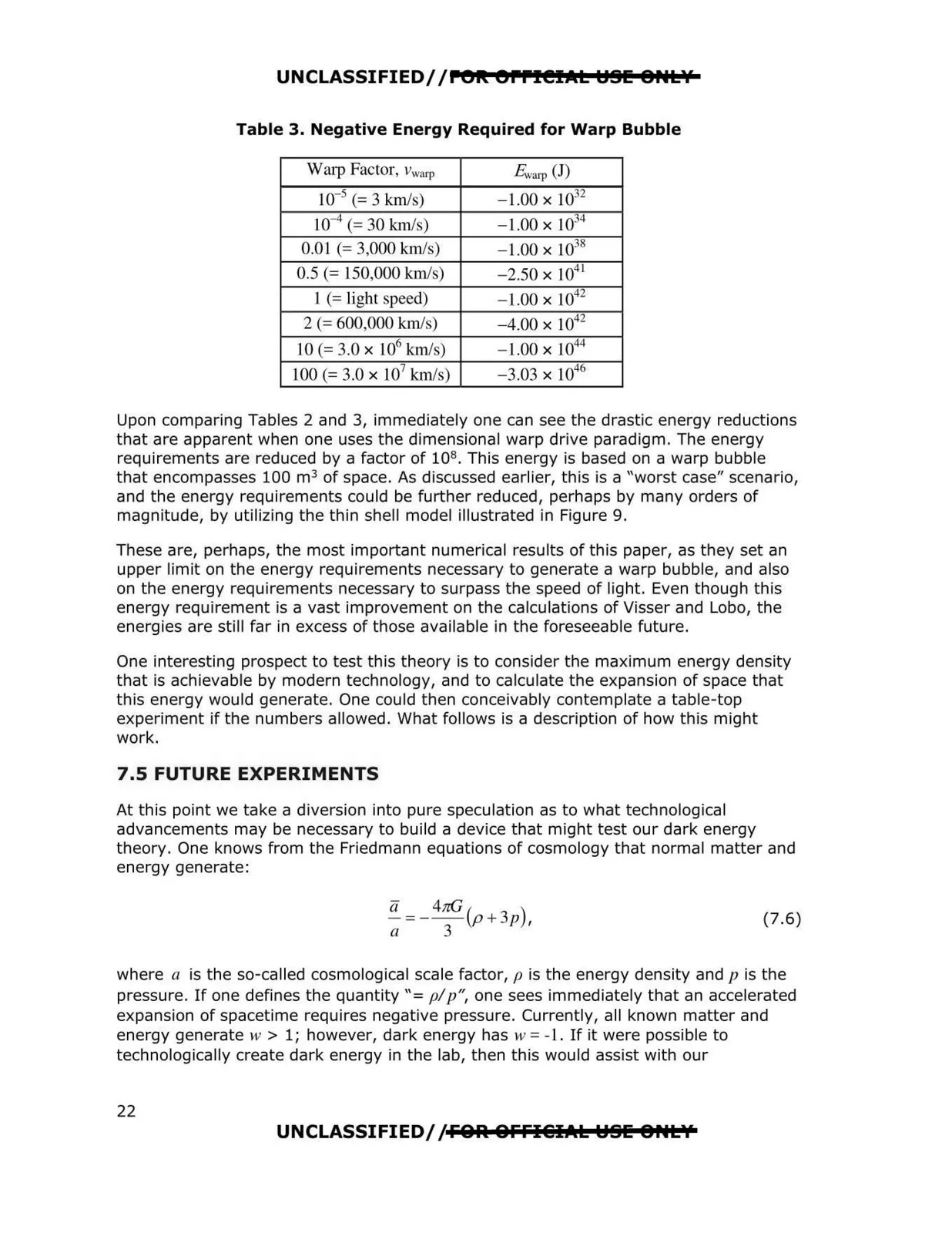
Table 3. Negative Energy Required for Warp Bubble
Warp Factor, Vwarp
£warp (J)
10-5 (= 3 km/s)
- 1.00 X 1032
10-4 (= 30 ktn/s)
-1.00 X 1034
0.01 (= 3,000 ktn/s)
-l.00 X 1038
0.5 (= 150,000 km/s)
- 2.50 X 10⁴ 1
I (= light speed)
- 1.00 X 1042
2 (= 600,000 km/s)
- 4.00 X 1042
10 (= 3.0 X 10⁶ km/s)
- 1.00 X 1044
100 (= 3.Q X 107 km/s)
- 3.03 X 1046
Upon comparing Tables 2 and 3, immediately one can see the drastic energy reductions
that are apparent when one uses the dimensional warp drive paradigm. The energy
requirements are reduced by a factor of 108 . This energy is based on a warp bubble
that encompasses 100 m3 of space. As discussed earlier, this is a "worst case" scenario,
and the energy requirements could be further reduced, perhaps by many orders of
magnitude, by utilizing the thin shell model illustrated in Figure 9.
These are, perhaps, the most important numerical results of this paper, as they set an
upper limit on the energy requirements necessary to generate a warp bubble, and also
on the energy requirements necessary to surpass the speed of light. Even though this
energy requirement is a vast improvement on the calculations of Visser and Lobo, the
energies are still far in excess of those available in the foreseeable future.
One interesting prospect to test this theory is to consider the maximum energy density
that is achievable by modern technology, and to calculate the expansion of space that
this energy would generate. One could then conceivably contemplate a table-top
experiment if the numbers allowed. What follows is a description of how this might
work.
7.5 FUTURE EXPERIMENTS
At this point we take a diversion into pure speculation as to what technological
advancements may be necessary to build a device that might test our dark energy
theory. One knows from the Friedmann equations of cosmology that normal matter and
energy generate:
a
4nG
-;; =- -3-(p + 3p),
(7.6)
where a is the so-called cosmological scale factor, p is the energy density and p is the
pressure. If one defines the quantity"= plp", one sees immediately that an accelerated
expansion of spacetime requires negative pressure. Currently, all known matter and
energy generate w > 1; however, dark energy has w = -1. If it were possible to
technologically create dark energy in the lab, then this would assist with our
UNCLASSIFIED//FOR OFFIOIAL ~SI! 8Ht,•
22