AAWSAP DIRD, Traversable Wormholes, Stargates, and Negative Energy, April 2010
DOW-UAP-D139 · page 24 of 42
Text
This text came with the file. It may have mistakes. When the text and the image disagree, the image is right.
UNCLASSIFIED/fFOA OFFl&I.t.k Y&li &PtLY
Finally, Ries et al. (Reference SO) experimentally demonstrated the very first simple,
scalable squeezed vacuum source in the laboratory that consisted of a continuous-wave
diode laser and an atomic rubidium vapor cell. The experimental tools one needs to
begin exploring the generation of negative energy for the purpose of creating
traversable wormholes are just now becoming available.
3. Gravitationally Squeezed Electromagnetic ZPF
A natural source of negative energy comes from the effect that gravitational fields (of
astronomical bodies) in space have upon the surrounding quantum vacuum. For
example, the gravitational field of the Earth produces a zone of negative energy around
it by dragging some of the virtual quanta (a.k.a. vacuum ZPF) downward. This concept
was initially developed in the 1970s as a byproduct of studies on quantum field theory
in curved space (Reference 25). However, Hochberg and Kephart (Reference 21)
derived an important application of this concept to the problem of creating and
stabilizing traversable wormholes. They showed that one can utilize the negative energy
densities, which arise from distortion of the vacuum ZPF due to the interaction with a
prescribed gravitational background, for providing a violation of the energy conditions.
The squeezed quantum states of quantum optics provide a natural form of matter
having negative energy density.
The analysis, via quantum optics, showed that gravitation itself provides the
mechanism for generating the squeezed vacuum states needed to support stable
traversable wormholes. The production of negative energy densities via a squeezed
vacuum is a necessary and unavoidable consequence of the interaction or coupling
between ordinary matter and gravity, and this defines what is meant by gravitationally
squeezed vacuum states. The magnitude of the gravitational squeezing of the vacuum
can be estimated from the quantum optics squeezing condition for given transverse
momentum and (equivalent) energy eigenvalues, j, of two electromagnetic ZPF field
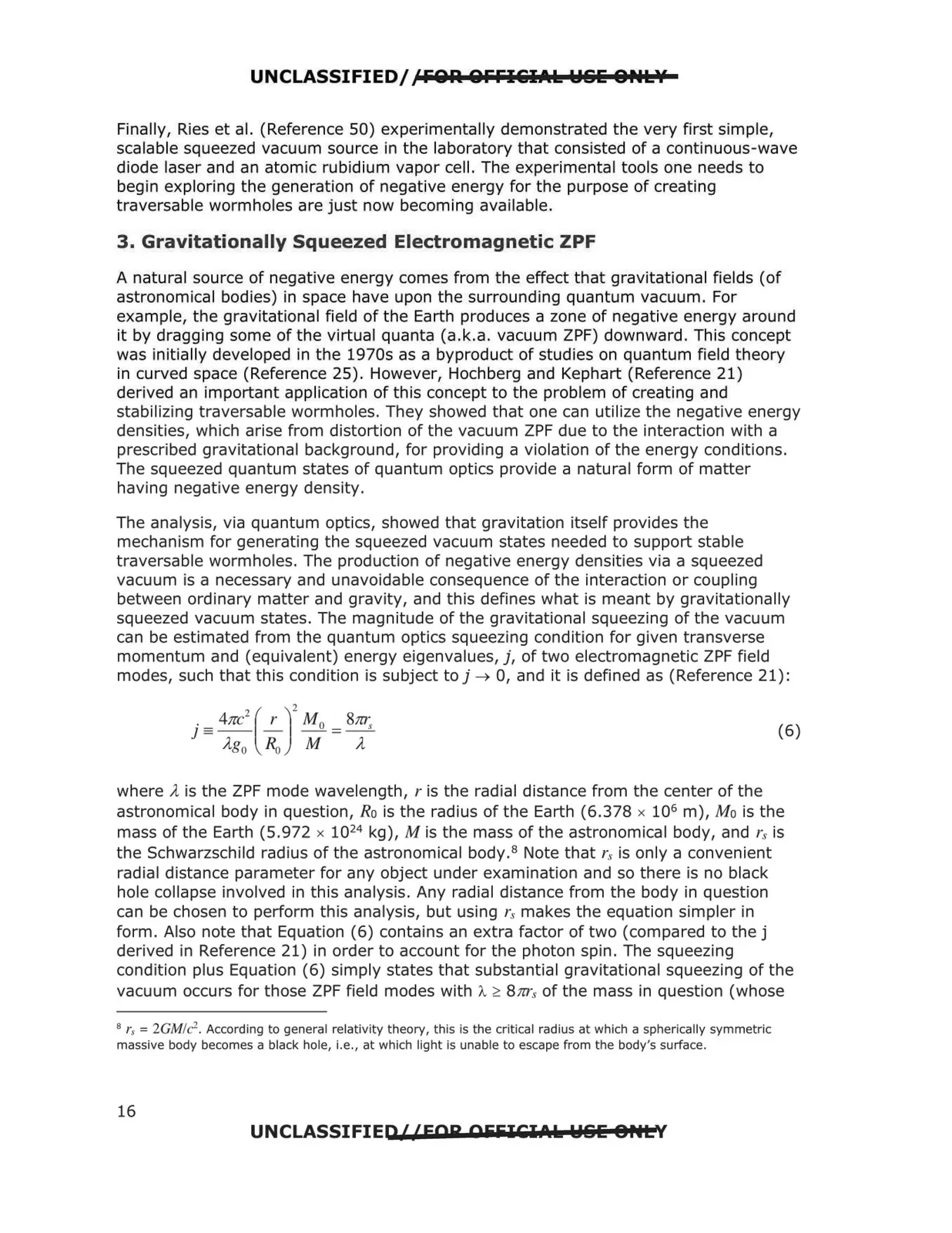
modes, such that this condition is subject toj ➔ 0, and it is defined as (Reference 21):
(6)
where ,l is the ZPF mode wavelength, r is the radial distance from the center of the
astronomical body in question, Ro is the radius of the Earth (6.378 x 10⁶ m), Mo is the
mass of the Earth (5,972 x 1024 kg), Mis the mass of the astronomical body, and rs is
the Schwarzschild radius of the astronomical body. 8 Note that rs is only a convenient
radial distance parameter for any object under examination and so there is no black
hole collapse involved in this analysis. Any radial distance from the body in question
can be chosen to perform this analysis, but using rs makes the equation simpler in
form. Also note that Equation (6) contains an extra factor of two (compared to the j
derived in Reference 21) in order to account for the photon spin. The squeezing
condition plus Equation (6) simply states that substantial gravitational squeezing of the
vacuum occurs for those ZPF field modes with A~ Bnrs of the mass in question (whose
8 r, = 2GM/c2. According to general relativity theory, this is the critical radius at which a spherically symmetric
massive body becomes a black hole, i.e., at which light is unable to escape from the body's surface.
16
UNCLASSIFIEQ { {FOR OFFICIAL Y&li 8HLY