AAWSAP DIRD, Traversable Wormholes, Stargates, and Negative Energy, April 2010
DOW-UAP-D139 · page 25 of 42
Text
This text came with the file. It may have mistakes. When the text and the image disagree, the image is right.
UNCLASSIFIED/fFOA OFFI&il.t..k Y&& 8Ptk\f
gravitational field is squeezing the vacuum). The corresponding local vacuum state
energy density is: pE-gsvac = -211h1c!A4.
The general result of the gravitational squeezing effect is that as the gravitational field
strength increases, the negative energy zone (surrounding the body) also increases in
strength. Table 1 shows when gravitational squeezing becomes important for sample
bodies and their associated pE-gsvac. The table shows that in the case of the Earth,
Jupiter and the Sun, the squeezing effect is extremely feeble because only ZPF mode
wavelengths above 0.2 m to 78 km are affected, each having very minute pE-gsvac. For a
solar mass black hole (radius of 2.95 km), the effect is still feeble because only ZPF
mode wavelengths above 78 km are affected. But note that Planck mass bodies will
have an enormously strong negative energy zone surrounding them because all ZPF
mode wavelengths above 8.50 x 10⁻³⁴ m will be squeezed, in other words, all
wavelengths of interest for vacuum fluctuations. Protons will have the strongest
negative energy zone in comparison because the squeezing effect includes all ZPF mode
wavelengths above 6.50 x 10-53 m. Furthermore, a body smaller than a nuclear
diameter (;::: 10-16 m) and containing the mass of a mountain (;::: 1011 kg) has a fairly
strong negative energy zone because all ZPF mode wavelengths above 10-15 m will be
squeezed. In each of these cases, the magnitude of the corresponding pE-gsvac is very
large.
However, the estimates for the wavelengths in Table 1 might be too small. Ford
(private communication, 2007) argues that Reference 21 is in error because spacetime
is flat on scales smaller than the local radius of curvature, which is defined by the
inverse square root of the typical Riemann curvature tensor component in a local
orthonormal frame, or Ac;::: (?c2/GM) 112 . According to Ford, only ZPF modes with A ;;;;: Ac
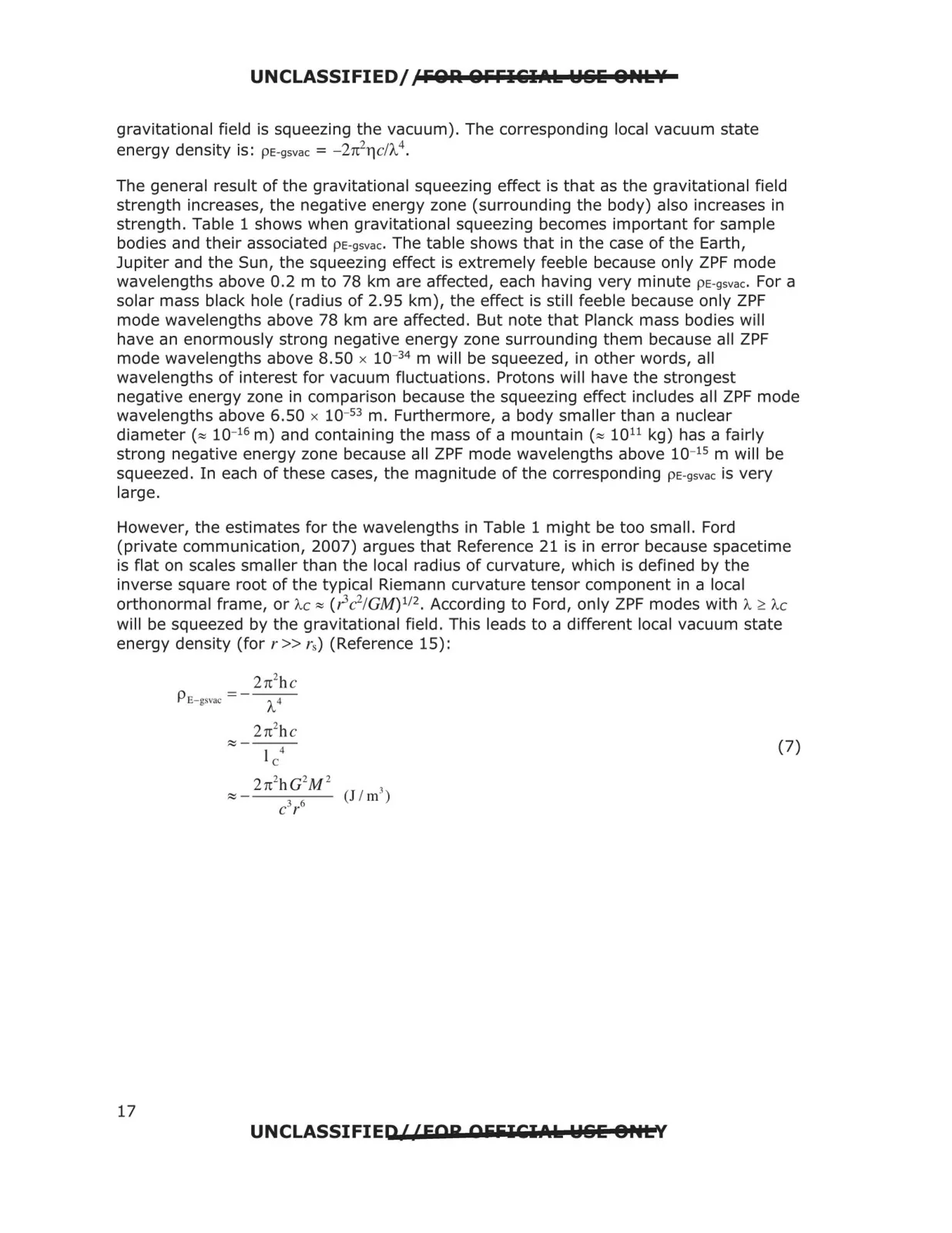
will be squeezed by the gravitational field. This leads to a different local vacuum state
energy density (for r >> rs) (Reference 15):
2n2hc
PE-gsvac = - ~
2n2hc
== - -l- 4-
(7)
c
2n2hG2M 2
(JI m3)
UNCLASSIFIEQ { {FOR OFFICIAL W&& 8HLY
17