AAWSAP DIRD, High-Frequency Gravitational Wave Communications, April 2010
DOW-UAP-D140 · page 15 of 57
Text
This text came with the file. It may have mistakes. When the text and the image disagree, the image is right.
UNCLASSIFIED//&Olil OiiiilCI0L Llili QPIL¥
G
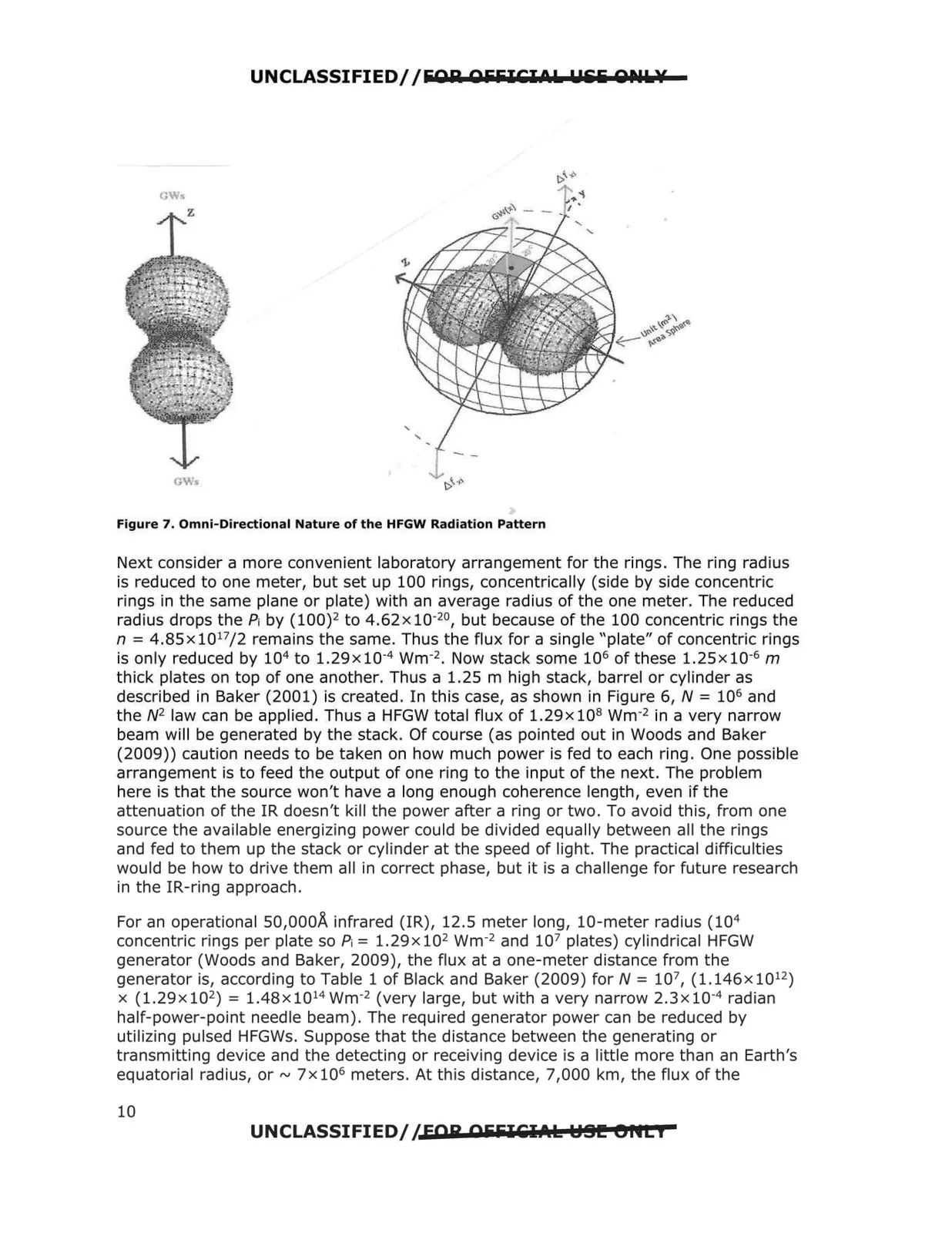
Figure 7. Omni-Directional Nature of the HFGW Radiation Pattern
Next consider a more convenient laboratory arrangement for the rings. The ring radius
is reduced to one meter, but set up 100 rings, concentrically (side by side concentric
rings in the same plane or plate) with an average radius of the one meter. The reduced
radius drops the Pi by (100) 2 to 4.62x 10⁻²⁰, but because of the 100 concentric rings the
n = 4.85x10¹⁷/2 remains the same. Thus the flux for a single "plate" of concentric rings
is only reduced by 104 to 1.29x 10-4 Wm·2. Now stack some 106 of these 1.25x 10⁻⁶ m
thick plates on top of one another. Thus a 1.25 m high stack, barrel or cylinder as
described in Baker (2001) is created. In this case, as shown in Figure 6, N = 106 and
the N2 law can be applied. Thus a HFGW total flux of 1.29x 10⁸ wm-2 in a very narrow
beam will be generated by the stack. Of course (as pointed out in Woods and Baker
(2009)) caution needs to be taken on how much power is fed to each ring. One possible
arrangement is to feed the output of one ring to the input of the next. The problem
here is that the source won't have a long enough coherence length, even if the
attenuation of the IR doesn't kill the power after a ring or two. To avoid this, from one
source the available energizing power could be divided equally between all the rings
and fed to them up the stack or cylinder at the speed of light. The practical difficulties
would be how to drive them all in correct phase, but it is a challenge for future research
in the IR-ring approach.
For an operational so,oooA infrared (IR), 12.5 meter long, 10-meter radius (104
concentric rings per plate so Pi = 1.29x 10² wm-2 and 107 plates) cylindrical HFGW
generator (Woods and Baker, 2009), the flux at a one-meter distance from the
generator is, according to Table 1 of Black and Baker (2009) for N = 107, (1.146x 1012)
x (1.29x 102) = 1.48x 1014 wm·2 (very large, but with a very narrow 2.3x 10⁻⁴ radian
half-power-point needle beam). The required generator power can be reduced by
utilizing pulsed HFGWs. Suppose that the distance between the generating or
transmitting device and the detecting or receiving device is a little more than an Earth's
equatorial radius, or~ 7x 10⁶ meters. At this distance, 7,000 km, the flux of the
UNCLASSIFIED//FOR OiiiilCl.t.k HSI!! eflti
10