AAWSAP DIRD, High-Frequency Gravitational Wave Communications, April 2010
DOW-UAP-D140 · page 3 of 57
Text
This text came with the file. It may have mistakes. When the text and the image disagree, the image is right.
UNCLASSIFIED//iiOlil OiiiilCI0L Llili QPIL¥
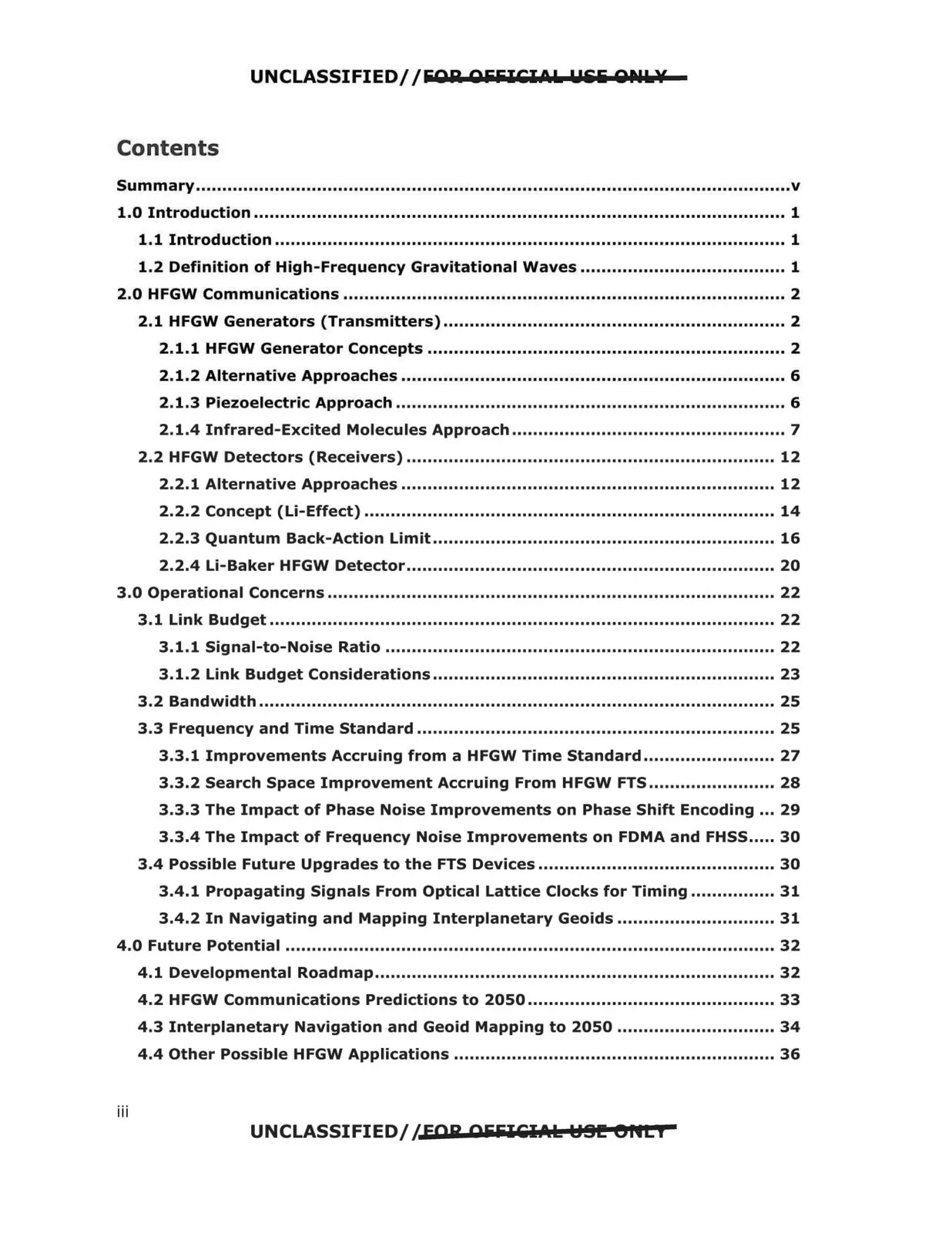
Contents
Summary................................................................................................................. v
1.0 Introduction ..................................................................................................... 1
1.1 Introduction ................................................................................................. 1
1.2 Definition of High-Frequency Gravitational Waves ....................................... 1
2.0 HFGW Communications .................................................................................... 2
2.1 HFGW Generators (Transmitters) ................................................................. 2
2.1.1 HFGW Generator Concepts .................................................................... 2
2.1.2 Alternative Approaches ......................................................................... 6
2.1.3 Piezoelectric Approach .......................................................................... 6
2.1.4 Infrared-Excited Molecules Approach .................................................... 7
2.2 HFGW Detectors (Receivers) ...................................................................... 12
2.2.1 Alternative Approaches ....................................................................... 12
2.2.2 Concept (Li-Effect) .............................................................................. 14
2.2.3 Quantum Back-Action Limit ................................................................. 16
2.2.4 Li-Baker HFGW Detector...................................................................... 20
3.0 Operational Concerns ..................................................................................... 22
3.1 Link Budget ................................................................................................ 22
3.1.1 Signal-to-Noise Ratio .......................................................................... 22
3.1.2 Link Budget Considerations ................................................................. 23
3.2 Bandwidth .................................................................................................. 25
3.3 Frequency and Time Standard .................................................................... 25
3.3.1 Improvements Accruing from a HFGW Time Standard ......................... 27
3.3.2 Search Space Improvement Accruing From HFGW FTS ........................ 28
3.3.3 The Impact of Phase Noise Improvements on Phase Shift Encoding ... 29
3.3.4 The Impact of Frequency Noise Improvements on FDMA and FHSS..... 30
3.4 Possible Future Upgrades to the FTS Devices ............................................. 30
3.4.1 Propagating Signals From Optical Lattice Clocks for Timing ................ 31
3.4.2 In Navigating and Mapping Interplanetary Geoids .............................. 31
4.0 Future Potential ............................................................................................. 32
4.1 Developmental Roadmap............................................................................ 32
4.2 HFGW Communications Predictions to 2050 ............................................... 33
4.3 Interplanetary Navigation and Geoid Mapping to 2050 .............................. 34
4.4 Other Possible HFGW Applications ............................................................. 36
UNCLASSIFIED//FOR OiiiilCl.t.k HSI!! eflti
iii