AAWSAP DIRD, High-Frequency Gravitational Wave Communications, April 2010
DOW-UAP-D140 · page 34 of 57
Text
This text came with the file. It may have mistakes. When the text and the image disagree, the image is right.
UNCLASSIFIED//&Olil OiiiilCI0L Llili QPIL¥
section below. For a 5 µsec acquire test time, the result is Tacq = 150 x 150 x 16 x 5
µsec= 1.8 seconds acquisition time.
However, with effectively perfect knowledge of time, frequency, and hence also phase,
there will only be one case to check, so result is Tacq = 1 x 1 x 1 x 5 µsec = 5 µsec
acquisition time. This is essentially instantaneous for applications such as TCP/IP or
VoIP. This will favorably impact the overall TDMA efficiency in that it speeds the
claiming process to the point where an "always on" link can be replaced by a "link on
demand." This is a savings of 25 to 50 percent in channel usage for VoIP and TCP/IP
sessions over "always on."
3.3.3 The Impact of Phase Noise Improvements on Phase Shift
Encoding
The use of a universal HFGW FTS would also benefit the relative phase noise of all
terminals, allowing for finer phase encoding. Phase noise limits the type of modulation
and manner of encoding that can be performed in phase space, commonly used for
over the air telecommunication systems. An HFGW FTS system could reduce phase
noise by providing a frequency reference with outstanding stability. For example,
moving from QPSK to 8PSK or 16-PSK improves bandwidth efficiency by a factor of 2 to
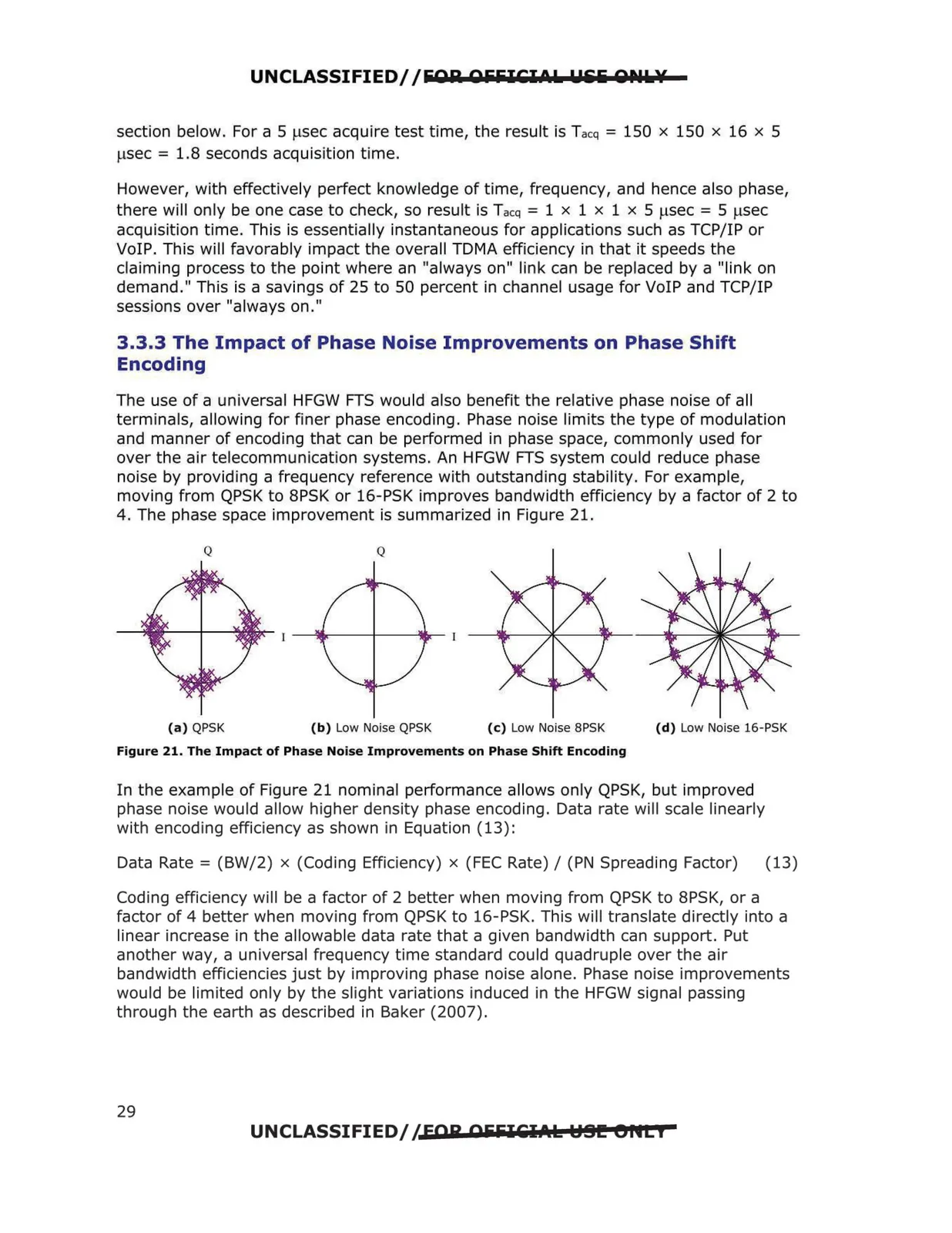
4. The phase space improvement is summarized in Figure 21.
Q
Q
(a) QPSK
(b) Low Noise QPSK
(c) Low Noise BPSK
(d) Low Noise 16-PSK
Figure 21. The Impact of Phase Noise Improvements on Phase Shift Encoding
In the example of Figure 21 nominal performance allows only QPSK, but improved
phase noise would allow higher density phase encoding. Data rate will scale linearly
with encoding efficiency as shown in Equation ( 13):
Data Rate = (BW/2) x (Coding Efficiency) x (FEC Rate)/ (PN Spreading Factor)
(13)
Coding efficiency will be a factor of 2 better when moving from QPSK to 8PSK, or a
factor of 4 better when moving from QPSK to 16-PSK. This will translate directly into a
linear increase in the allowable data rate that a given bandwidth can support. Put
another way, a universal frequency time standard could quadruple over the air
bandwidth efficiencies just by improving phase noise alone. Phase noise improvements
would be limited only by the slight variations induced in the HFGW signal passing
through the earth as described in Baker (2007).
UNCLASSIFIED//FOR OiiiilCl.t.k HSI!! eflti
29