AAWSAP DIRD, High-Frequency Gravitational Wave Communications, April 2010
DOW-UAP-D140 · page 33 of 57
Text
This text came with the file. It may have mistakes. When the text and the image disagree, the image is right.
UNCLASSIFIED//&Olil OiiiilCI0L Llili QPIL¥
3.3.2 Search Space Improvement Accruing From HFGW FTS
The following points are relevant with respect to the universal use of HFGW FTS among
all remote terminals (including for instance cell phone handsets and their associated
cellular towers):
•
During signal acquisition the receiving terminal must perform a search of the search
space of frequency, phase, and code to acquire the transmitting terminal signal.
•
If there is less noise in these parameters the search space is reduced, speeding
acquisition.
•
Ultra-fast acquisition allows more efficient TOMA, or Time Domain Multiple Access
style operations, such as transmit on demand, that use bandwidth more efficiently.
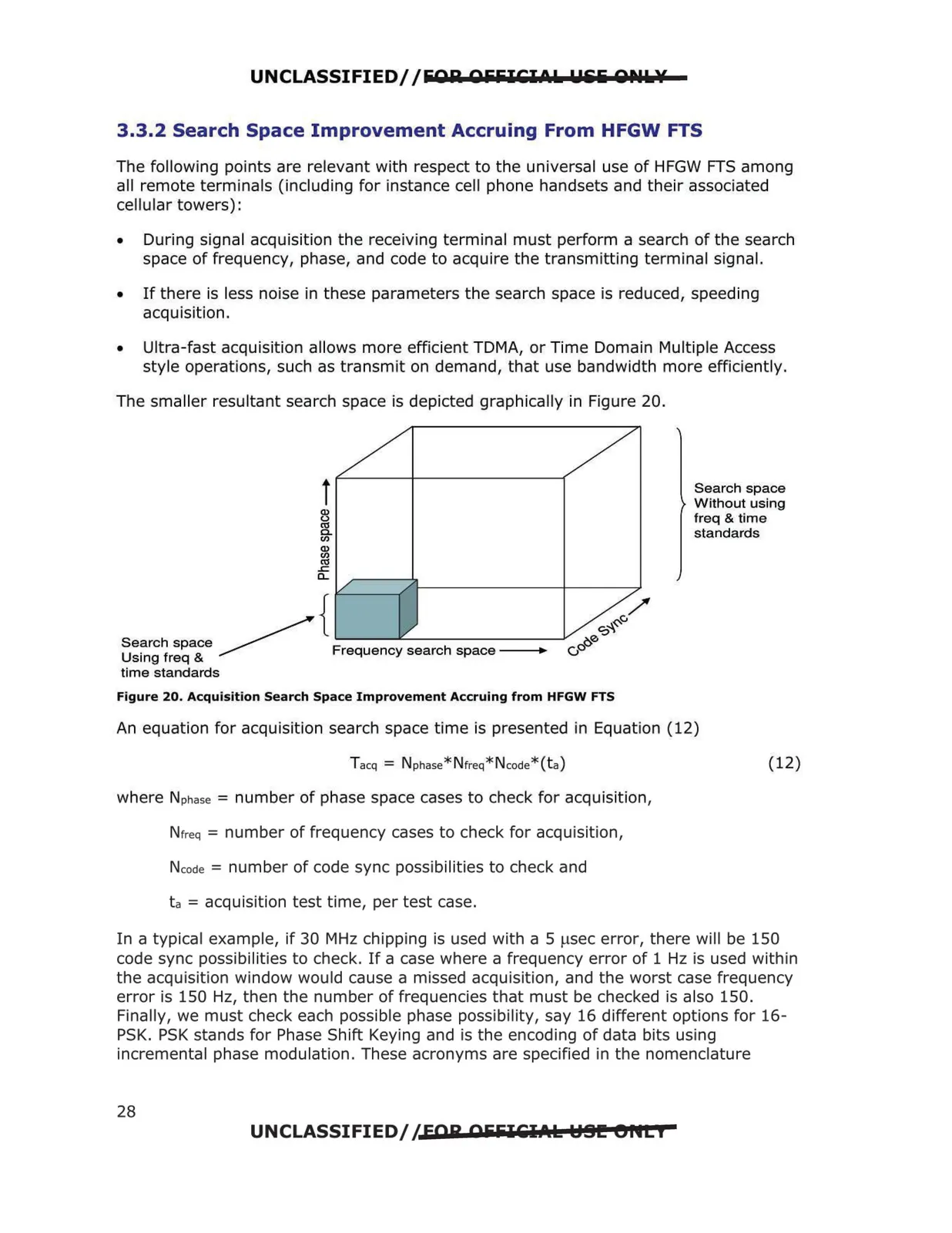
The smaller resultant search space is depicted graphically in Figure 20.
f
{
~/
~
,___..L,._________,,, cf,0eo-\~
Search space
Without using
freq & time
standards
Search space
Using freq & ~
Frequency search space -
c;
time standards
Figure 20. Acquisition Search Space Improvement Accruing from HFGW FTS
An equation for acquisition search space time is presented in Equation (12)
Tacq = Nphase*Nfreq*Ncode*(ta)
(12)
where Nphase = number of phase space cases to check for acquisition,
Ntreq = number of frequency cases to check for acquisition,
Ncode = number of code sync possibilities to check and
ta = acquisition test time, per test case.
In a typical example, if 30 MHz chipping is used with a 5 µsec error, there will be 150
code sync possibilities to check. If a case where a frequency error of 1 Hz is used within
the acquisition window would cause a missed acquisition, and the worst case frequency
error is 150 Hz, then the number of frequencies that must be checked is also 150.
Finally, we must check each possible phase possibility, say 16 different options for 16
PSK. PSK stands for Phase Shih Keying and is the encoding of data bits using
incremental phase modulation. These acronyms are specified in the nomenclature
UNCLASSIFIED//FOR OiiiilCl.t.k HSI!! eflti
28