AAWSAP DIRD, Metamaterials for Aerospace Applications, April 2010
DOW-UAP-D141 · page 13 of 38
Text
This text came with the file. It may have mistakes. When the text and the image disagree, the image is right.
UNCLASSIFIEr,,} POR: OPPIEll<L tt.!I!! 8HL'f
Despite the convenience of the near-field super-lens, (that is, its ability to transport the
image) it still requires an NSOM to read out the image. Within the confines of an
advanced aerospace platform such device (with its necessary auxiliaries) may not fit.
Therefore, one has to consider alternative metamaterials-based ideas for sub-diffraction
imaging. One such idea, the hyper-lens, has been proposed recently by two groups
(References 22-24), and already experimentally tested by another group (Reference
25). The principle of the hyper-lens is very simple: to use an indefinite permittivity
medium (sometimes referred to as the hyperbolic medium because the relationship
between the propagation wavenumbers and the frequency, also known as the constant
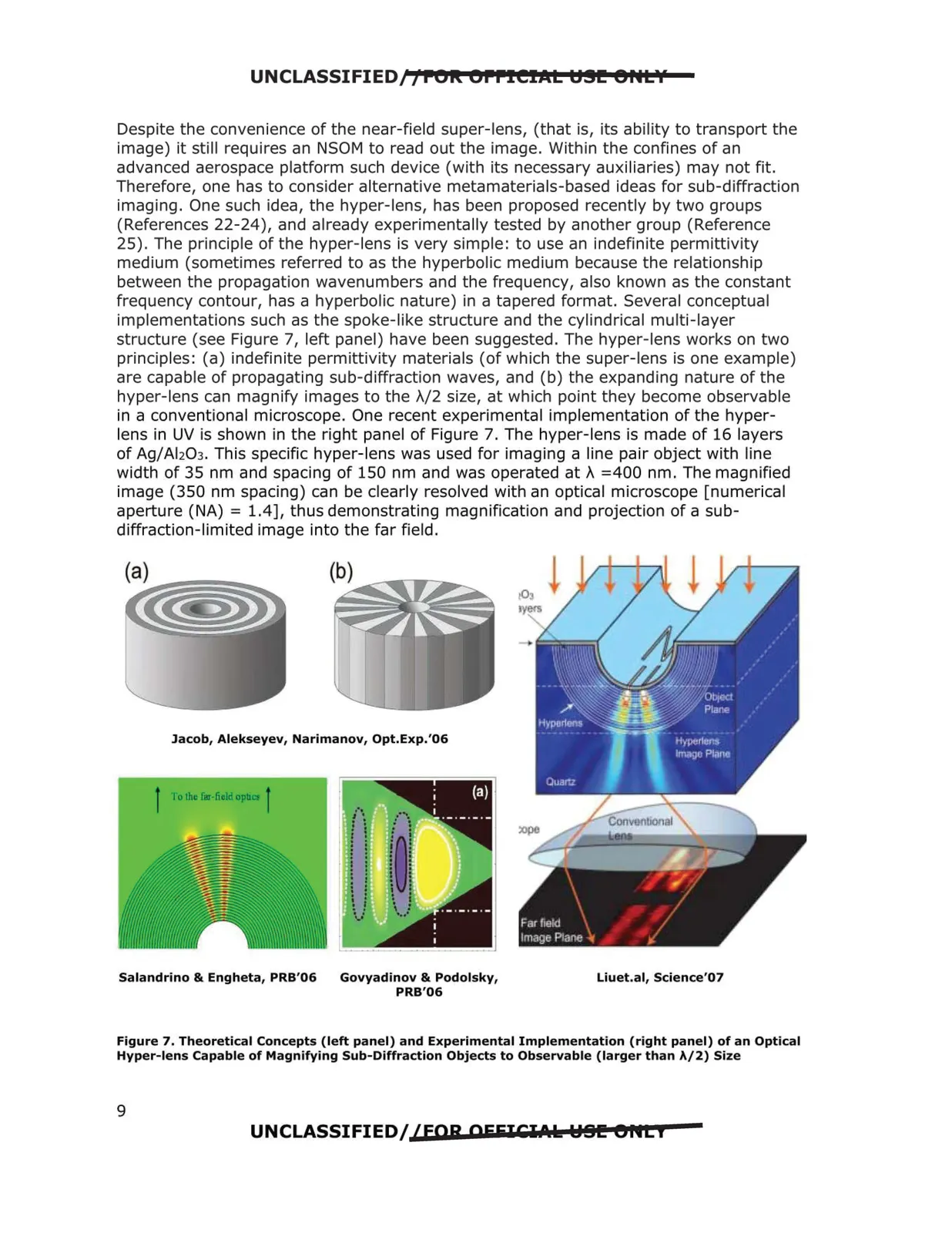
frequency contour, has a hyperbolic nature) in a tapered format. Several conceptual
implementations such as the spoke-like structure and the cylindrical multi-layer
structure (see Figure 7, left panel) have been suggested. The hyper-lens works on two
principles: (a) indefinite permittivity materials (of which the super-lens is one example)
are capable of propagating sub-diffraction waves, and (b) the expanding nature of the
hyper-lens can magnify images to the 'A./2 size, at which point they become observable
in a conventional microscope. One recent experimental implementation of the hyper
lens in UV is shown in the right panel of Figure 7. The hyper-lens is made of 16 layers
of Ag/ AbOJ. This specific hyper-lens was used for imaging a line pair object with line
width of 35 nm and spacing of 150 nm and was operated at>,., =400 nm . The magnified
image (350 nm spacing) can be clearly resolved with an optical microscope [numerical
aperture (NA) = 1.4], thus demonstrating magnification and projection of a sub
diffraction-limited image into the far field.
Jacob, Alekseyev, Narimanov, Opt.Exp.'06
1To the fir-field opllCI 1
Salandrino & Engheta, PRB'06
Govyadinov & Podolsky,
Liuet.al, Science'07
PRB'06
Figure 7. Theoretical Concepts (left panel) and Experimental Implementation (right panel) of an Optical
Hyper-lens Capable of Magnifying Sub-Diffraction Objects to Observable (larger than A,/2) Size
UNCLASSIFIED/ {EAR OFFICI.IJ.k W81!! tJfltf
9