AAWSAP DIRD, Metamaterials for Aerospace Applications, April 2010
DOW-UAP-D141 · page 14 of 38
Text
This text came with the file. It may have mistakes. When the text and the image disagree, the image is right.
UNCLASSIFIED/ (FOR OFEICI0k YSE 8Htt
Note that the hyper-lens concept does not require employing a bulky near-field
scanning optical microscope. However, the practical implementation of the hyper-lens is
by no means simple. The original implementation required depositing the sample on the
curved surface of the hyper-lens. A more practical implementation of the super-lens has
been theoretically proposed by another group (Reference 26). The concept is shown in
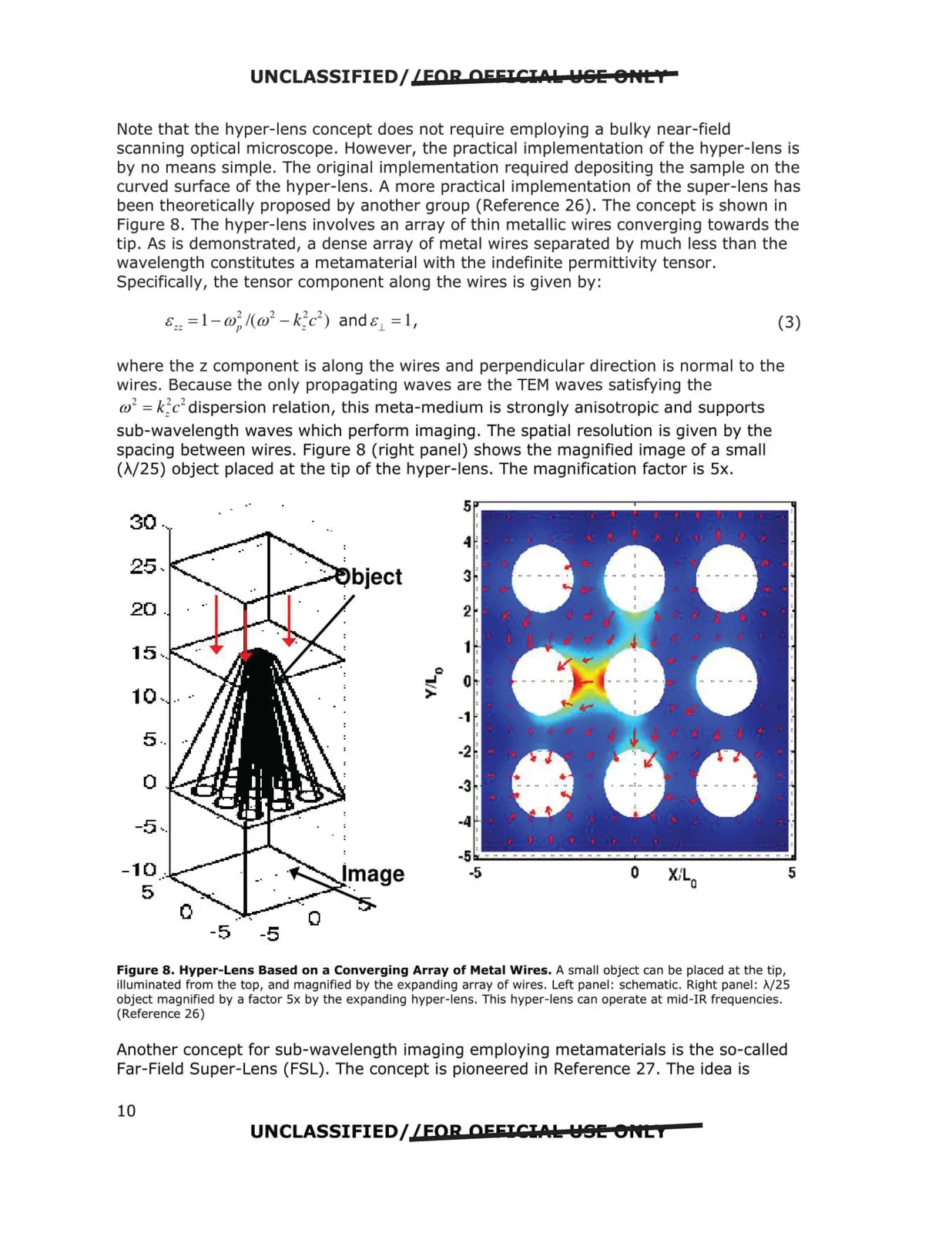
Figure 8. The hyper-lens involves an array of thin metallic wires converging towards the
tip. As is demonstrated, a dense array of metal wires separated by much less than the
wavelength constitutes a metamaterial with the indefinite permittivity tensor.
Specifically, the tensor component along the wires is given by:
(3)
where the z component is along the wires and perpendicular direction is normal to the
wires. Because the only propagating waves are the TEM waves satisfying the
o/ =k; c2 dispersion relation, this meta-medium is strongly anisotropic and supports
sub-wavelength waves which perform imaging. The spatial resolution is given by the
spacing between wires. Figure 8 (right panel) shows the magnified image of a small
('A/25) object placed at the tip of the hyper-lens. The magnification factor is Sx.
5
30
20.
2
15
5-.
0
-4 :·
-5------------------
-1 o __.
0
X!L0
-5
5
5
-5
-5
Figures. Hyper-Lens Based on a Converging Array of Metal Wires. A small object can be placed at the tip,
illuminated from the top, and magnified by the expanding array of wires. Left panel : schematic. Right panel: A./25
object magnified by a factor Sx by the expanding hyper-lens. This hyper-lens can operate at mid-IR frequencies.
(Reference 26)
Another concept for sub-wavelength imaging employing metamaterials is the so-called
Far-Field Super-Lens (FSL). The concept is pioneered in Reference 27. The idea is
10
UNCLASSIFIED/ {EAR OFFICI.IJ.k W81!!! Britt