AAWSAP DIRD, Metamaterials for Aerospace Applications, April 2010
DOW-UAP-D141 · page 22 of 38
Text
This text came with the file. It may have mistakes. When the text and the image disagree, the image is right.
UNCLASSIFIED/fFOA OFFI€1.t.k W&i ONkY
slowed down and/or stopped light, the schematic shown in Figure 13 provides some key
ideas. Moreover, the prospect of producing a low-loss negative index material in the
optical domain still remains somewhat distant. Therefore, it may be worthwhile to
examine other approaches to slowing down light that have emerged in the past few
years.
Stopping and/or slowing down light is an old idea originating from the atomic concept of
Electromagnetically Induced Transparency (EIT). The phenomenon has been considered
to be purely quantum mechanical until several groups have demonstrated that it has
some classical analogies (Reference 31). Remarkably, at least one group has
demonstrated in the past year that EIT can be achieved using plasmonic meta materials
(Reference 32). The idea is to create a plasmonic "molecule" consisting of a radiative
element coupled with a subradiant (dark) element. The plasmonic molecule showed
electromagnetic response that closely resembles the electromagnetically induced
transparency in an atomic system. Because of its subwavelength dimension, this
electromagnetically induced transparency-like molecule was shown to be suitable as a
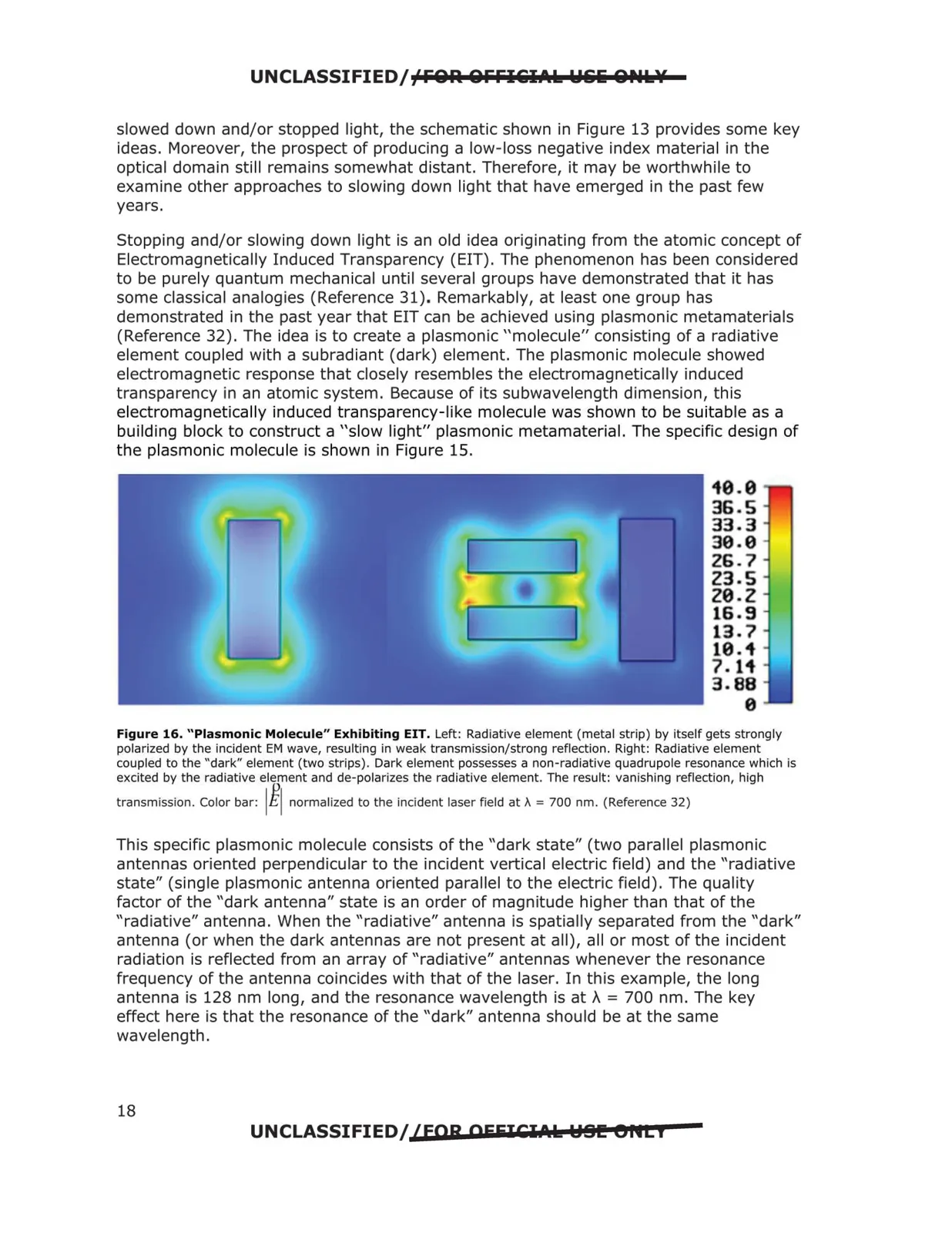
building block to construct a "slow light" plasmonic metamaterial. The specific design of
the plasmonic molecule is shown in Figure 15.
10.0
36.5
33.3
30°0
26.7
23.5
20.2
16-9
13-7
10.1
7. 11
3.88
0
Figure 16. "Plasmonic Molecule" Exhibiting EIT. Lelt: Radiative element (metal strip) by itself gets strongly
polarized by the incident EM wave, resulting in weak transmission/strong reflection. Right: Radiative element
coupled to the "dark" element (two strips). Dark element possesses a non-radiative quadrupole resonance which is
excited by the radiative element and de-polarizes the radiative element. The result: vanishing reflection, high
transmission. Color bar: IEInormalized to the incident laser field at>. = 700 nm. (Reference 32)
This specific plasmonic molecule consists of the "dark state" (two parallel plasmonic
antennas oriented perpendicular to the incident vertical electric field) and the "radiative
state" (single plasmonic antenna oriented parallel to the electric field). The quality
factor of the "dark antenna" state is an order of magnitude higher than that of the
"radiative" antenna. When the "radiative" antenna is spatially separated from the "dark"
antenna (or when the dark antennas are not present at all), all or most of the incident
radiation is reflected from an array of "radiative" antennas whenever the resonance
frequency of the antenna coincides with that of the laser. In this example, the long
antenna is 128 nm long, and the resonance wavelength is at>-. = 700 nm. The key
effect here is that the resonance of the "dark" antenna should be at the same
wavelength.
UNCLASSIFIED/ {EAR OFEICl.t.ls: Y81!! 8flti
18