AAWSAP DIRD, Metamaterials for Aerospace Applications, April 2010
DOW-UAP-D141 · page 23 of 38
Text
This text came with the file. It may have mistakes. When the text and the image disagree, the image is right.
UNCLASSIFIED/ (EAR OFEICJ0k W&E 8Htt
Because the exploited resonance has a quadrupole nature, it is slightly red-shifted. For
that reason, the length of the "dark" antenna is 100 nm. When the two antennas are
brought together, the radiative antenna polarizes the dark antenna, which, in turn,
depolarizes the radiative antenna. As a result, the dipole moment of the coupled system
is drastically reduced, the reflection drops and transmission increases to almost 100
percent (limited only by losses). Most of the energy is now stored inside the non
radiative (dark) antenna.
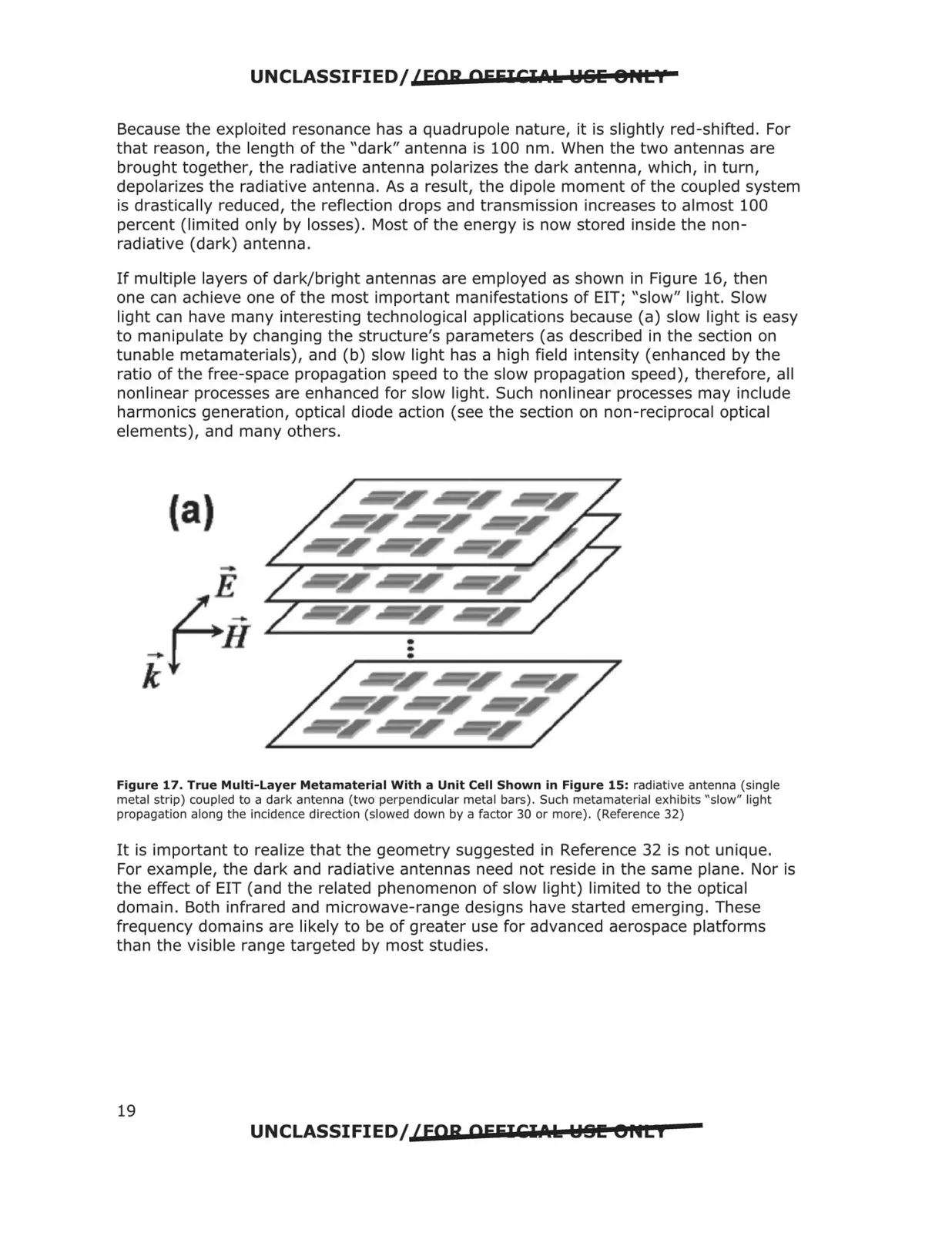
If multiple layers of dark/bright antennas are employed as shown in Figure 16, then
one can achieve one of the most important manifestations of EIT; "slow" light. Slow
light can have many interesting technological applications because (a) slow light is easy
to manipulate by changing the structure's parameters (as described in the section on
tunable metamaterials), and (b) slow light has a high field intensity (enhanced by the
ratio of the free-space propagation speed to the slow propagation speed), therefore, all
nonlinear processes are enhanced for slow light. Such nonlinear processes may include
harmonics generation, optical diode action (see the section on non-reciprocal optical
elements), and many others.
(a)
Figure 17. True Multi-Layer Metamaterial With a Unit Cell Shown in Figure 15: radiative antenna (single
metal strip) coupled to a dark antenna (two perpendicu lar metal bars). Such metamaterial exhibits "slow" light
propagation along the incidence direction (slowed down by a factor 30 or more). (Reference 32)
It is important to realize that the geometry suggested in Reference 32 is not unique.
For example, the dark and radiative antennas need not reside in the same plane. Nor is
the effect of EIT (and the related phenomenon of slow light) limited to the optical
domain. Both infrared and microwave-range designs have started emerging. These
frequency domains are likely to be of greater use for advanced aerospace platforms
than the visible range targeted by most studies.
UNCLASSIFIED/ {EAR OFEICll.k W8I!! eNti
19