AAWSAP DIRD, Metamaterials for Aerospace Applications, April 2010
DOW-UAP-D141 · page 28 of 38
Text
This text came with the file. It may have mistakes. When the text and the image disagree, the image is right.
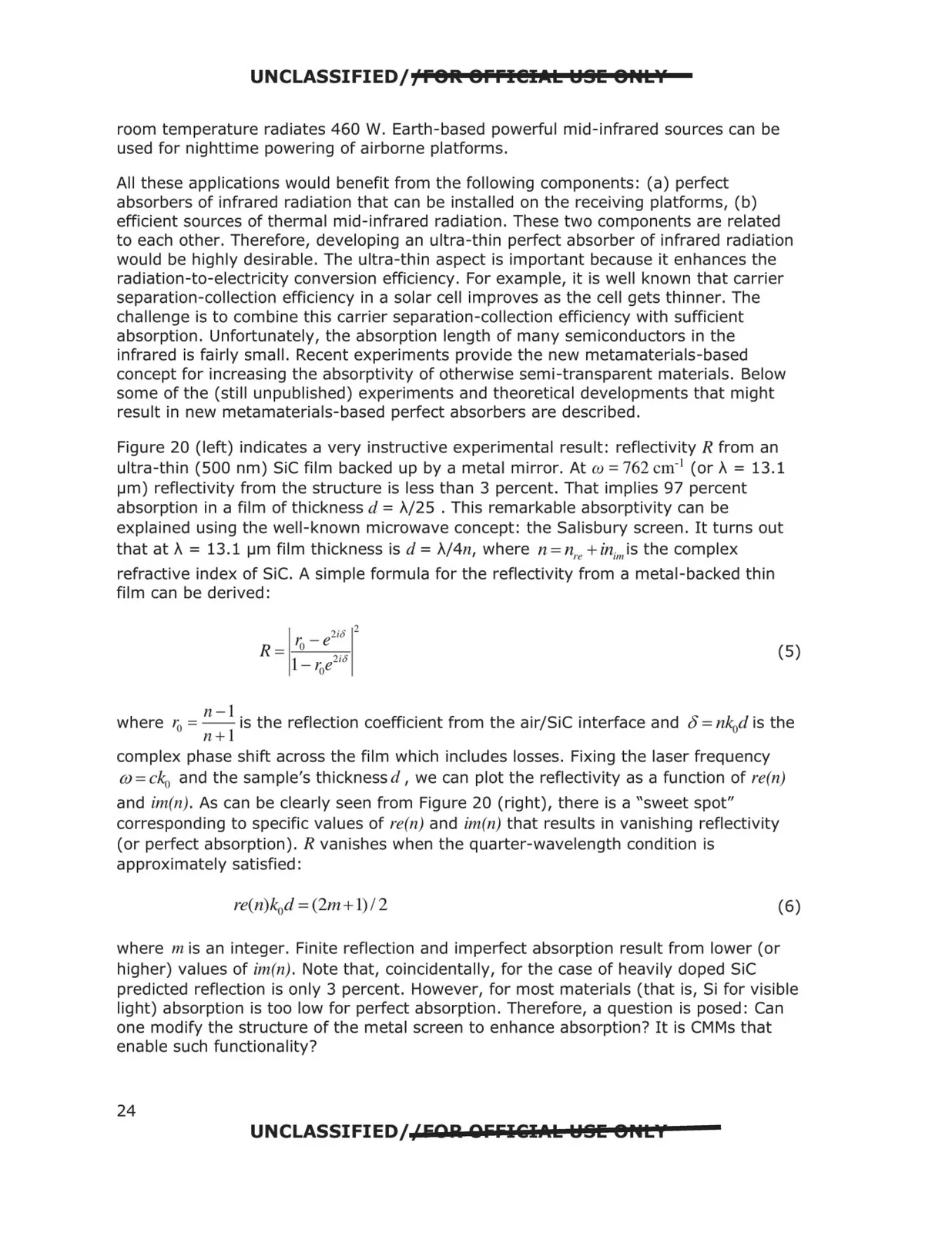
UNCLASSIFIED/;'fOll Offl@lsltt HS! OHLY room temperature radiates 460 W. Earth-based powerful mid-infrared sources can be used for nighttime powering of airborne platforms. All these applications would benefit from the following components: (a) perfect absorbers of infrared radiation that can be installed on the receiving platforms, (b) efficient sources of thermal mid-infrared radiation. These two components are related to each other. Therefore, developing an ultra-thin perfect absorber of infrared radiation would be highly desirable. The ultra-thin aspect is important because it enhances the radiation-to-electricity conversion efficiency. For example, it is well known that carrier separation-collection efficiency in a solar cell improves as the cell gets thinner. The challenge is to combine this carrier separation-collection efficiency with sufficient absorption. Unfortunately, the absorption length of many semiconductors in the infrared is fairly small. Recent experiments provide the new metamaterials-based concept for increasing the absorptivity of otherwise semi-transparent materials. Below some of the (still unpublished) experiments and theoretical developments that might result in new metamaterials-based perfect absorbers are described. Figure 20 (left) indicates a very instructive experimental result: reflectivity R from an ultra-thin (500 nm) SiC film backed up by a metal mirror. At w = 762 cm- 1 (or 'A = 13.1 µm) reflectivity from the structure is less than 3 percent. That implies 97 percent absorption in a film of thickness d = 'A/25 . This remarkable absorptivity can be explained using the well-known microwave concept: the Salisbury screen. It turns out that at 'A = 13.1 µm film thickness is d = 'A/4n, where n = n,.e + in;111 is the complex refractive index of SiC. A simple formula for the reflectivity from a metal-backed thin film can be derived: 2 r, _ e2;0 0 R _1.....::....--2;,5-1 (5) 1- r0e where r0 = n - l is the reflection coefficient from the air/SiC interface and 5 =nf<od is the n+l complex phase shift across the film which includes losses. Fixing the laser frequency w =cf<o and the sample's thickness d, we can plot the reflectivity as a function of re(n) and im(n). As can be clearly seen from Figure 20 (right), there is a "sweet spot" corresponding to specific values of re(n) and im(n) that results in vanishing reflectivity (or perfect absorption). R vanishes when the quarter-wavelength condition is approximately satisfied: re(n)k0d =(2m+l)/2 (6) where mis an integer. Finite reflection and imperfect absorption result from lower (or higher) values of im(n), Note that, coincidentally, for the case of heavily doped SiC predicted reflection is only 3 percent. However, for most materials (that is, Si for visible light) absorption is too low for perfect absorption. Therefore, a question is posed: Can one modify the structure of the metal screen to enhance absorption? It is CM Ms that enable such functionality? UNCLASSIFIED//FOR QFFI€ililik HS! OHL I 24