AAWSAP DIRD, Metamaterials for Aerospace Applications, April 2010
DOW-UAP-D141 · page 29 of 38
Text
This text came with the file. It may have mistakes. When the text and the image disagree, the image is right.
..
UNCLASSIFIED/ (FOR OFEICI0k YSE 8Htt
Specifically, it has been found that by making the mirror slightly leaky, we can actually
increase absorption. If the reflection coefficient of a mirror is given by r2 , then the
reflection/transmission coefficients r ,t through the structure are given by:
(7)
where t2 = 1+ r2 and t0 = l + r0 • Note that Equation 7 turns into Equation 6 if
r2 = -1 (perfectly reflecting mirror). From Equation 7 it follows that it may be possible to
engineer the reflectivity 'i in such a way that minimizes reflection Ir1
2 while keeping
transmission It 12 small. The remainder of the energy is guaranteed to be absorbed by
the quarter-wavelength thick absorber.
1,-----.-----.------.------,------,
1,-----.----....-----.-----,---,
.
'
0.8 · -
v
········
.
--·---.---------------'-···--·
0.8
-
H
C
~ 0_6 . -s~ooth Au ........................
a....
-
0
•
·····••·
Bao
700
760
Cl)
0
~ 0.4 ,------'-----'-,..............,.........
~ 0.4
'
'
'
'
'
'
'
'
.2 0. 6....._____.
0::
-
v
<(
-
H
0.2
0.2 -smooth Au
Bao
700
'
.
'
.
------ -- -- -- - -'-- ----- ------ - --'--
760
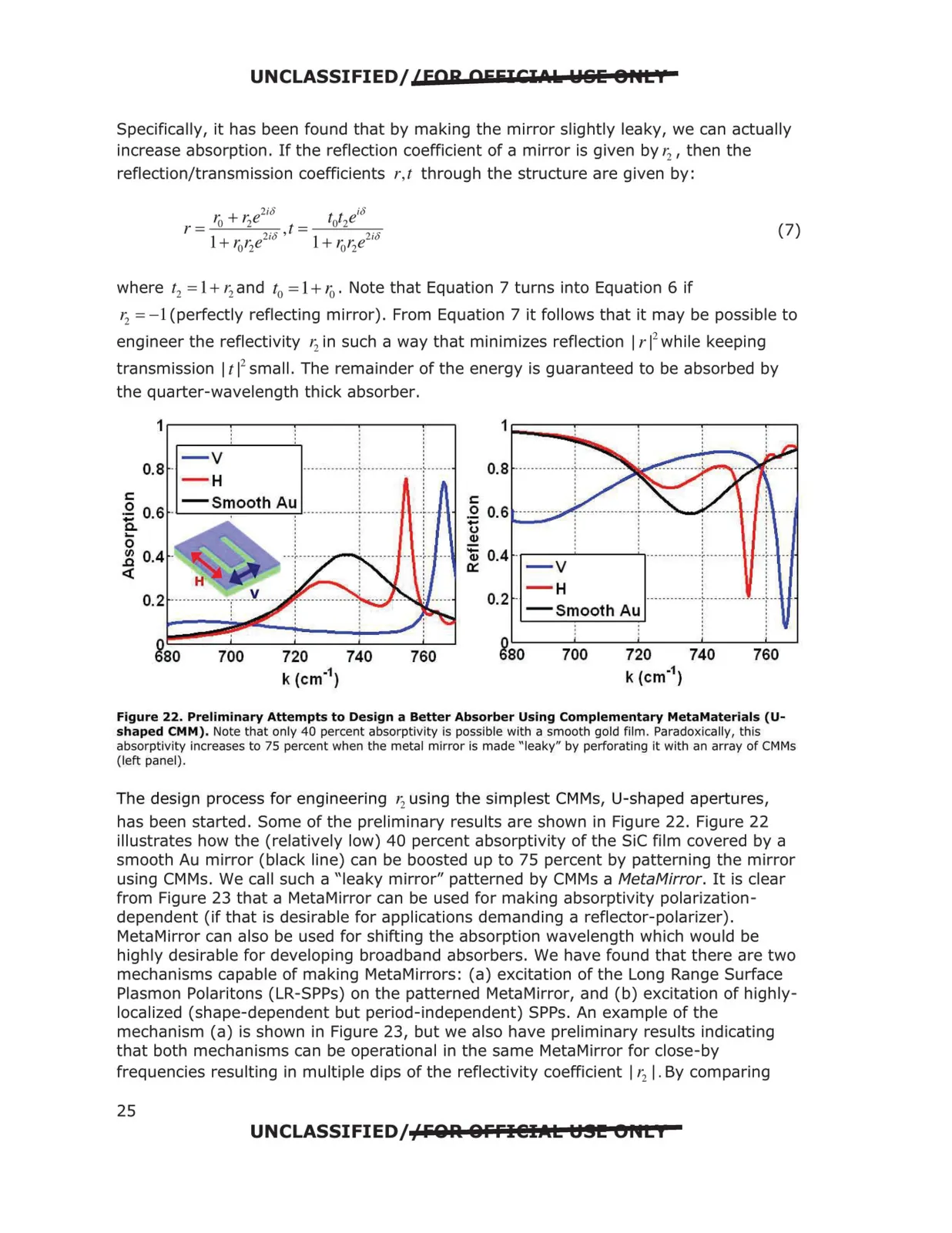
Figure 22. Preliminary Attempts to Design a Better Absorber Using Complementary MetaMaterials {U
shaped CMM). Note that only 40 percent absorptivity is possible with a smooth gold film . Paradoxically, this
absorptivity increases to 75 percent when the metal mirror is made "leaky" by perforating it with an array of CMMs
(left panel) .
The design process for engineering r1 using the simplest CMMs, U-shaped apertures,
has been started. Some of the preliminary results are shown in Figure 22. Figure 22
illustrates how the (relatively low) 40 percent absorptivity of the SiC film covered by a
smooth Au mirror (black line) can be boosted up to 75 percent by patterning the mirror
using CMMs. We call such a "leaky mirror" patterned by CMMs a MetaMirror. It is clear
from Figure 23 that a MetaMirror can be used for making absorptivity polarization
dependent (if that is desirable for applications demanding a reflector-polarizer).
MetaMirror can also be used for shifting the absorption wavelength which would be
highly desirable for developing broadband absorbers. We have found that there are two
mechanisms capable of making MetaMirrors: (a) excitation of the Long Range Surface
Plasmon Polaritons (LR-SPPs) on the patterned MetaMirror, and (b) excitation of highly
localized (shape-dependent but period-independent) SPPs. An example of the
mechanism (a) is shown in Figure 23, but we also have preliminary results indicating
that both mechanisms can be operational in the same MetaMirror for close-by
frequencies resulting in multiple dips of the reflectivity coefficient I r2 1- By comparing
UNCLASSIFIED/,<FOA 8FFIOIAL tt91!! er,tt
25