AAWSAP DIRD, Concepts for Extracting Energy from the Quantum Vacuum, April 2010
DOW-UAP-D142 · page 14 of 57
Text
This text came with the file. It may have mistakes. When the text and the image disagree, the image is right.
UNCLASSIFIED//FOR OFFIEIAk WS& OPtkY
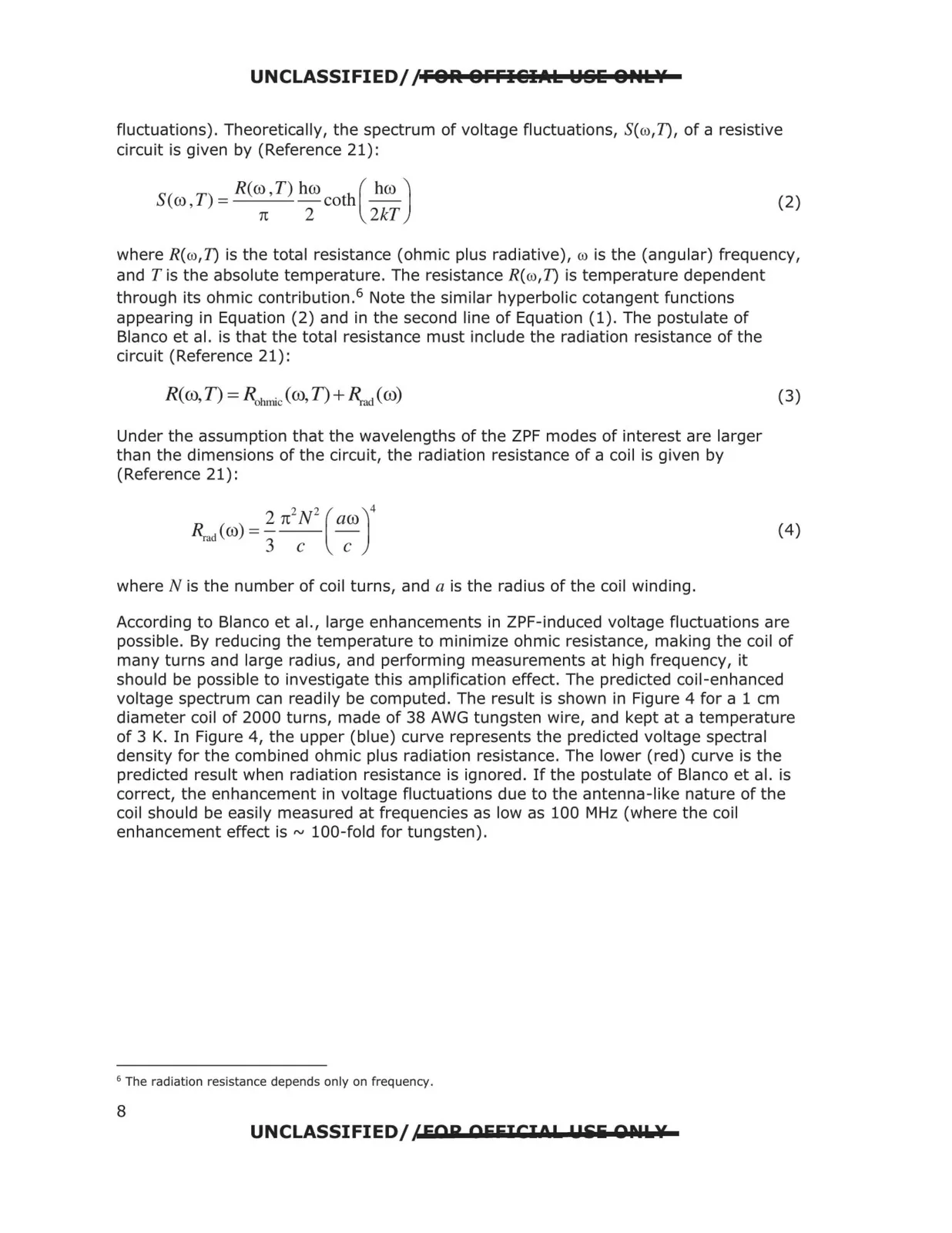
fluctuations). Theoretically, the spectrum of voltage fluctuations, S(ro,T), of a resistive
circuit is given by (Reference 21):
S(w T) = R(w ,T) hw coth( hw)
(2)
'
1t
2
2kT
where R(w,T) is the total resistance (ohmic plus radiative), ro is the (angular) frequency,
and Tis the absolute temperature. The resistance R(ro,T) is temperature dependent
through its ohmic contribution. 6 Note the similar hyperbolic cotangent functions
appearing in Equation (2) and in the second line of Equation (1). The postulate of
Blanco et al. is that the total resistance must include the radiation resistance of the
circuit (Reference 21):
R(ro,T) =l\hmic(ro, I)+ l\act(ro)
(3)
Under the assumption that the wavelengths of the ZPF modes of interest are larger
than the dimensions of the circuit, the radiation resistance of a coil is given by
(Reference 21):
R ( ) = ~ 1t2N 2 ( aw J4
(4)
rad 0)
3
C
C
where N is the number of coil turns, and a is the radius of the coil winding.
According to Blanco et al., large enhancements in ZPF-induced voltage fluctuations are
possible. By reducing the temperature to minimize ohmic resistance, making the coil of
many turns and large radius, and performing measurements at high frequency, it
should be possible to investigate this amplification effect. The predicted coil-enhanced
voltage spectrum can readily be computed. The result is shown in Figure 4 for a 1 cm
diameter coil of 2000 turns, made of 38 AWG tungsten wire, and kept at a temperature
of 3 K. In Figure 4, the upper (blue) curve represents the predicted voltage spectral
density for the combined ohmic plus radiation resistance. The lower (red) curve is the
predicted result when radiation resistance is ignored. If the postulate of Blanco et al. is
correct, the enhancement in voltage fluctuations due to the antenna-like nature of the
coil should be easily measured at frequencies as low as 100 MHz (where the coil
enhancement effect is~ 100-fold for tungsten).
6 The radiation resistance depends only on frequency.
UNCLASSIFIED//FOR OFFICIO! P!ili QIU.,¥
8