AAWSAP DIRD, Concepts for Extracting Energy from the Quantum Vacuum, April 2010
DOW-UAP-D142 · page 15 of 57
Text
This text came with the file. It may have mistakes. When the text and the image disagree, the image is right.
UNCLASSIFIED//FOR OFFI@IAk WSE 9Ptk\f
10•18
Material: W
N coil: 2000
10·19
a coil: 1 cm
1o-20
b coil: 0.01 cm
VJ
T: 3 Kelvin
1o-21
108
{{Hz
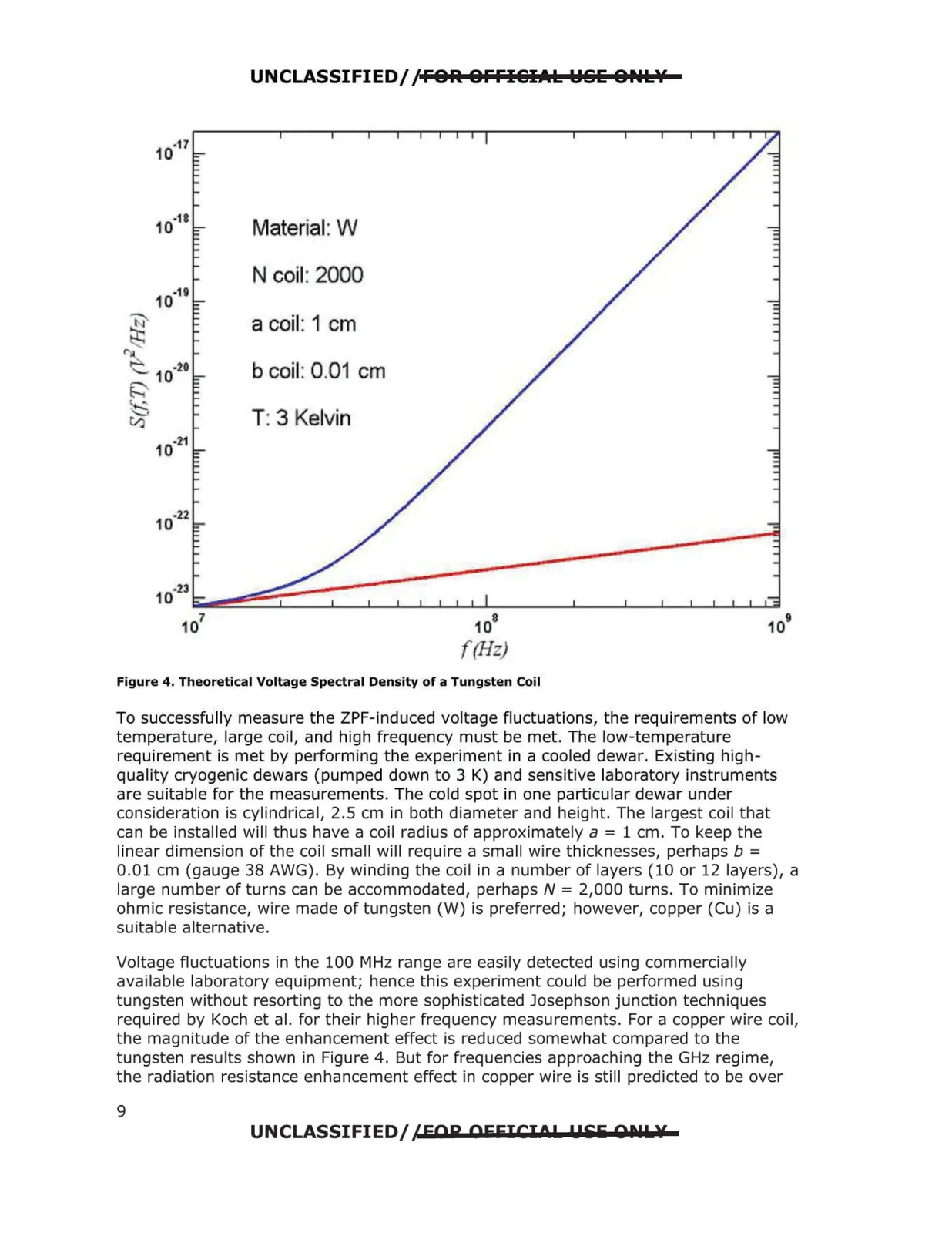
Figure 4. Theoretical Voltage Spectral Density of a Tungsten Coil
To successfully measure the ZPF-induced voltage fluctuations, the requirements of low
temperature, large coil, and high frequency must be met. The low-temperature
requirement is met by performing the experiment in a cooled dewar. Existing high
quality cryogenic dewars (pumped down to 3 K) and sensitive laboratory instruments
are suitable for the measurements. The cold spot in one particular dewar under
consideration is cylindrical, 2.5 cm in both diameter and height. The largest coil that
can be installed will thus have a coil radius of approximately a = 1 cm. To keep the
linear dimension of the coil small will require a small wire thicknesses, perhaps b =
0.01 cm (gauge 38 AWG). By winding the coil in a number of layers (10 or 12 layers), a
large number of turns can be accommodated, perhaps N = 2,000 turns. To minimize
ohmic resistance, wire made of tungsten (W) is preferred; however, copper (Cu) is a
suitable alternative.
Voltage fluctuations in the 100 MHz range are easily detected using commercially
available laboratory equipment; hence this experiment could be performed using
tungsten without resorting to the more sophisticated Josephson junction techniques
required by Koch et al. for their higher frequency measurements. For a copper wire coil,
the magnitude of the enhancement effect is reduced somewhat compared to the
tungsten results shown in Figure 4. But for frequencies approaching the GHz regime,
the radiation resistance enhancement effect in copper wire is still predicted to be over
UNCLASSIFIED//FOR OFFICI0L: 11ili QIU.,¥
9