AAWSAP DIRD, Concepts for Extracting Energy from the Quantum Vacuum, April 2010
DOW-UAP-D142 · page 19 of 57
Text
This text came with the file. It may have mistakes. When the text and the image disagree, the image is right.
UNCLASSIFIED//FOR OFFI@IAk WSE 9Ptk\f
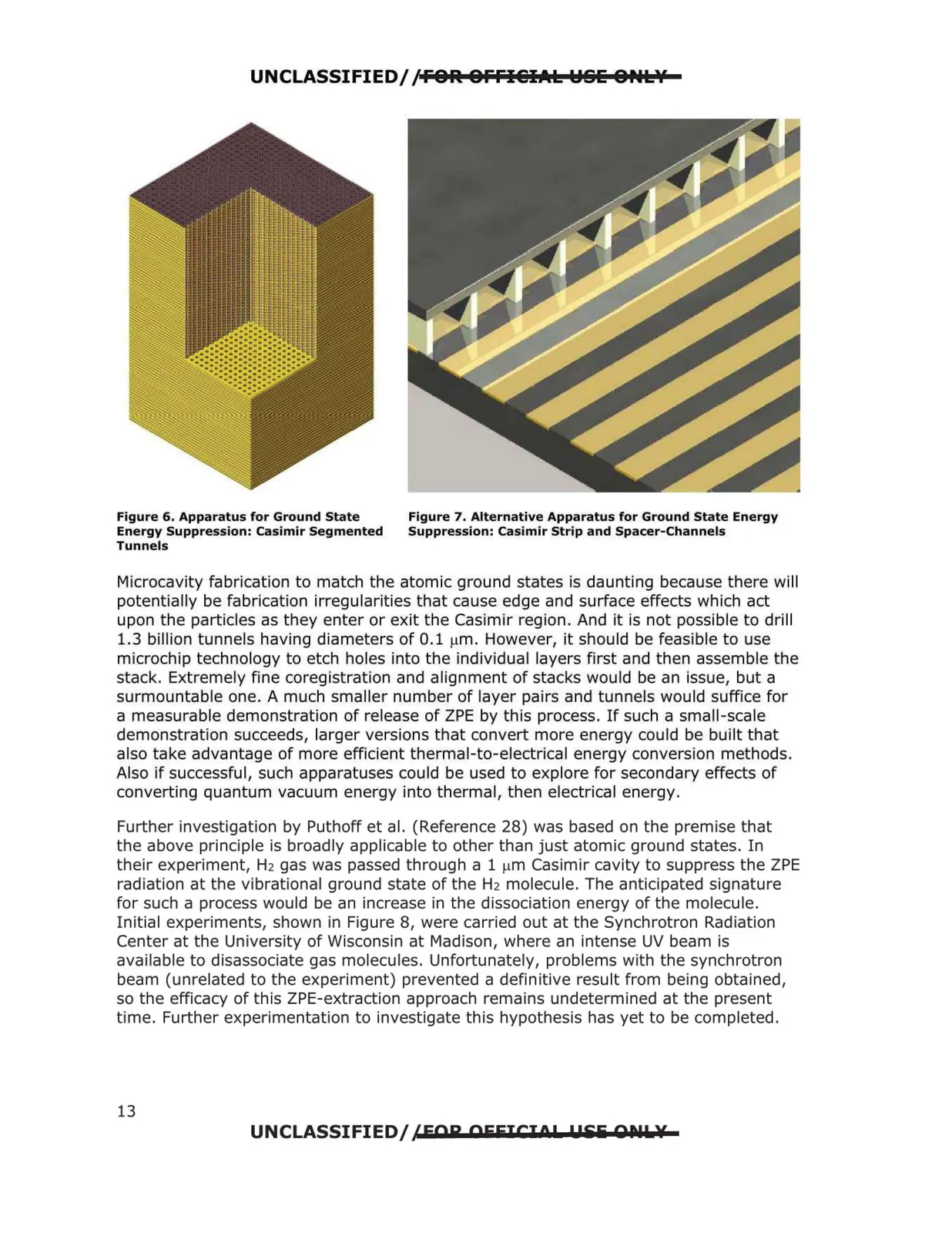
Figure 6. Apparatus for Ground State
Figure 7. Alternative Apparatus for Ground State Energy
Energy Suppression: Casimir Segmented
Suppression: Casimir Strip and Spacer-Channels
Tunnels
Microcavity fabrication to match the atomic ground states is daunting because there will
potentially be fabrication irregularities that cause edge and surface effects which act
upon the particles as they enter or exit the Casimir region. And it is not possible to drill
1.3 billion tunnels having diameters of 0.1 µm. However, it should be feasible to use
microchip technology to etch holes into the individual layers first and then assemble the
stack. Extremely fine coregistration and alignment of stacks would be an issue, but a
surmountable one. A much smaller number of layer pairs and tunnels would suffice for
a measurable demonstration of release of ZPE by this process. If such a small-scale
demonstration succeeds, larger versions that convert more energy could be built that
also take advantage of more efficient thermal-to-electrical energy conversion methods.
Also if successful, such apparatuses could be used to explore for secondary effects of
converting quantum vacuum energy into thermal, then electrical energy.
Further investigation by Puthoff et al. (Reference 28) was based on the premise that
the above principle is broadly applicable to other than just atomic ground states. In
their experiment, H2 gas was passed through a 1 µm Casimir cavity to suppress the ZPE
radiation at the vibrational ground state of the H2 molecule. The anticipated signature
for such a process would be an increase in the dissociation energy of the molecule.
Initial experiments, shown in Figure 8, were carried out at the Synchrotron Radiation
Center at the University of Wisconsin at Madison, where an intense UV beam is
available to disassociate gas molecules. Unfortunately, problems with the synchrotron
beam (unrelated to the experiment) prevented a definitive result from being obtained,
so the efficacy of this ZPE-extraction approach remains undetermined at the present
time. Further experimentation to investigate this hypothesis has yet to be completed.
UNCLASSIFIED//FOR OFFICI0L: 11ili QIU.,¥
13