AAWSAP DIRD, Concepts for Extracting Energy from the Quantum Vacuum, April 2010
DOW-UAP-D142 · page 36 of 57
Text
This text came with the file. It may have mistakes. When the text and the image disagree, the image is right.
UNCLASSIFIED//FOR OFFIEIAk WS&i OPtkY
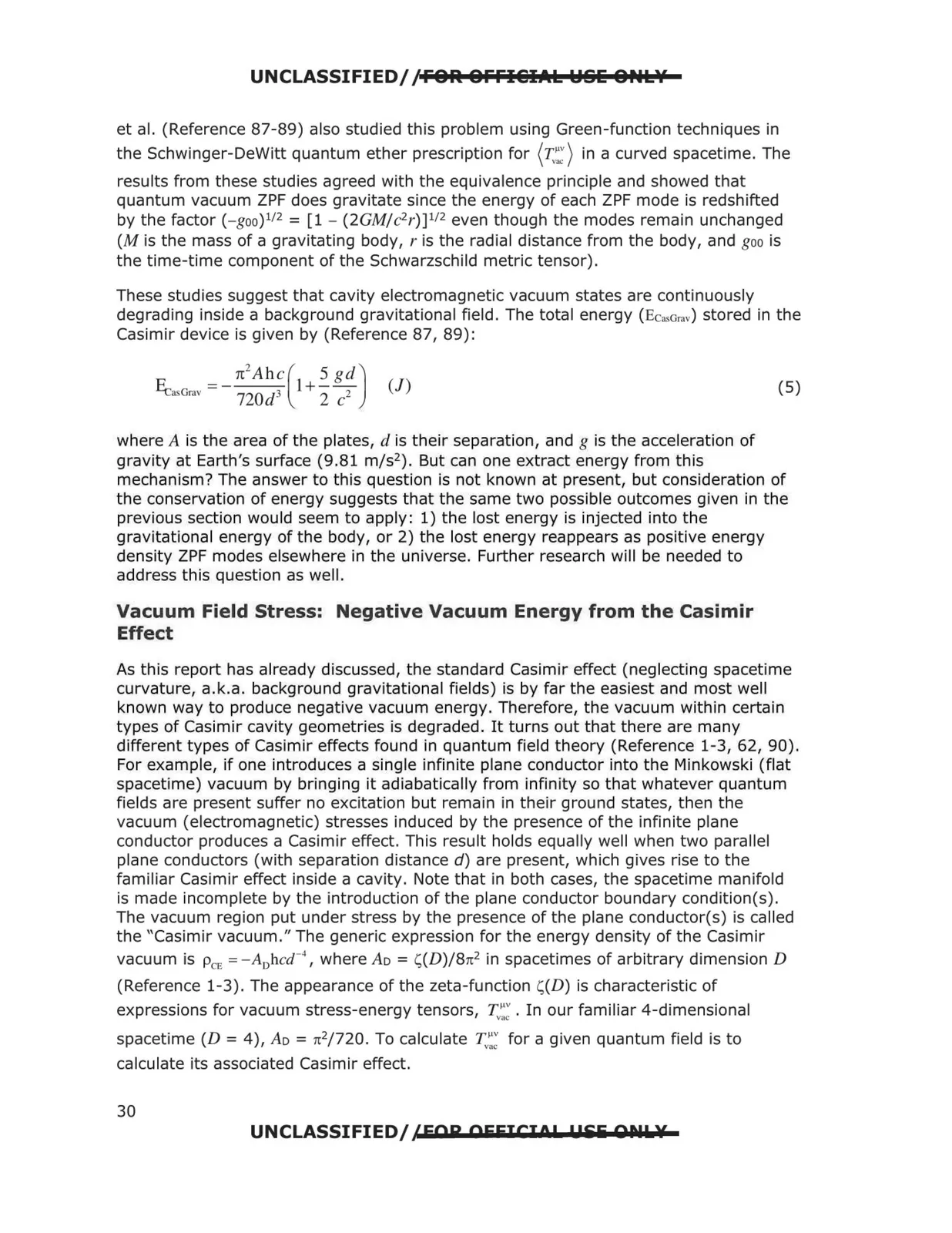
et al. (Reference 87-89) also studied this problem using Green-function techniques in
the Schwinger-DeWitt quantum ether prescription for (T:; ) in a curved spacetime. The
results from these studies agreed with the equivalence principle and showed that
quantum vacuum ZPF does gravitate since the energy of each ZPF mode is redshifted
by the factor (- goo)1l2 = [1 - (2GM/c2r)]112 even though the modes remain unchanged
(Mis the mass of a gravitating body, r is the radial distance from the body, and goo is
the time-time component of the Schwarzschild metric tensor).
These studies suggest that cavity electromagnetic vacuum states are continuously
degrading inside a background gravitational field. The total energy (Ecasarav) stored in the
Casimir device is given by (Reference 87, 89):
_ _ 1t2Ahc(l + ~ gel)
(J)
(5)
G::asarav -
720d3
2 C2
where A is the area of the plates, dis their separation, and g is the acceleration of
gravity at Earth's surface (9.81 m/s2). But can one extract energy from this
mechanism? The answer to this question is not known at present, but consideration of
the conservation of energy suggests that the same two possible outcomes given in the
previous section would seem to apply: 1) the lost energy is injected into the
gravitational energy of the body, or 2) the lost energy reappears as positive energy
density ZPF modes elsewhere in the universe. Further research will be needed to
address this question as well.
Vacuum Field Stress: Negative Vacuum Energy from the Casimir
Effect
As this report has already discussed, the standard Casimir effect (neglecting spacetime
curvature, a.k.a. background gravitational fields) is by far the easiest and most well
known way to produce negative vacuum energy. Therefore, the vacuum within certain
types of Casimir cavity geometries is degraded. It turns out that there are many
different types of Casimir effects found in quantum field theory (Reference 1-3, 62, 90).
For example, if one introduces a single infinite plane conductor into the Minkowski (flat
spacetime) vacuum by bringing it adiabatically from infinity so that whatever quantum
fields are present suffer no excitation but remain in their ground states, then the
vacuum (electromagnetic) stresses induced by the presence of the infinite plane
conductor produces a Casimir effect. This result holds equally well when two parallel
plane conductors (with separation distance d) are present, which gives rise to the
familiar Casimir effect inside a cavity. Note that in both cases, the spacetime manifold
is made incomplete by the introduction of the plane conductor boundary condition(s).
The vacuum region put under stress by the presence of the plane conductor(s) is called
the "Casimir vacuum." The generic expression for the energy density of the Casimir
vacuum is Pee = - ADhcd-4 , where Ao = C,(D)/8rc2 in spacetimes of arbitrary dimension D
(Reference 1-3). The appearance of the zeta-function C,(D) is characteristic of
expressions for vacuum stress-energy tensors, Tv'.:; . In our familiar 4-dimensional
spacetime (D = 4), Ao= rr.2/720 . To calculate T;~; for a given quantum field is to
calculate its associated Casimir effect.
UNCLASSIFIED//FOR OFFICI0L: 11ili QIU.,¥
30