AAWSAP DIRD, Concepts for Extracting Energy from the Quantum Vacuum, April 2010
DOW-UAP-D142 · page 37 of 57
Text
This text came with the file. It may have mistakes. When the text and the image disagree, the image is right.
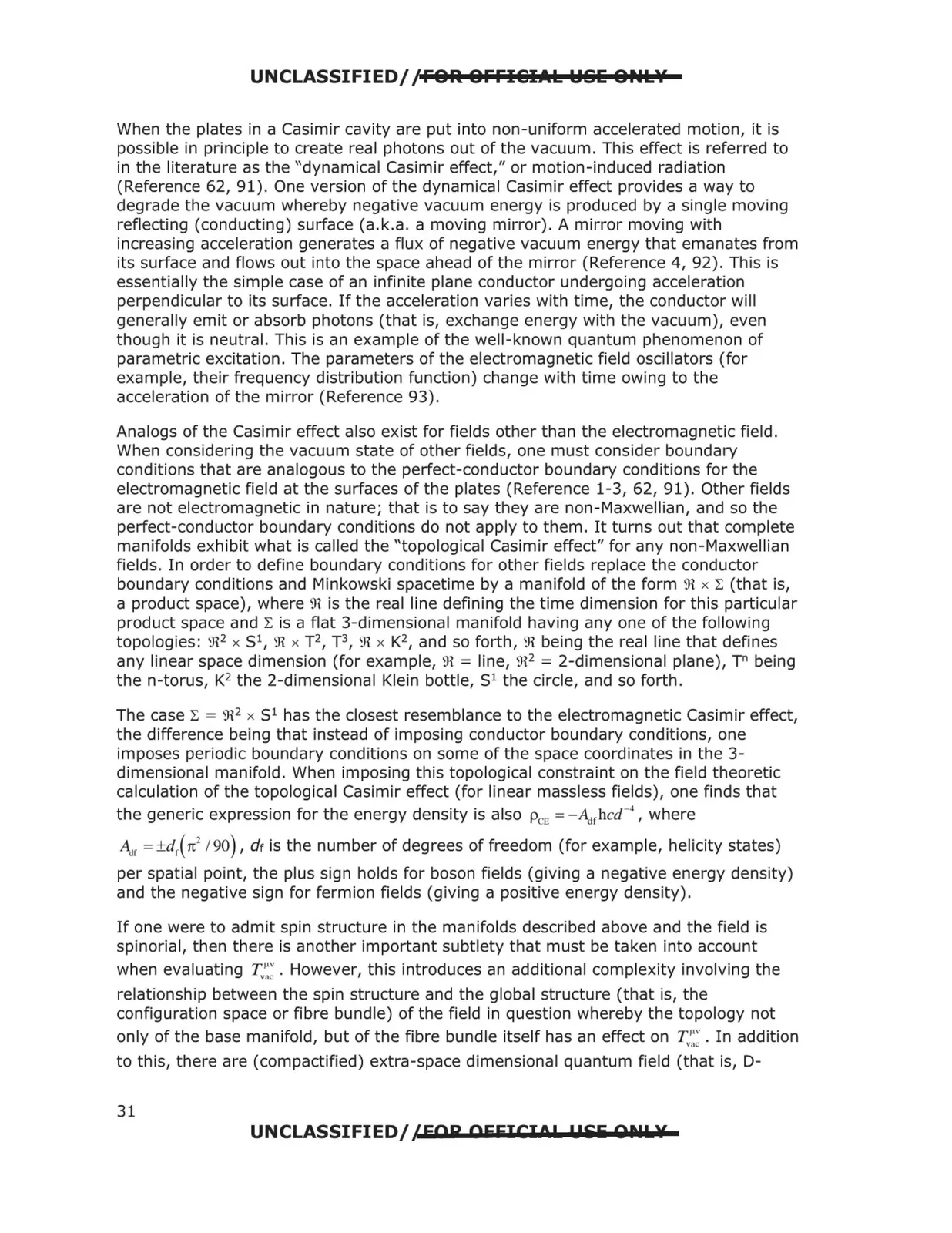
UNCLASSIFIED//FOR OFFIEIAk WS& OPtkY When the plates in a Casimir cavity are put into non-uniform accelerated motion, it is possible in principle to create real photons out of the vacuum. This effect is referred to in the literature as the "dynamical Casimir effect," or motion-induced radiation (Reference 62, 91). One version of the dynamical Casimir effect provides a way to degrade the vacuum whereby negative vacuum energy is produced by a single moving reflecting (conducting) surface (a.k.a. a moving mirror). A mirror moving with increasing acceleration generates a flux of negative vacuum energy that emanates from its surface and flows out into the space ahead of the mirror (Reference 4, 92). This is essentially the simple case of an infinite plane conductor undergoing acceleration perpendicular to its surface. If the acceleration varies with time, the conductor will generally emit or absorb photons (that is, exchange energy with the vacuum), even though it is neutral. This is an example of the well-known quantum phenomenon of parametric excitation. The parameters of the electromagnetic field oscillators (for example, their frequency distribution function) change with time owing to the acceleration of the mirror (Reference 93). Analogs of the Casimir effect also exist for fields other than the electromagnetic field. When considering the vacuum state of other fields, one must consider boundary conditions that are analogous to the perfect-conductor boundary conditions for the electromagnetic field at the surfaces of the plates (Reference 1-3, 62, 91). Other fields are not electromagnetic in nature; that is to say they are non-Maxwellian, and so the perfect-conductor boundary conditions do not apply to them. It turns out that complete manifolds exhibit what is called the "topological Casimir effect" for any non-Maxwellian fields. In order to define boundary conditions for other fields replace the conductor boundary conditions and Minkowski spacetime by a manifold of the form mx I (that is, a product space), where 91 is the real line defining the time dimension for this particular product space and I is a flat 3-dimensional manifold having any one of the following topologies: ~H2 x 5 1, mx T2, T3, 91 x K2, and so forth, ~1 being the real line that defines any linear space dimension (for example, !H = line, 91 2 = 2-dimensional plane), Tn being the n-torus, K2 the 2-dimensional Klein bottle, 5 1 the circle, and so forth. The case I = 91 2 x 5 1 has the closest resemblance to the electromagnetic Casimir effect, the difference being that instead of imposing conductor boundary conditions, one imposes periodic boundary conditions on some of the space coordinates in the 3 dimensional manifold. When imposing this topological constraint on the field theoretic calculation of the topological Casimir effect (for linear massless fields), one finds that the generic expression for the energy density is also PcE = - Actrhc[4 , where Adr = ±dr(ri:2 /90), df is the number of degrees of freedom (for example, helicity states) per spatial point, the plus sign holds for boson fields (giving a negative energy density) and the negative sign for fermion fields (giving a positive energy density). If one were to admit spin structure in the manifolds described above and the field is spinorial, then there is another important subtlety that must be taken into account when evaluating r:~; . However, this introduces an additional complexity involving the relationship between the spin structure and the global structure (that is, the configuration space or fibre bundle) of the field in question whereby the topology not only of the base manifold, but of the fibre bundle itself has an effect on r :,:: . In addition to this, there are (compactified) extra-space dimensional quantum field (that is, D UNCLASSIFIED//FOR OFFICIO! P!ili QIU.,¥ 31