AAWSAP DIRD, Laser Lightcraft Nanosatellites, November 2010
DOW-UAP-D143 · page 21 of 77
Text
This text came with the file. It may have mistakes. When the text and the image disagree, the image is right.
UNCLASSIFIED//fOR. 8FFl&IAk W&li ,HIia¥
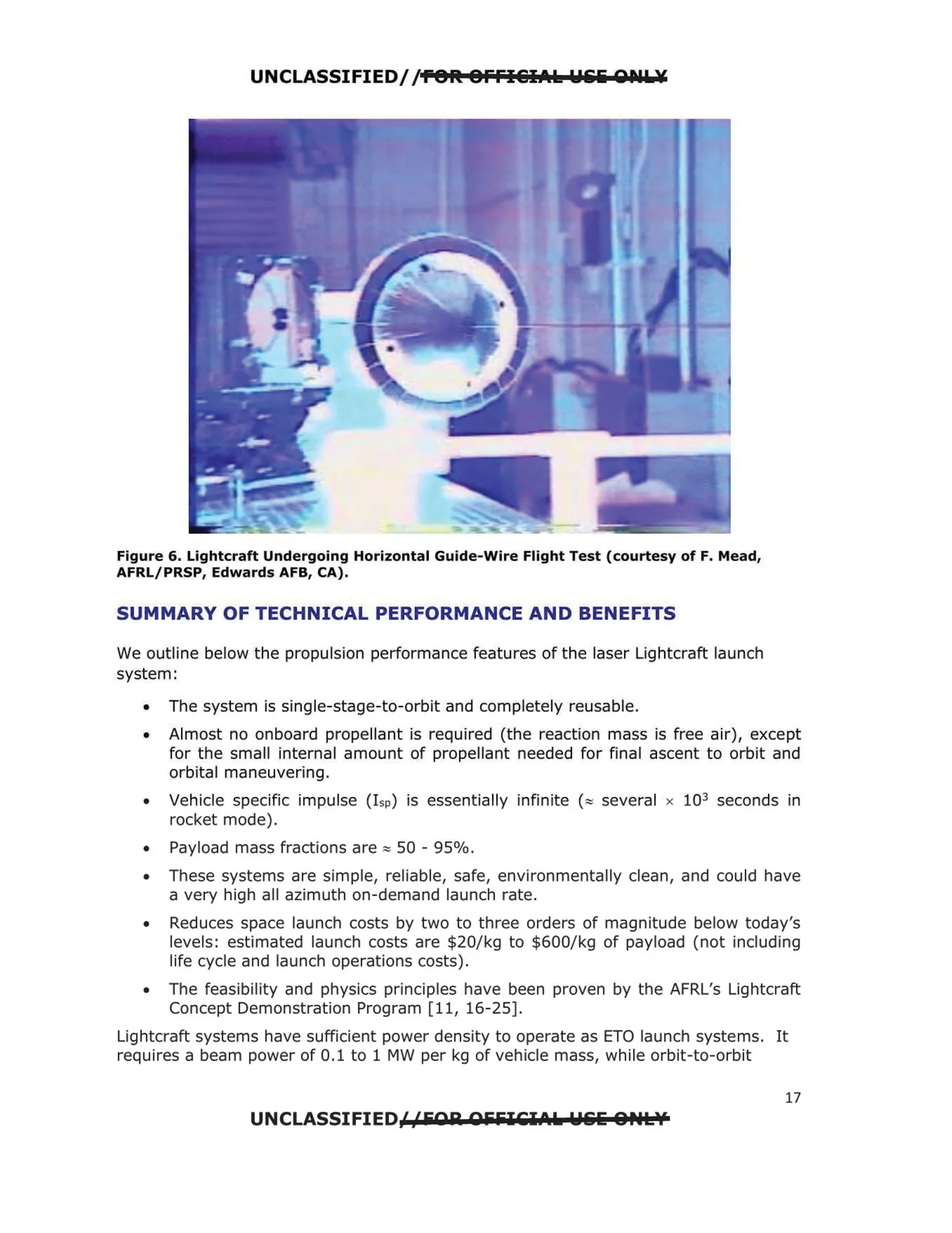
Figure 6. Lightcraft Undergoing Horizontal Guide-Wire Flight Test (courtesy of F. Mead,
AFRL/PRSP, Edwards AFB, CA).
SUMMARY OF TECHNICAL PERFORMANCE AND BENEFITS
We outline below the propulsion performance features of the laser Lightcraft launch
system:
•
The system is single-stage-to-orbit and completely reusable.
•
Almost no onboard propellant is required (the reaction mass is free air), except
for the small internal amount of propellant needed for final ascent to orbit and
orbital maneuvering.
•
Vehicle specific impulse (lsp) is essentially infinite (::: several x 103 seconds in
rocket mode).
•
Payload mass fractions are"" 50 - 95%.
•
These systems are simple, reliable, safe, environmentally clean, and could have
a very high all azimuth on-demand launch rate.
•
Reduces space launch costs by two to three orders of magnitude below today's
levels: estimated launch costs are $20/kg to $600/kg of payload (not including
life cycle and launch operations costs).
•
The feasibility and physics principles have been proven by the AFRL's Lightcraft
Concept Demonstration Program [11, 16-25].
Lightcraft systems have sufficient power density to operate as ETO launch systems. It
requires a beam power of 0.1 to 1 MW per kg of vehicle mass, while orbit-to-orbit
UNCLASSIFIED//FOR O61ilCl.li.k W&& 8Ptl'l
17