AAWSAP DIRD, Laser Lightcraft Nanosatellites, November 2010
DOW-UAP-D143 · page 22 of 77
Text
This text came with the file. It may have mistakes. When the text and the image disagree, the image is right.
---------------
UNCLASSIFIED//fOR. 8FFl&IAk W&li Qlhll.¥
propulsion requires a modest 0.1 to 10 MW of total beam power. The ground-based
megawatt-class laser beam generator is state-of-the-art technology. The cost of
generating electrical power for the ground-based laser beam generator is ~ $0.10/kWh,
which translates to < $2/kg of payload. An SDIO study [10, 11] showed that all launch
to orbit conditions for a Lightcraft could be satisfied by a single, high-power ground
based laser - with or without the aid of a low altitude laser relay mirror or space-based
laser beam generator system. The majority of the system mass required to launch a
payload to orbit is left on the ground in the form of the beam generators and their
electrical power sources. The dry spacecraft mass can be further reduced by two
orders of magnitude, and thus the operating costs reduced by a factor of 10 (to <
$2/kg of payload), if Buckytubes are used to construct the vehicle and its subsystems.
LIGHTCRAFT NANOSATELLITE CONFIGURATION
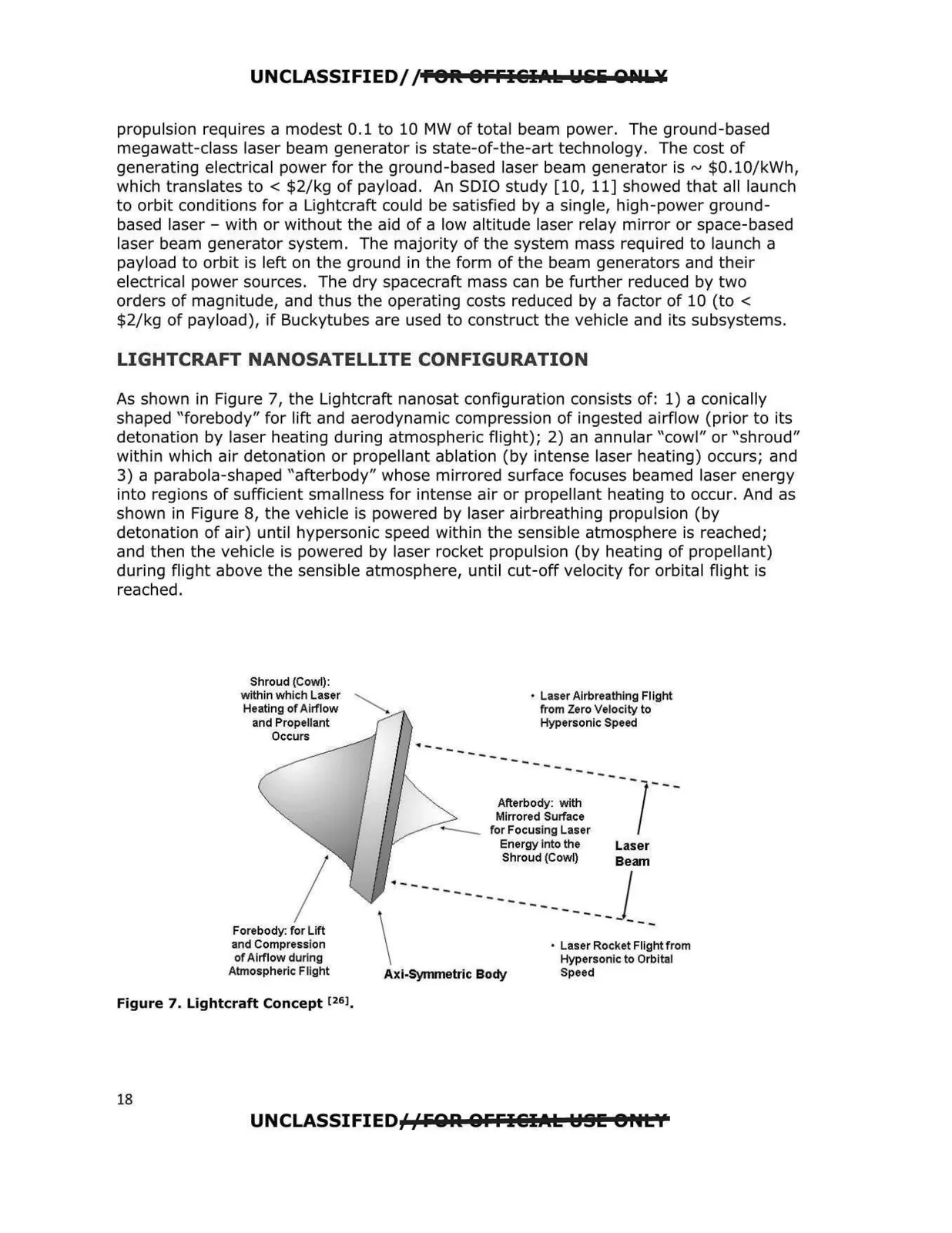
As shown in Figure 7, the Lightcraft nanosat configuration consists of: 1) a conically
shaped "forebody" for lift and aerodynamic compression of ingested airflow (prior to its
detonation by laser heating during atmospheric flight); 2) an annular "cowl" or "shroud"
within which air detonation or propellant ablation (by intense laser heating) occurs; and
3) a parabola-shaped "afterbody" whose mirrored surface focuses beamed laser energy
into regions of sufficient smallness for intense air or propellant heating to occur. And as
shown in Figure 8, the vehicle is powered by laser airbreathing propulsion (by
detonation of air) until hypersonic speed within the sensible atmosphere is reached;
and then the vehicle is powered by laser rocket propulsion (by heating of propellant)
during flight above the sensible atmosphere, until cut-off velocity for orbital flight is
reached.
Shroud (Cowl):
within which Laser
• Laser Airbreathing Flight
Heating of Airflow
from Zero Velocity to
and Propellant
Hypersonic Speed
Occurs
Afterbody: with
Mirrored Surface
for Focusing Laser
Energy into the
Laser
Shroud (Cowl)
\
Beam
.______ ___ __ _________ }__
Forebody: for Lift
and Compression
• Laser Rocket Flight from
of Airflow during
Hypersonic to Orbital
Atmospheric Flight
Axi-Symmetric Body
Speed
Figure 7. Lightcraft Concept 1261.
UNCLASSIFIED{fFOA QFFI&IAL ~8! 8HLY
18