AAWSAP DIRD, Laser Lightcraft Nanosatellites, November 2010
DOW-UAP-D143 · page 39 of 77
Text
This text came with the file. It may have mistakes. When the text and the image disagree, the image is right.
UNCLASSIFIED//rOR: orrlCIAE USE O14Lf
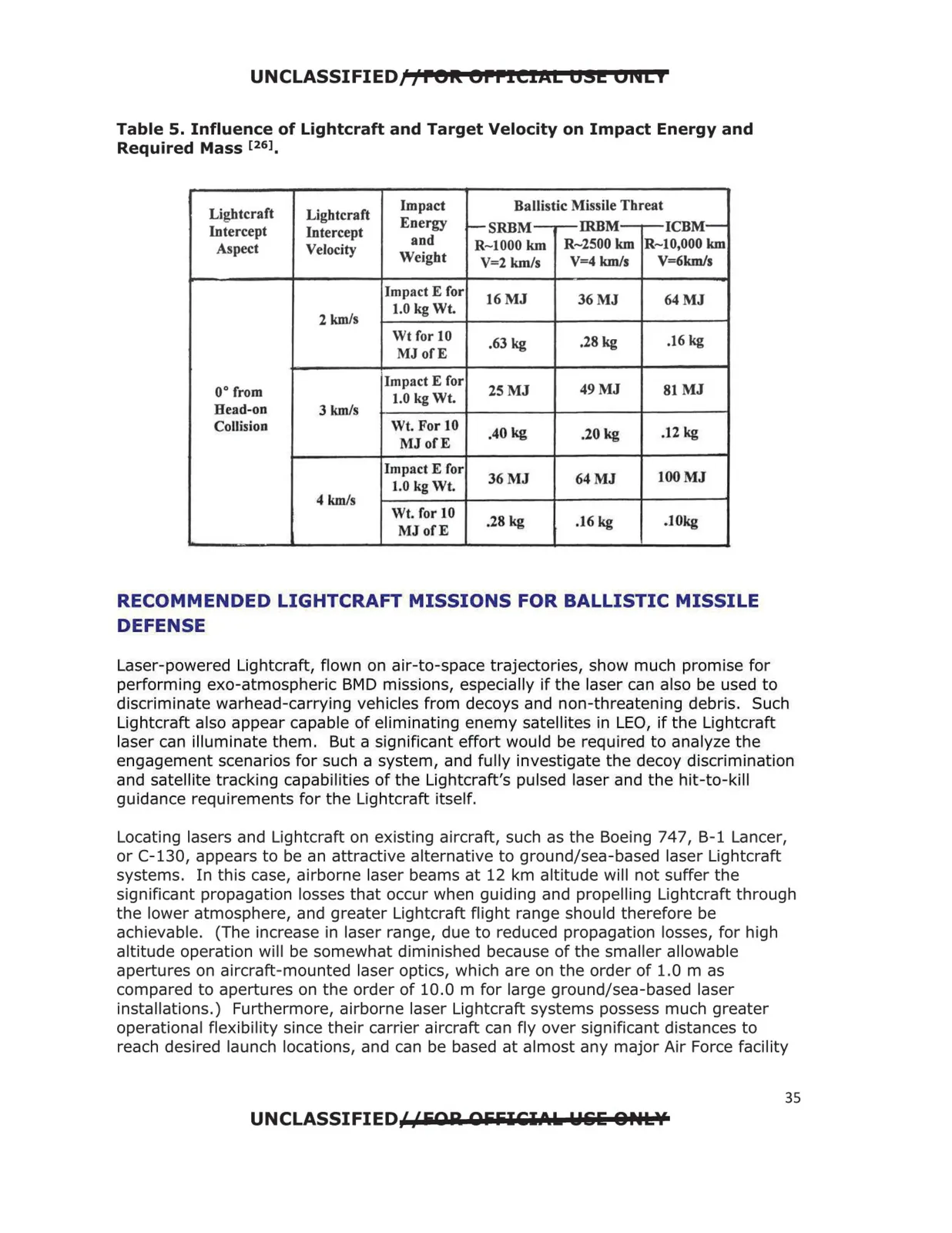
Table 5. Influence of Lightcraft and Target Velocity on Impact Energy and
Required Mass [261.
Impact
Ballistic Missile Threat
Ligbtcraft
Lightcraft
Energy
-SRBM--IRBM--ICBM-
Intercept
Intercept
and
R-10,000 km
R-2500 km
R-1000 km
Aspect
Velocity
Weight
V=6km/s
Impact E for
V=4 km/s
V=2 km/s
16MJ
36MJ
64MJ
1.0 kg Wt.
2 km/s
Wt for 10
.16 kg
.28kg
.63 kg
MJofE
Impact E for
49MJ
81 MJ
25MJ
0° from
1.0 kg Wt.
Bead-on
3 km/s
Wt. For 10
Collision
.12 kg
.40 kg
.20kg
MJofE
Impact E for
lOOMJ
36MJ
64MJ
1.0 kg Wt.
4 km/s
Wt. for 10
.JOkg
.28 kg
.16 kg
MJofE
RECOMMENDED LIGHTCRAFT MISSIONS FOR BALLISTIC MISSILE
DEFENSE
Laser-powered Lightcraft, flown on air-to-space trajectories, show much promise for
performing exo-atmospheric BMD missions, especially if the laser can also be used to
discriminate warhead-carrying vehicles from decoys and non-threatening debris. Such
Lightcraft also appear capable of eliminating enemy satellites in LEO, if the Lightcraft
laser can illuminate them. But a significant effort would be required to analyze the
engagement scenarios for such a system, and fully investigate the decoy discrimination
and satellite tracking capabilities of the Lightcraft's pulsed laser and the hit-to-kill
guidance requirements for the Lightcraft itself.
Locating lasers and Lightcraft on existing aircraft, such as the Boeing 747, B-1 Lancer,
or C-130, appears to be an attractive alternative to ground/sea-based laser Lightcraft
systems. In this case, airborne laser beams at 12 km altitude will not suffer the
significant propagation losses that occur when guiding and propelling Lightcraft through
the lower atmosphere, and greater Lightcraft flight range should therefore be
achievable. (The increase in laser range, due to reduced propagation losses, for high
altitude operation will be somewhat diminished because of the smaller allowable
apertures on aircraft-mounted laser optics, which are on the order of 1.0 m as
compared to apertures on the order of 10.0 m for large ground/sea-based laser
installations.) Furthermore, airborne laser Lightcraft systems possess much greater
operational flexibility since their carrier aircraft can fly over significant distances to
reach desired launch locations, and can be based at almost any major Air Force facility
UNCLASSIFIED//FOR O61ilCl.li.k W&& 8Ptl'l
35