AAWSAP DIRD, Laser Lightcraft Nanosatellites, November 2010
DOW-UAP-D143 · page 69 of 77
Text
This text came with the file. It may have mistakes. When the text and the image disagree, the image is right.
UNCLASSIFIED/,'rOR: orrlCIJ!tL USE 014Lf
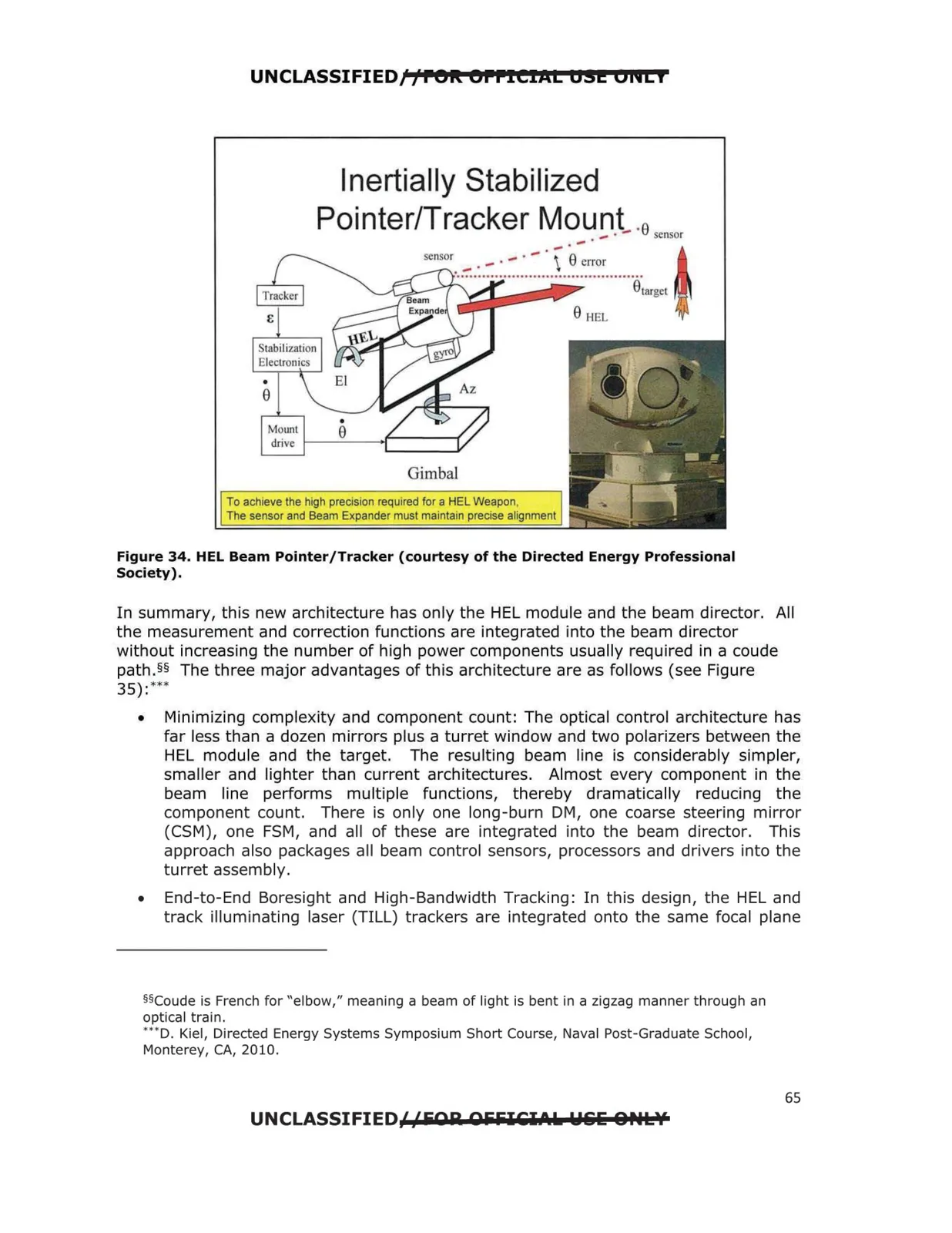
Inertially Stabilized
Pointer/Tracker Mount .0
.,. • ...
sensor
....
-·
en or_-:.-.·.- .- .• _\ . eerror·· ·······
0 target
GimbaJ
To achieve the high prec1s1on required for a HEL Weapon,
The sensor and Beam Expander must maintain precise alignment
Figure 34. HEL Beam Pointer/Tracker (courtesy of the Directed Energy Professional
Society).
In summary, this new architecture has only the HEL module and the beam director. All
the measurement and correction functions are integrated into the beam director
without increasing the number of high power components usually required in a coude
path.§§ The three major advantages of this architecture are as follows (see Figure
35): ***
•
Minimizing complexity and component count: The optical control architecture has
far less than a dozen mirrors plus a turret window and two polarizers between the
HEL module and the target.
The resulting beam line is considerably simpler,
smaller and lighter than current architectures. Almost every component in the
beam line performs multiple functions, thereby dramatically reducing the
component count. There is only one long-burn DM, one coarse steering mirror
(CSM), one FSM, and all of these are integrated into the beam director. This
approach also packages all beam control sensors, processors and drivers into the
turret assembly.
•
End-to-End Boresight and High-Bandwidth Tracking: In this design, the HEL and
track illuminating laser (TILL) trackers are integrated onto the same focal plane
§§Coude is French for "elbow," meaning a beam of light is bent in a zigzag manner through an
optical train.
***D. Kiel, Directed Energy Systems Symposium Short Course, Naval Post-Graduate School,
Monterey, CA, 2010.
UNCLASSIFIED//FOR 061ilCl.li.k W&& 8Ptl'l
65