AAWSAP DIRD, Laser Lightcraft Nanosatellites, November 2010
DOW-UAP-D143 · page 70 of 77
Text
This text came with the file. It may have mistakes. When the text and the image disagree, the image is right.
----
UNCLASSIFIED//rOR: orrlCIAL USE 014Lf
and are controlled by a single FSM which is also the primary mirror and DM. This
eliminates the traditional split between local and target loop stabilization,
combining both into a single controller. This is accomplished so that the high
power path is minimized to its fundamental limit of six mirrors, which are
necessary to get the beam from the HEL module through the coude path and out
through the exit aperture of the telescope.
•
Eliminating the BILL (see Figure 36): The BILL is a solid-state, kilowatt-class laser
that measures atmospheric conditions, allowing the beam and fire control
systems to compensate for atmospheric turbulence that the HEL beam would
encounter in its path to a target. The beam from the BILL bounces off the target
and returns to the HEL source, where optical and software equipment measures
the amount of distortion in the atmosphere between the HEL source and the
target. The HEL adaptive optics system compensates for the distortion using a
deformable mirror. Thus, eliminating the BILL was a very importa nt innovation
towards decreasing the number of high-power components required in the coude
path.
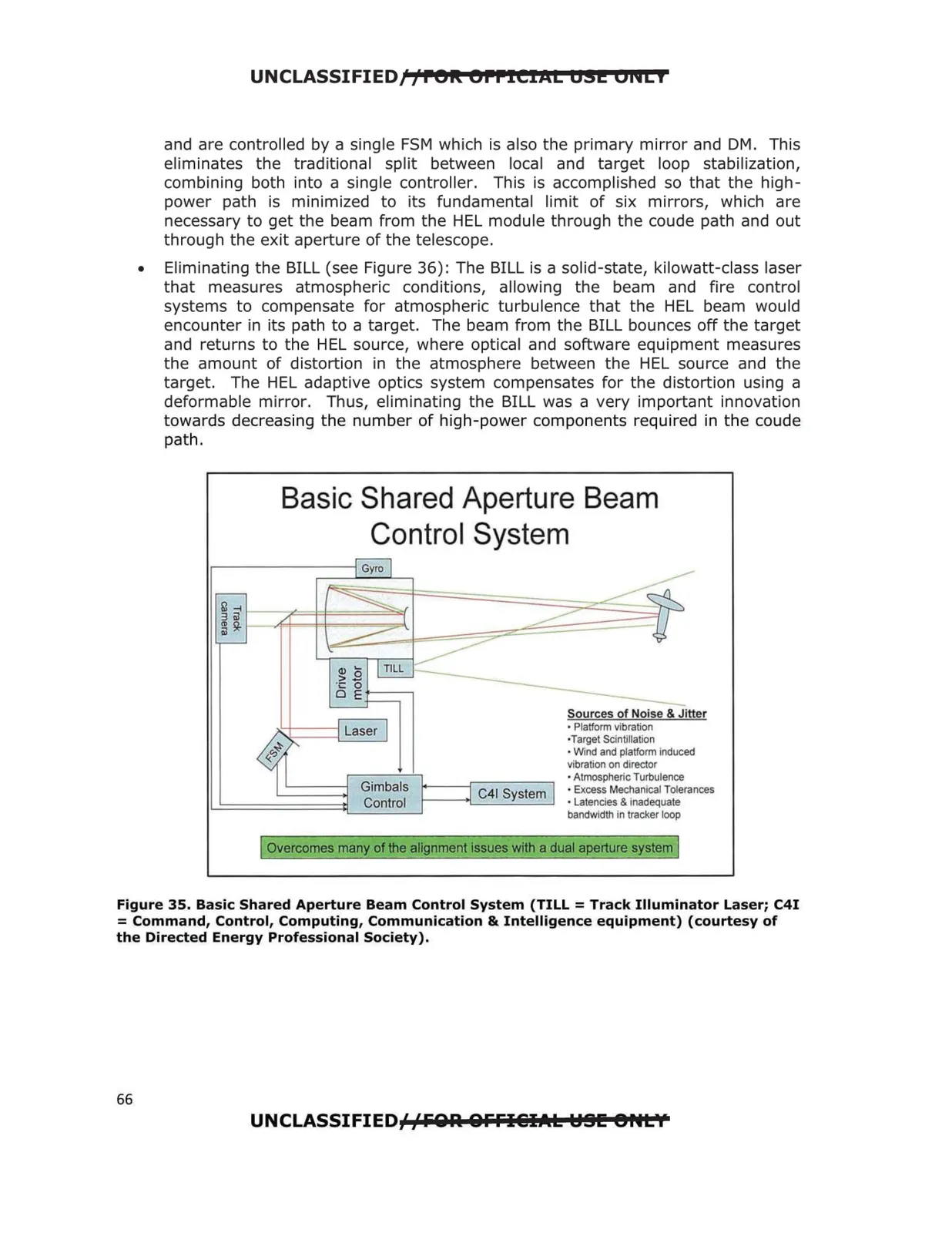
Basic Shared Aperture Beam
Control System
Sources of Noise & Jitter
• Platform vibration
•Target Scintlllation
• Wind and platform induced
vibration on director
• Atmospheric Turbulence
Gimbals
• Excess Mechanical Tolerances
C41 System
Control
• l atencies & Inadequate
bandwidth in tracker loop
~ Overcomes many of the alignment issues with a dual aperturE;system I
Figure 35. Basic Shared Aperture Beam Control System (TILL = Track Illuminator Laser; C4I
= Command, Control, Computing, Communication & Intelligence equipment} (courtesy of
the Directed Energy Professional Society}.
UNCLASSIFIED{fFOA QFFIEiIAL ~81!! 8HLY
66