AAWSAP DIRD, Cockpits in the Era of Breakthrough Flight, November 2010
DOW-UAP-D144 · page 10 of 57
Text
A machine read this text from the scan. When the text and the image disagree, the image is right.
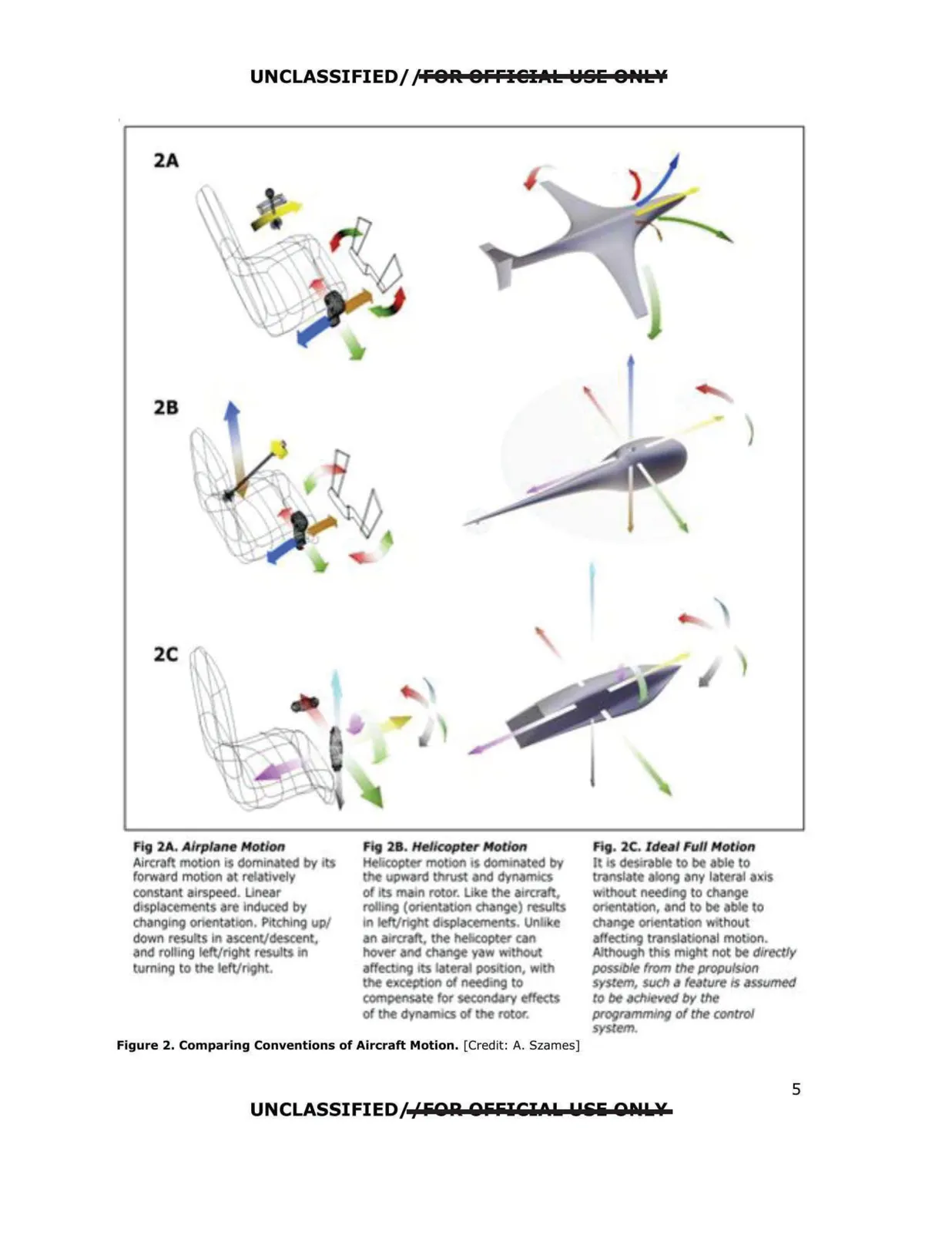
Fig 2A. Airplane Motion
Aircraft motion is dominated by its forward motion at relatively constant airspeed. Linear displacements are induced by changing orientation. Pitching up/down results in ascent/descent, and rolling left/right results in turning to the left/right.

Fig 2B. Helicopter Motion
Helicopter motion is dominated by the upward thrust and dynamics of its main rotor. Like the aircraft, rolling (orientation change) results in left/right displacements. Unlike an aircraft, the helicopter can hover and change yaw without affecting its lateral position, with the exception of needing to compensate for secondary effects of the dynamics of the rotor.

Fig. 2C. Ideal Full Motion
It is desirable to be able to translate along any lateral axis without needing to change orientation, and to be able to change orientation without affecting translational motion. Although this might not be directly possible from the propulsion system, such a feature is assumed to be achieved by the programming of the control system.

Figure 2. Comparing Conventions of Aircraft Motion. [Credit: A. Szames]

UNCLASSIFIED//FOR OFFICIAL USE ONLY

5

UNCLASSIFIED//FOR OFFICIAL USE ONLY