AAWSAP DIRD, Cockpits in the Era of Breakthrough Flight, November 2010
DOW-UAP-D144 · page 11 of 57
Text
This text came with the file. It may have mistakes. When the text and the image disagree, the image is right.
UNCLASSIFIED/ ,'FOR OFFI@IAL WSE QptLY
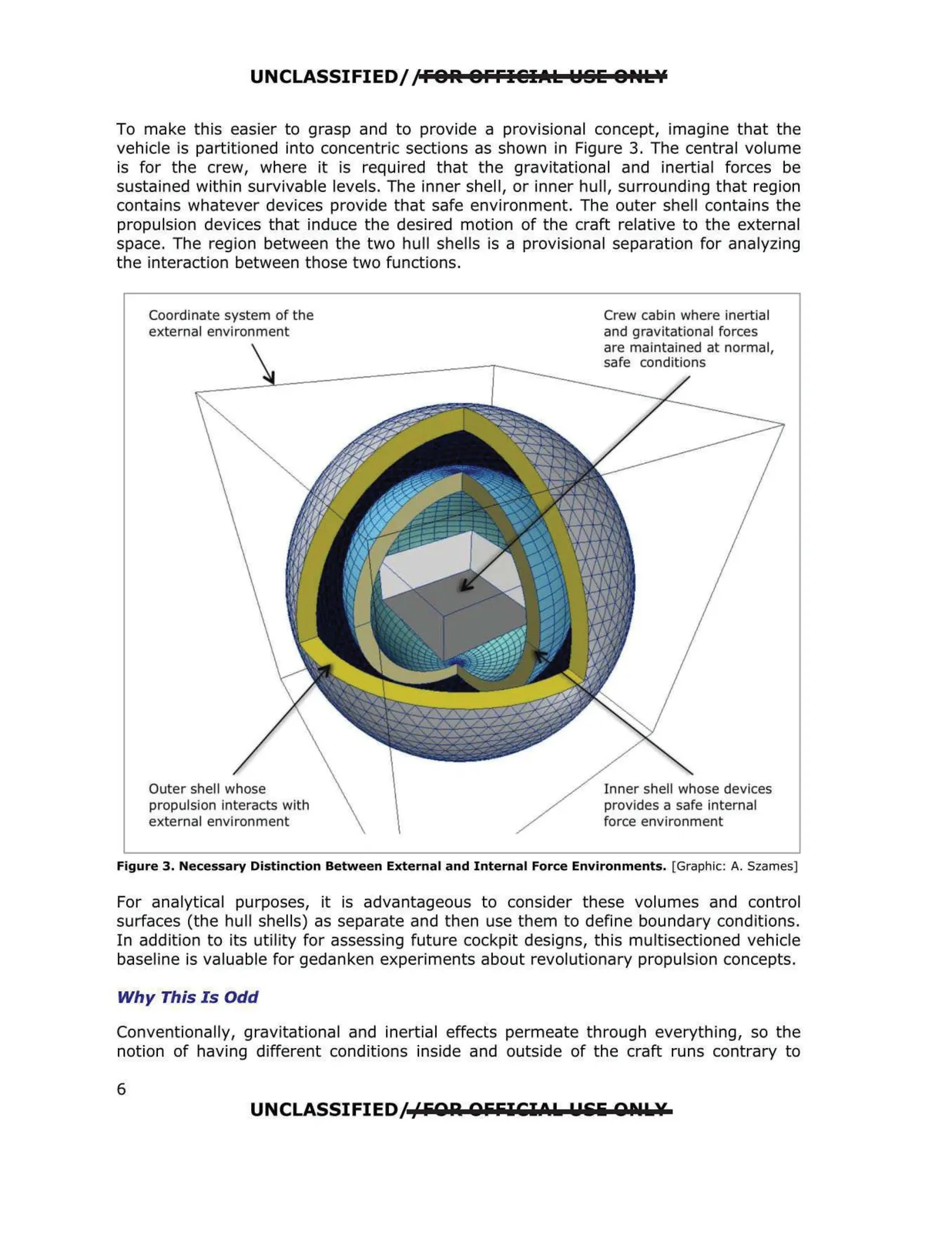
To make this easier to grasp and to provide a provisional concept, imagine that the
vehicle is partitioned into concentric sections as shown in Figure 3. The central volume
is for the crew, where it is required that the gravitational and inertial forces be
sustained within survivable levels. The inner shell, or inner hull, surrounding that region
contains whatever devices provide that safe environment. The outer shell contains the
propulsion devices that induce the desired motion of the craft relative to the external
space. The region between the two hull shells is a provisional separation for analyzing
the interaction between those two functions.
Coordinate system of the
Crew cabin where inertial
external environment
and gravitational forces
are maintained at normal,
safe conditions
Outer shell whose
propulsion interacts with
provides a safe internal
external environment
force environment
Figure 3. Necessary Distinction Between External and Internal Force Environments. [Graphic: A. Szames]
For analytical purposes, it is advantageous to consider these volumes and control
surfaces (the hull shells) as separate and then use them to define boundary conditions.
In addition to its utility for assessing future cockpit designs, this multisectioned vehicle
baseline is valuable for gedanken experiments about revolutionary propulsion concepts.
Why This Is Odd
Conventionally, gravitational and inertial effects permeate through everything, so the
notion of having different conditions inside and outside of the craft runs contrary to
UNCLASSIFIED/fFOA: OFFICIO la Plili Oralla¥
6