AAWSAP DIRD, Cockpits in the Era of Breakthrough Flight, November 2010
DOW-UAP-D144 · page 34 of 57
Text
This text came with the file. It may have mistakes. When the text and the image disagree, the image is right.
UNCLASSIFIED/ ,'FOR OFFI@IAI:: WSE ONl::Y
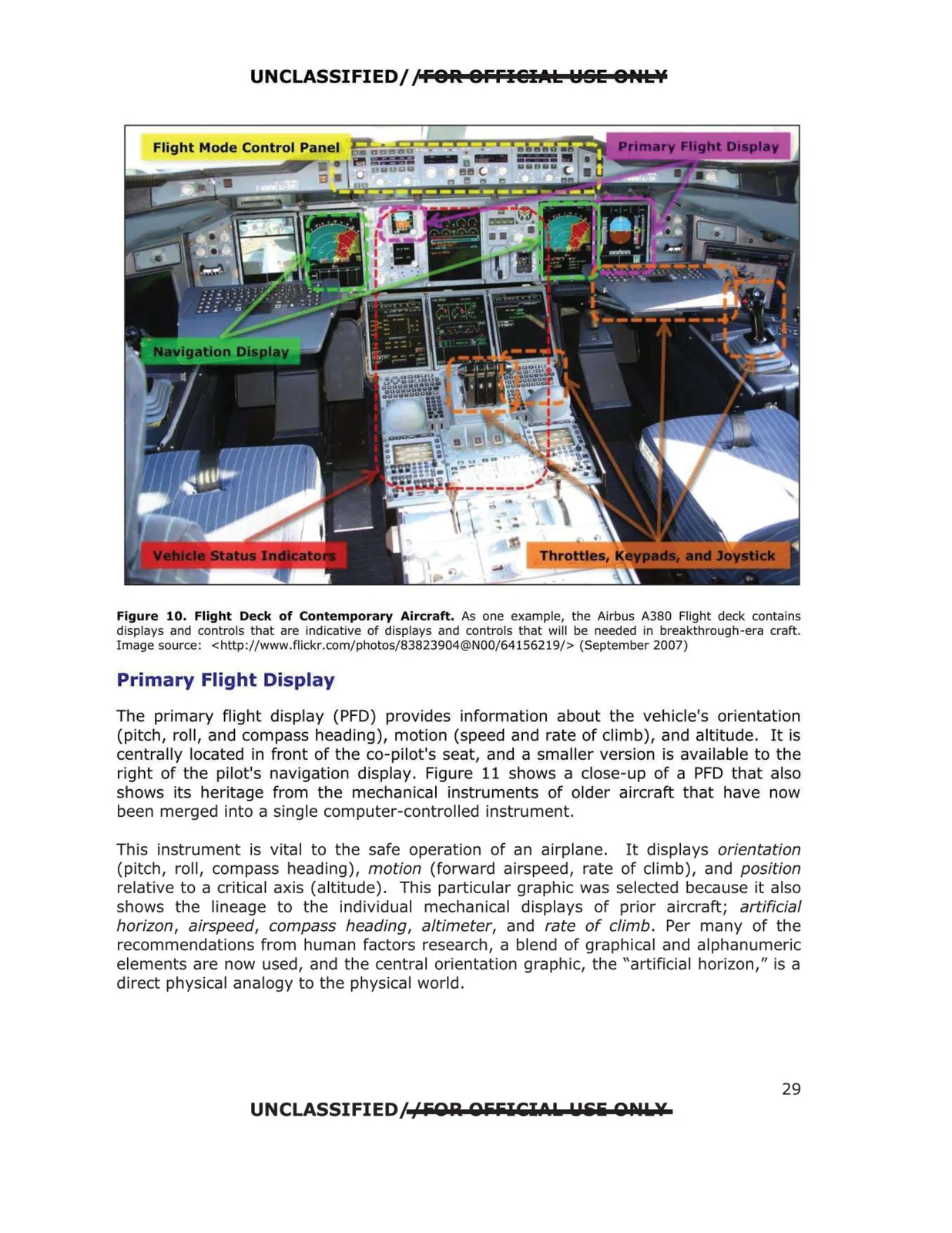
Flight Mode Con
Figure 10. Flight Deck of Contemporary Aircraft. As one example, the Airbus A380 Flight deck contains
displays and controls that are indicative of displays and controls that will be needed in breakthrough-era craft.
Image source : <http ://www.flickr.com/photos/83823904@N00/641S6219/> (September 2007)
Primary Flight Display
The primary flight display (PFD) provides information about the vehicle's orientation
(pitch, roll, and compass heading), motion (speed and rate of climb), and altitude. It is
centrally located in front of the co-pilot's seat, and a smaller version is available to the
right of the pilot's navigation display. Figure 11 shows a close-up of a PFD that also
shows its heritage from the mechanical instruments of older aircraft that have now
been merged into a single computer-controlled instrument.
This instrument is vital to the safe operation of an airplane. It displays orientation
(pitch, roll, compass heading), motion (forward airspeed, rate of climb), and position
relative to a critical axis (altitude). This particular graphic was selected because it also
shows the lineage to the individual mechanical displays of prior aircraft; artificial
horizon, airspeed, compass heading, altimeter, and rate of climb. Per many of the
recommendations from human factors research, a blend of graphical and alphanumeric
elements are now used, and the central orientation graphic, the "artificial horizon," is a
direct physical analogy to the physical world.
UNCLASSIFIED/fFOA. OFFICIO ls. Plili ONls.¥
29