AAWSAP DIRD, Aneutronic Fusion Propulsion I, November 2010
DOW-UAP-D145 · page 13 of 50
Text
This text came with the file. It may have mistakes. When the text and the image disagree, the image is right.
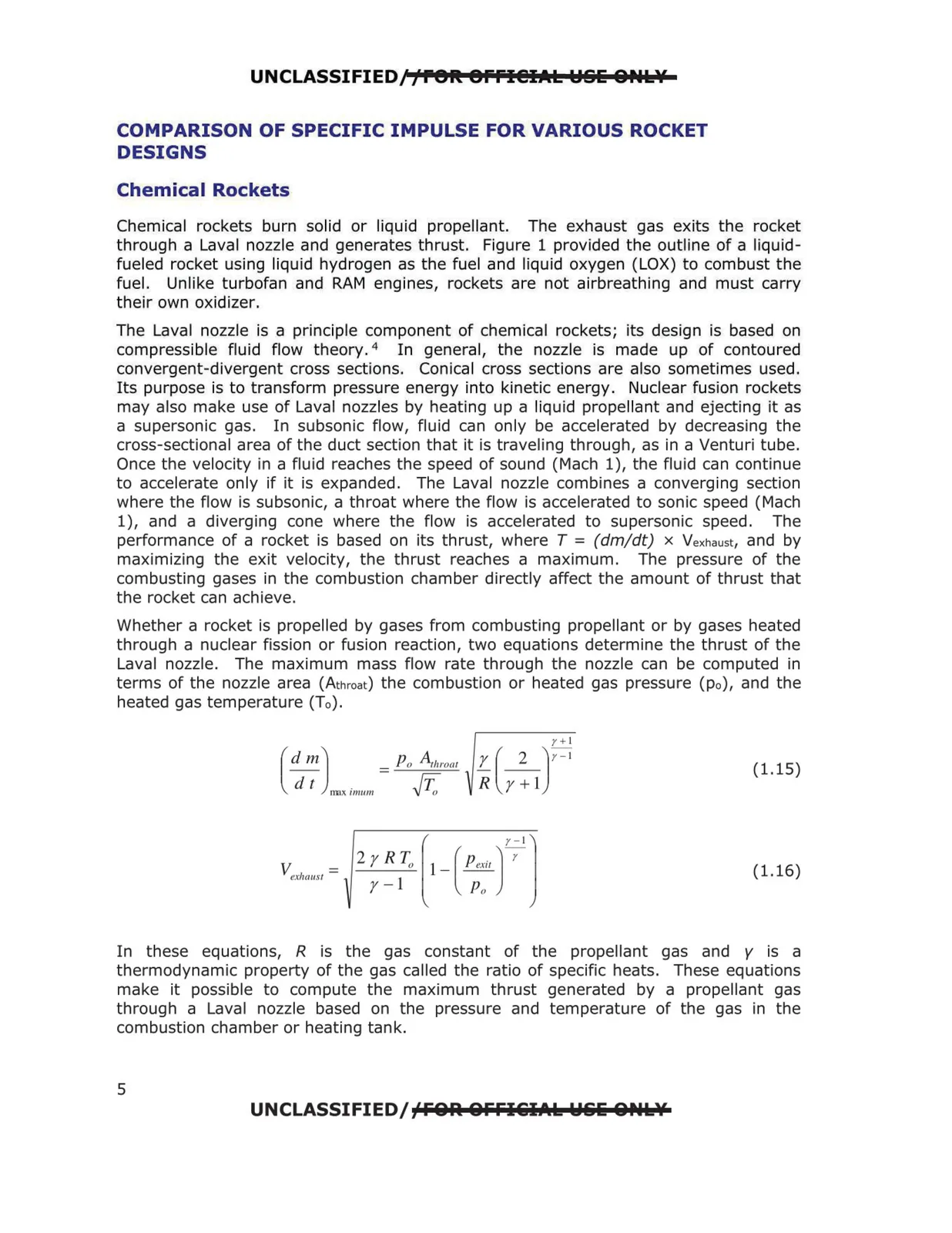
UNCLASSIFIED//POlt Offl@IAL WS& &NkY COMPARISON OF SPECIFIC IMPULSE FOR VARIOUS ROCKET DESIGNS Chemical Rockets Chemical rockets burn solid or liquid propellant. The exhaust gas exits the rocket through a Laval nozzle and generates thrust. Figure 1 provided the outline of a liquid fueled rocket using liquid hydrogen as the fuel and liquid oxygen (LOX) to combust the fuel. Unlike turbofan and RAM engines, rockets are not airbreathing and must carry their own oxidizer. The Laval nozzle is a principle component of chemical rockets; its design is based on compressible fluid flow theory. 4 In general, the nozzle is made up of contoured convergent-divergent cross sections. Conical cross sections are also sometimes used. Its purpose is to transform pressure energy into kinetic energy. Nuclear fusion rockets may also make use of Laval nozzles by heating up a liquid propellant and ejecting it as a supersonic gas. In subsonic flow, fluid can only be accelerated by decreasing the cross-sectional area of the duct section t hat it is traveling through, as in a Venturi tube. Once the velocity in a fluid reaches the speed of sound (Mach 1), the fluid can continue to accelerate only if it is expanded. The Laval nozzle combines a converging section where the flow is subsonic, a throat where the flow is accelerated to sonic speed (Mach 1), and a diverging cone where the flow is accelerated to supersonic speed. The performance of a rocket is based on its thrust, where T = (dm/dt) x Vexhaust, and by maximizing the exit velocity, the thrust reaches a maximum. The pressure of the combusting gases in the combustion chamber directly affect the amount of thrust that the rocket can achieve. Whether a rocket is propelled by gases from combusting propellant or by gases heated through a nuclear fission or fusion reaction, two equations determine the thrust of the Laval nozzle. The maximum mass flow rate through the nozzle can be computed in terms of the nozzle area (Athroat) the combustion or heated gas pressure (po), and the heated gas temperature (To). ( d mJ = Po ~hroat (1.15) d t _ 'T mu1m11m --..Jl. o V (1.16) exhaust In these equations, R is the gas constant of the propellant gas and y is a thermodynamic property of the gas called the ratio of specific heats. These equations make it possible to compute the maximum thrust generated by a propellant gas through a Laval nozzle based on the pressure and temperature of the gas in the combustion chamber or heating tank. 5 UNCLASSIFIED/fF&A &FFI&I:.l.k W&li &NkY