AAWSAP DIRD, Aneutronic Fusion Propulsion I, November 2010
DOW-UAP-D145 · page 12 of 50
Text
This text came with the file. It may have mistakes. When the text and the image disagree, the image is right.
UNCLASSIFIED//POlt Offl@IAL WS& &NkY
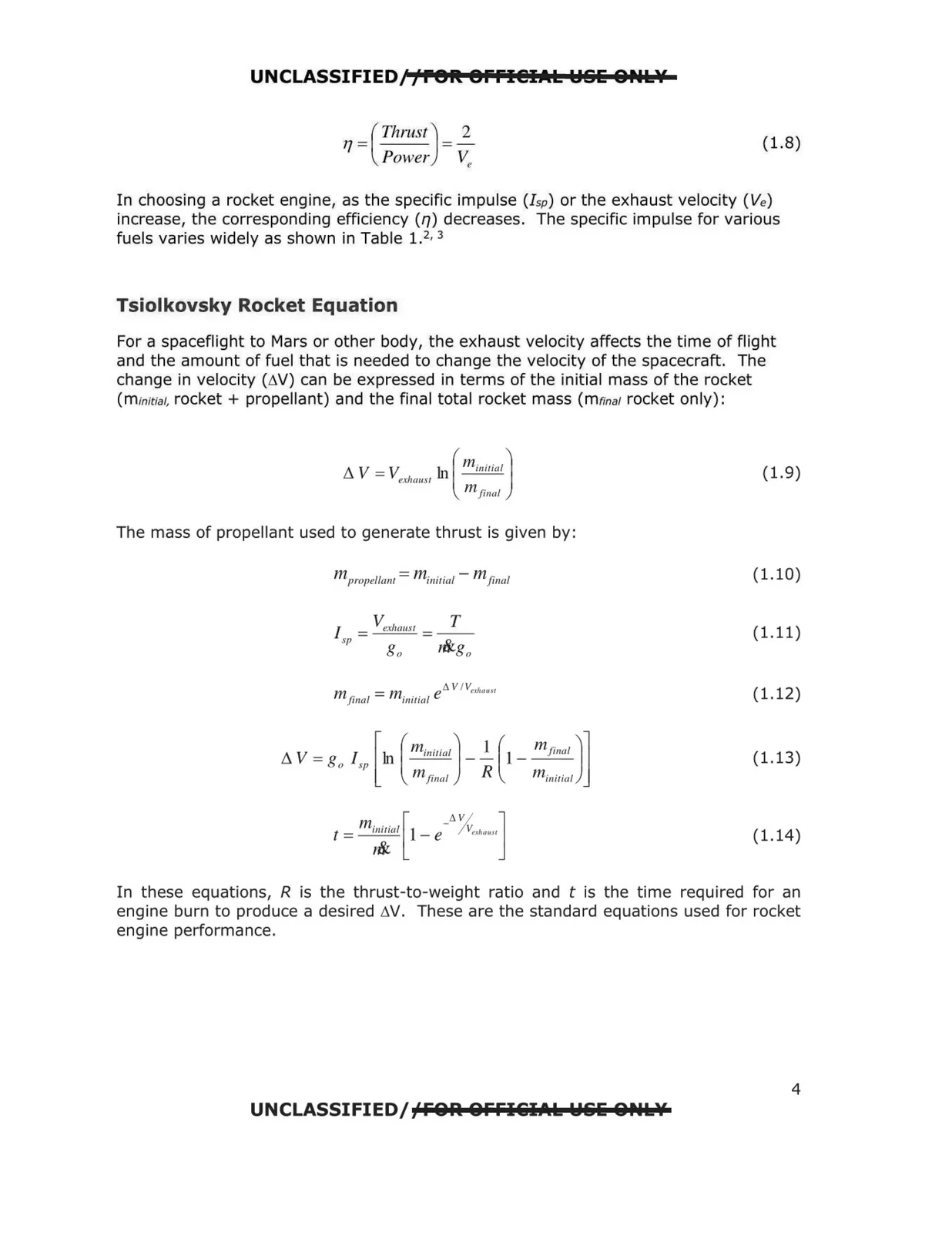
r, = ( Thrust) = ]_
(1.8)
Power
Ve
In choosing a rocket engine, as the specific impulse (Isp ) or the exhaust velocity (Ve)
increase, the corresponding efficiency (TJ) decreases. The specific impulse for various
fuels varies widely as shown in Table 1.2, 3
Tsiolkovsky Rocket Equation
For a spaceflight to Mars or other body, the exhaust velocity affects the time of flight
and the amount of fuel that is needed to change the velocity of the spacecraft. The
change in velocity (t-.V) can be expressed in terms of the initial mass of the rocket
(m ;n;t1a1, rocket+ propellant) and the final total rocket mass (mt;na1 rocket only):
~ V = V
In (minilia/)
(1.9)
exhaust
mfinal
The mass of propellant used to generate thrust is given by:
mpropellanr = minirial - mfinal
(1.10)
(1.11)
m
- m
e~V / Vt'.r:lr ,rns r
(1.12)
~ V = gO Jsp [In [ m i11i1ial]- ..!_ (1 _mfina l J]
(1.13)
fina l -
'initial
mfi11a/
R
mi11irial
(1.14)
In these equations, R is the thrust-to-weight ratio and t is the time required for an
engine burn to produce a desired t-.V. These are the standard equations used for rocket
engine performance.
UNCLASSIFIED/fF&A &FFI&I:.l.k W&li &NkY
4