AAWSAP DIRD, Aneutronic Fusion Propulsion I, November 2010
DOW-UAP-D145 · page 18 of 50
Text
This text came with the file. It may have mistakes. When the text and the image disagree, the image is right.
UNCLASSIFIED//POlt Offl@IAL WS& &NkY
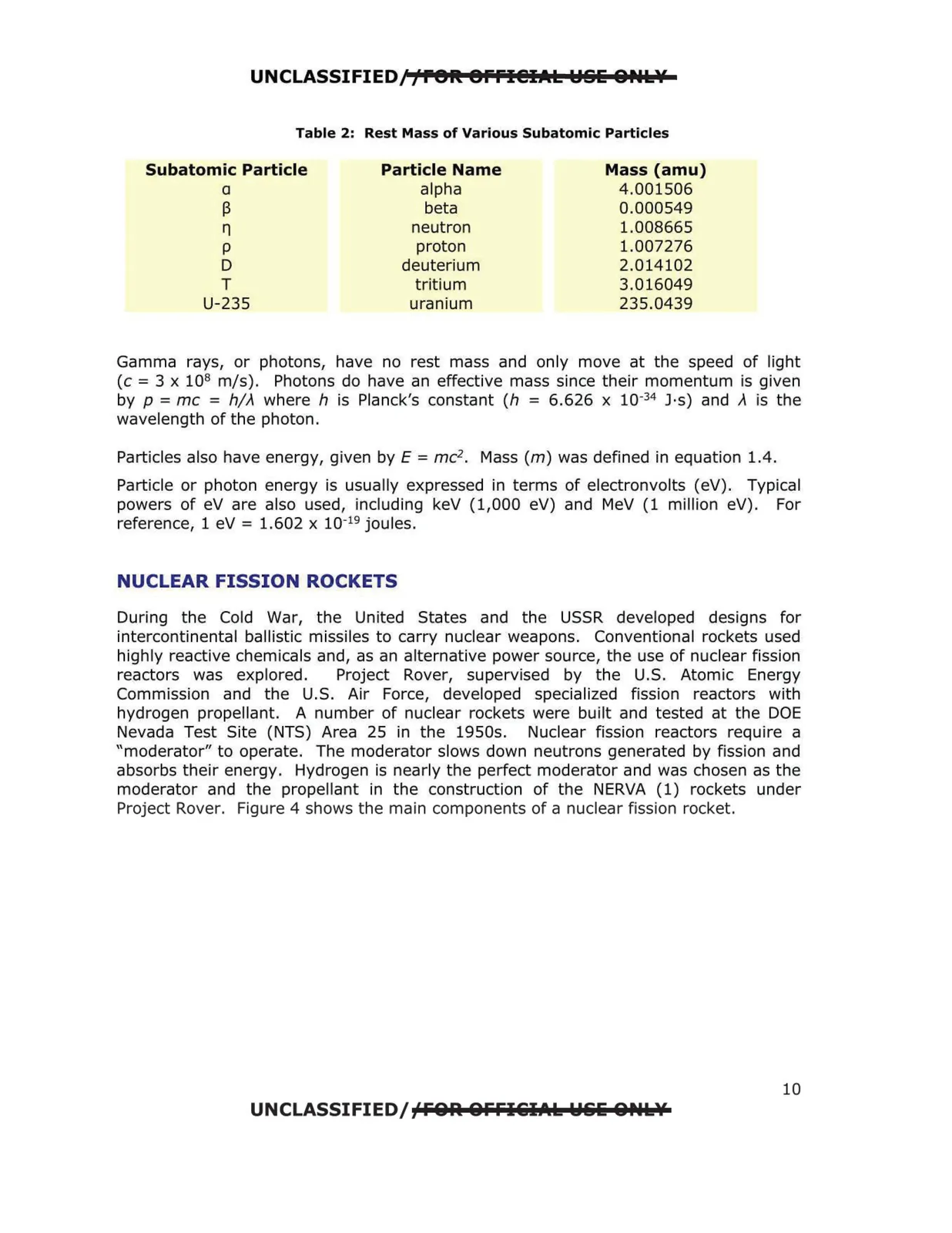
Table 2: Rest Mass of Various Subatomic Particles
Subatomic Particle
Particle Name
Mass (amu)
a
alpha
4.001506
13
beta
0.000549
ri
neutron
1.008665
p
proton
1.007276
D
deuterium
2.014102
T
tritium
3.016049
U-235
uranium
235.0439
Gamma rays, or photons, have no rest mass and only move at the speed of light
(c = 3 x 10⁸ m/s). Photons do have an effective mass since their momentum is given
by p = me = h/A where h is Planck's constant (h = 6.626 x 10⁻³⁴ J·s) and ,.\ is the
wavelength of the photon.
Particles also have energy, given by E = mc2 . Mass (m) was defined in equation 1.4.
Particle or photon energy is usually expressed in terms of electronvolts (eV). Typical
powers of eV are also used, including keV (1,000 eV) and MeV (1 million eV).
For
reference, 1 eV = 1.602 x 10⁻¹⁹ joules.
NUCLEAR FISSION ROCKETS
During the Cold War, the United States and the USSR developed designs for
intercontinental ballistic missiles to carry nuclear weapons. Conventional rockets used
highly reactive chemicals and, as an alternative power source, the use of nuclear fission
reactors was explored.
Project Rover, supervised by the U.S. Atomic Energy
Commission and the U.S. Air Force, developed specialized fission reactors with
hydrogen propellant. A number of nuclear rockets were built and tested at the DOE
Nevada Test Site (NTS) Area 25 in the 1950s.
Nuclear fission reactors require a
"moderator" to operate. The moderator slows down neutrons generated by fission and
absorbs their energy. Hydrogen is nearly the perfect moderator and was chosen as the
moderator and the propellant in the construction of the NERVA (1) rockets under
Project Rover. Figure 4 shows the main components of a nuclear fission rocket.
UNCLASSIFIED/fF&A &FFI&I:.l.k W&li &NkY
10