AAWSAP DIRD, Aneutronic Fusion Propulsion I, November 2010
DOW-UAP-D145 · page 38 of 50
Text
This text came with the file. It may have mistakes. When the text and the image disagree, the image is right.
UNCLASSIFIED//POlt Offl@IAL WS& &NkY
Appendix A: Relativistic Rockets
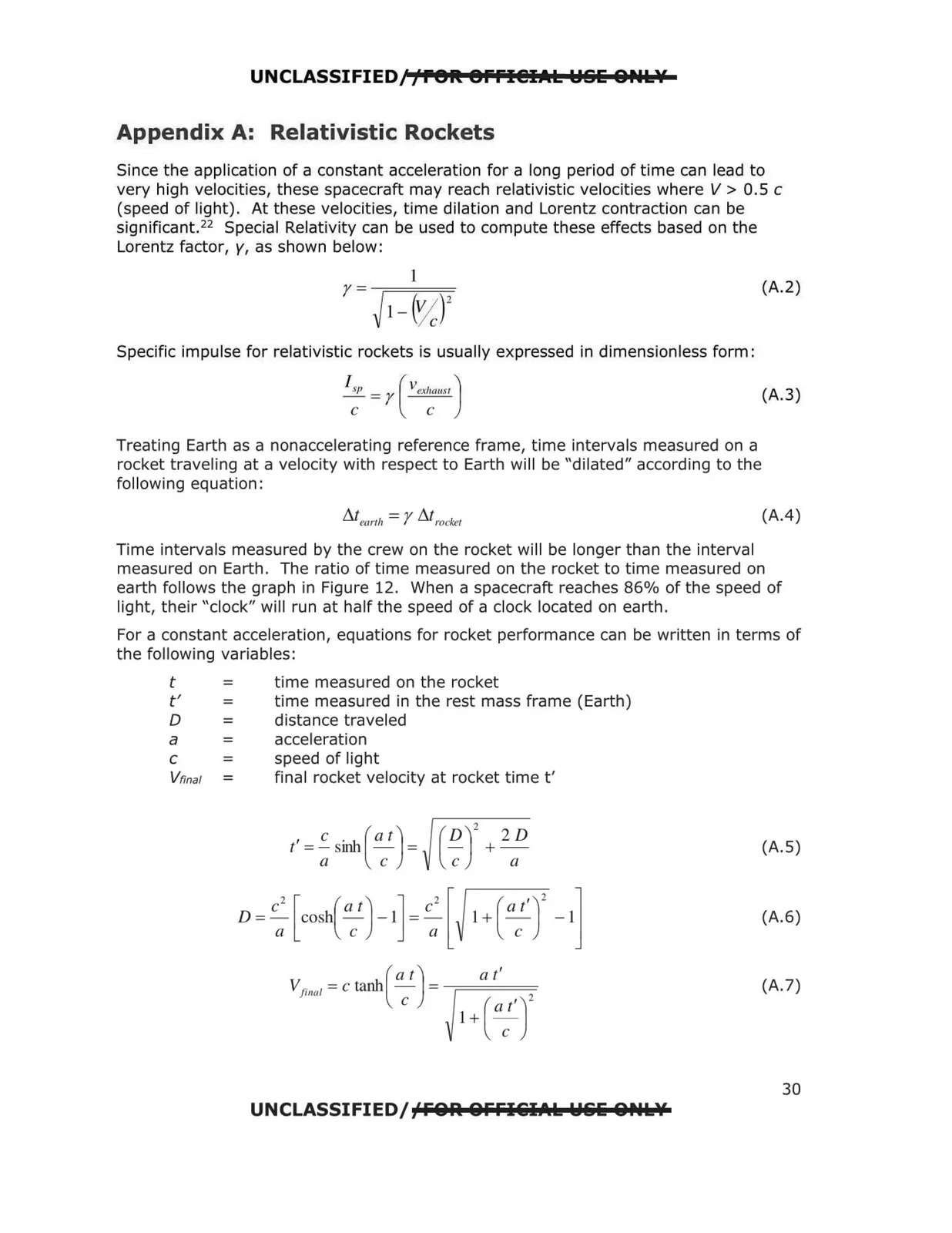
Since the application of a constant acceleration for a long period of time can lead to
very high velocities, these spacecraft may reach relativistic velocities where V > 0.5 c
(speed of light). At these velocities, time dilation and Lorentz contraction can be
significant. 22 Special Relativity ca n be used to compute these effects based on the
Lorentz factor, y, as shown below:
(A.2)
Specific impulse for relativistic rockets is usually expressed in dimensionless form:
I;, = y ( v,x; rns,)
(A.3)
Treating Earth as a nonaccelerating reference frame, time intervals measured on a
rocket traveling at a velocity with respect to Earth will be "dilated" according to the
following equation:
!!i_tearth = y !!i_trocket
(A.4)
Time intervals measured by the crew on the rocket will be longer than the interval
measured on Earth. The ratio of time measured on the rocket to time measured on
earth follows the graph in Figure 12. When a spacecraft reaches 86% of the speed of
light, their "clock" will run at half the speed of a clock located on earth.
For a constant acceleration, equations for rocket performance can be written in terms of
the following variables:
t
=
time measured on the rocket
t'
=
time measured in the rest mass frame (Earth)
D
=
distance traveled
a
=
acceleration
C
=
speed of light
V final
=
final rocket velocity at rocket time t'
(A.5)
t' =~ smh (a/)= (~r+ ~
(A.6)
D< [cost')-,]< [ 1+(":J 1]
(A.7)
UNCLASSIFIED/fF&A &FFI&I:.l.k W&li &NkY
30