AAWSAP DIRD, Aneutronic Fusion Propulsion I, November 2010
DOW-UAP-D145 · page 39 of 50
Text
This text came with the file. It may have mistakes. When the text and the image disagree, the image is right.
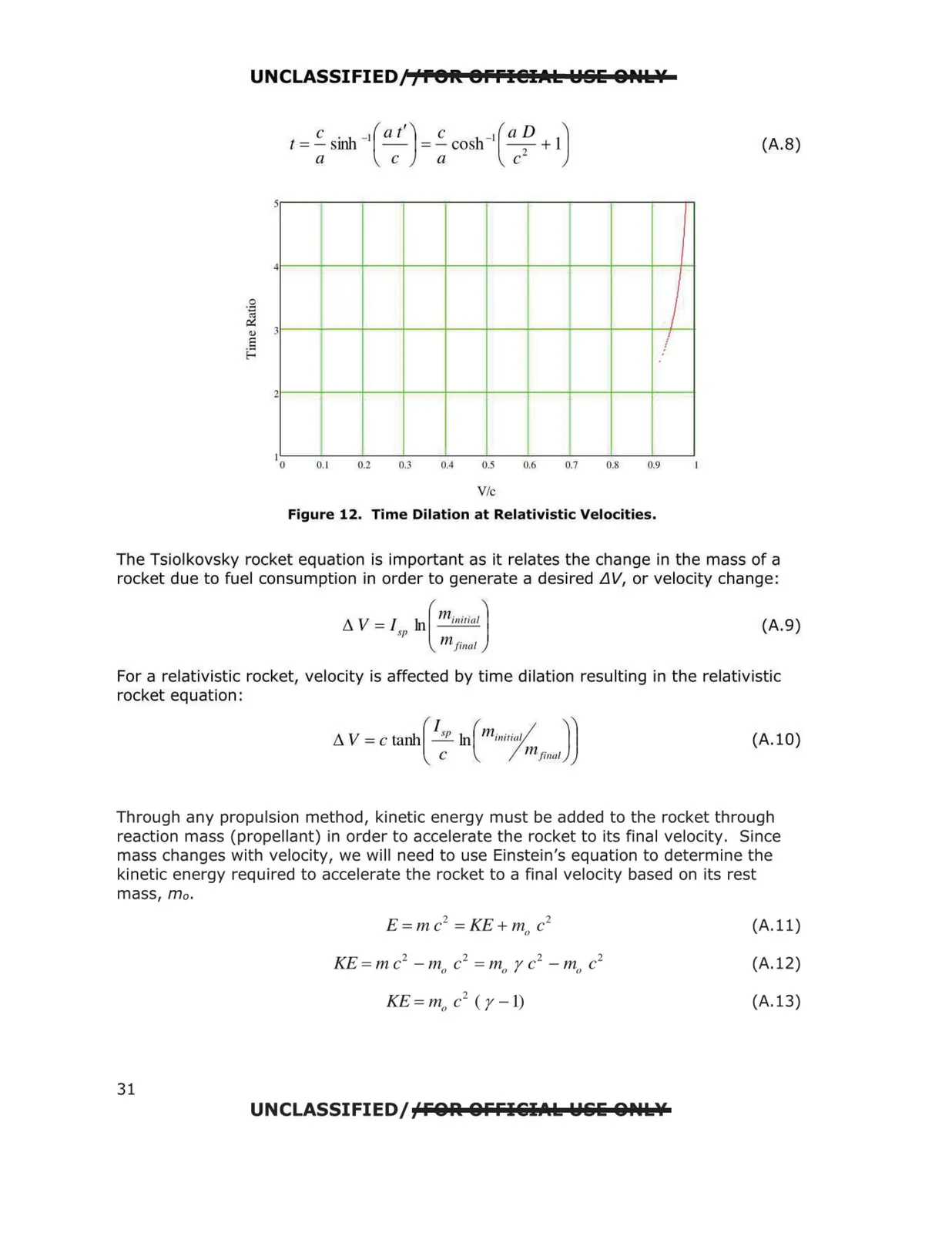
UNCLASSIFIED//POlt Offl@IAL WS& &NkY C • -I ( a t') C -I ( a D ) t = - sinb - = - cosh -? + 1 (A.8) a c a c 4 I I f I I I 0. 1 0.2 0.3 0.4 0.5 0.6 0.7 0.8 0.9 Y/c Figure 12. Time Dilation at Relativistic Velocities. The Tsiolkovsky rocket equation is important as it relates the change in the mass of a rocket due to fuel consumption in order to generate a desired LlV, or velocity change: I:). V =l Sf' 1n(m;,,;1;a1) (A.9) m final For a relativistic rocket, velocity is affected by time dilation resulting in the relativistic rocket equation: ~ V =c tanh[/•P 1n (m;,,;,;a1/ . )J (A.10) C / m f111e1 l Through any propulsion method, kinetic energy must be added to the rocket through reaction mass (propellant) in order to accelerate the rocket to its final velocity. Since mass changes with velocity, we will need to use Einstein's equation to determine the kinetic energy required to accelerate the rocket to a final velocity based on its rest mass, mo. (A.11) KE= m c2 - m c2 = m y c2 - m c2 (A.12) 0 0 0 (A.13) UNCLASSIFIED/fF&A &FFI&I:.l.k W&li &NkY 31