AAWSAP DIRD, Aneutronic Fusion Propulsion I, November 2010
DOW-UAP-D145 · page 40 of 50
Text
This text came with the file. It may have mistakes. When the text and the image disagree, the image is right.
UNCLASSIFIED//POlt Offl@IAL WS& &NkY
Appendix B: Aneutronic Fusion Rocket
For travel to the stars, aneutronic fusion combines a high specific impulse of l sp/c =
0.119 (ideal), compared to a maximum possible of 1.0, with minimal radiation to the
crew. The Bussard fusion propulsion system is an example of this design and uses the
Farnsworth/Hirsch electrostatic confinement method to initiate fusion of hydrogen and
boron-11. 23 The specific impulse of this design is reported from 1,500 to 6,000 seconds
requiring 4.5 to 8 gigawatts of power from the fusion reactor. In this design, 0.078%
of the mass converted into energy actually goes into thrust with the remaining energy
converted into heat and gamma rays. For a long-duration space flight, the specific
impulse of the fuel source must be very high since a great deal of fuel is consumed over
time, but the thrust required is relatively small.
To explore the needs for high lsp, we can envision a flight to Proxima Centauri, a
distance of 4.22 light-years. The maximum acceleration that the crew can survive is
assumed to be 1 g (earth gravity). As the vehicle accelerates away from Earth,
relativistic effects described through equations A.5 to A.10 become important. The
clocks on the rocket appear to be moving slower than the clocks on Earth, the rest
mass frame. During this mission, the rocket is assumed to accelerate for the first 2.11
light-years to its maximum velocity. At this midpoint in its journey, the rocket turns
around and decelerates at the same rate until it reaches Proxima Centauri.
Typical questions about the mission:
•
How long will the journey take (in terms of both Earth clocks and rocket clocks)?
•
How much fuel is consumed?
•
What maximum velocity is achieved?
The answers to these questions are dependent upon:
•
The distance to the star.
•
The mass of the rocket payload, engine, and fuel.
•
The effective specific impulse of the engine, when all inefficiencies are included.
For the trip to Proxima Centauri, the minimum duration flight is affected by how close
to the speed of light the ship can travel. Unfortunately, the higher the maximum speed,
the greater mass fraction of fuel required. This is shown in Figure 13. If the fuel is
assumed to be no more than 50% of the initial mass of the rocket, for example, the
maximum speed that could be attained is limited to 8% of the speed of light for the
ideal fusion drive (lsp/c = 0.119).
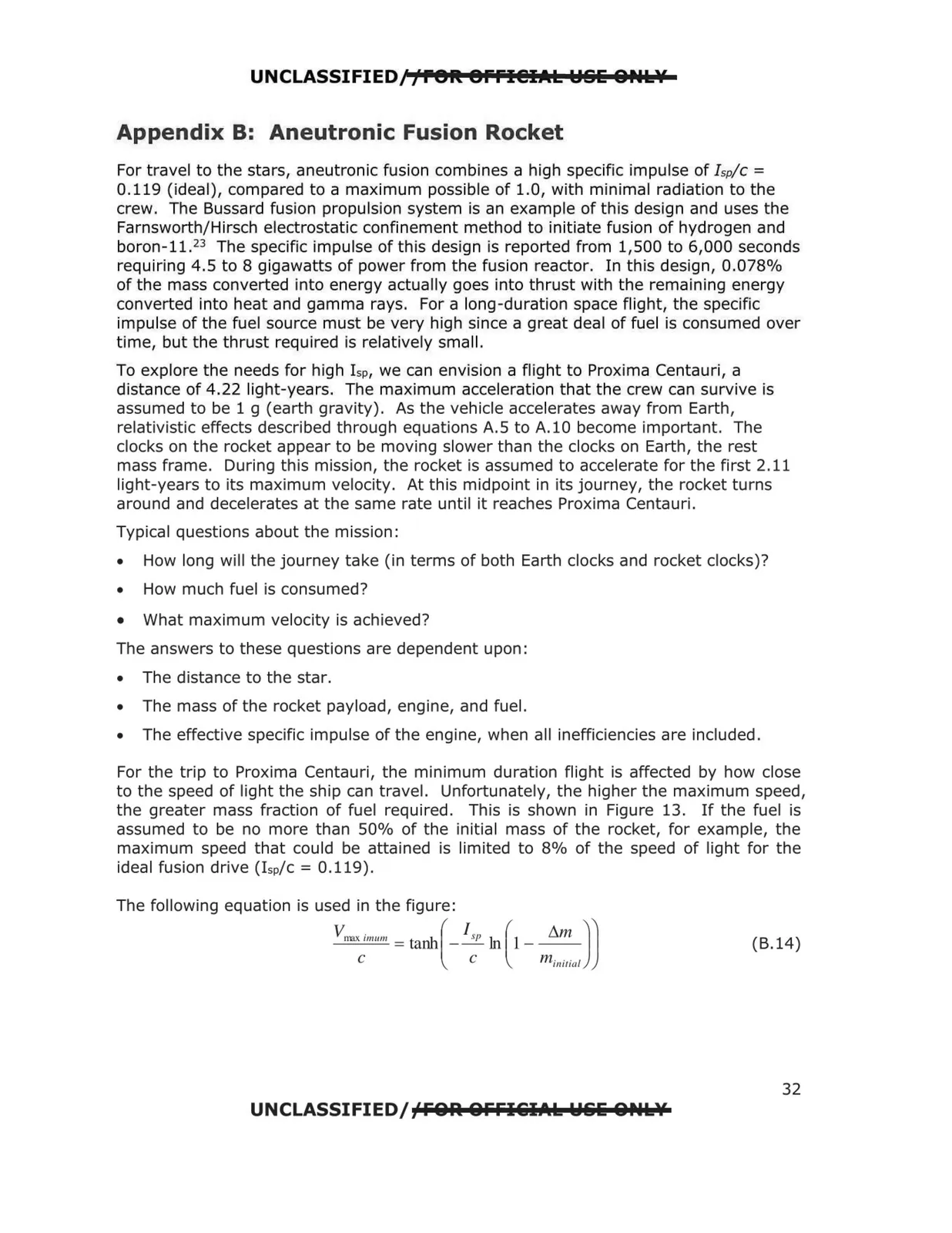
The following equation is used in the figure:
~ mx im 11m = tanh ( -
J .,P In (1 -
!::i.m JJ
(B.14)
C
C
m i11itial
UNCLASSIFIED/fF&A &FFI&I:.l.k W&li &NkY
32