AAWSAP DIRD, Aneutronic Fusion Propulsion II, November 2010
DOW-UAP-D146 · page 11 of 36
Text
This text came with the file. It may have mistakes. When the text and the image disagree, the image is right.
UNCLASSIFIED/ /FOR. OFFICIAL t:191!!! OHL¥
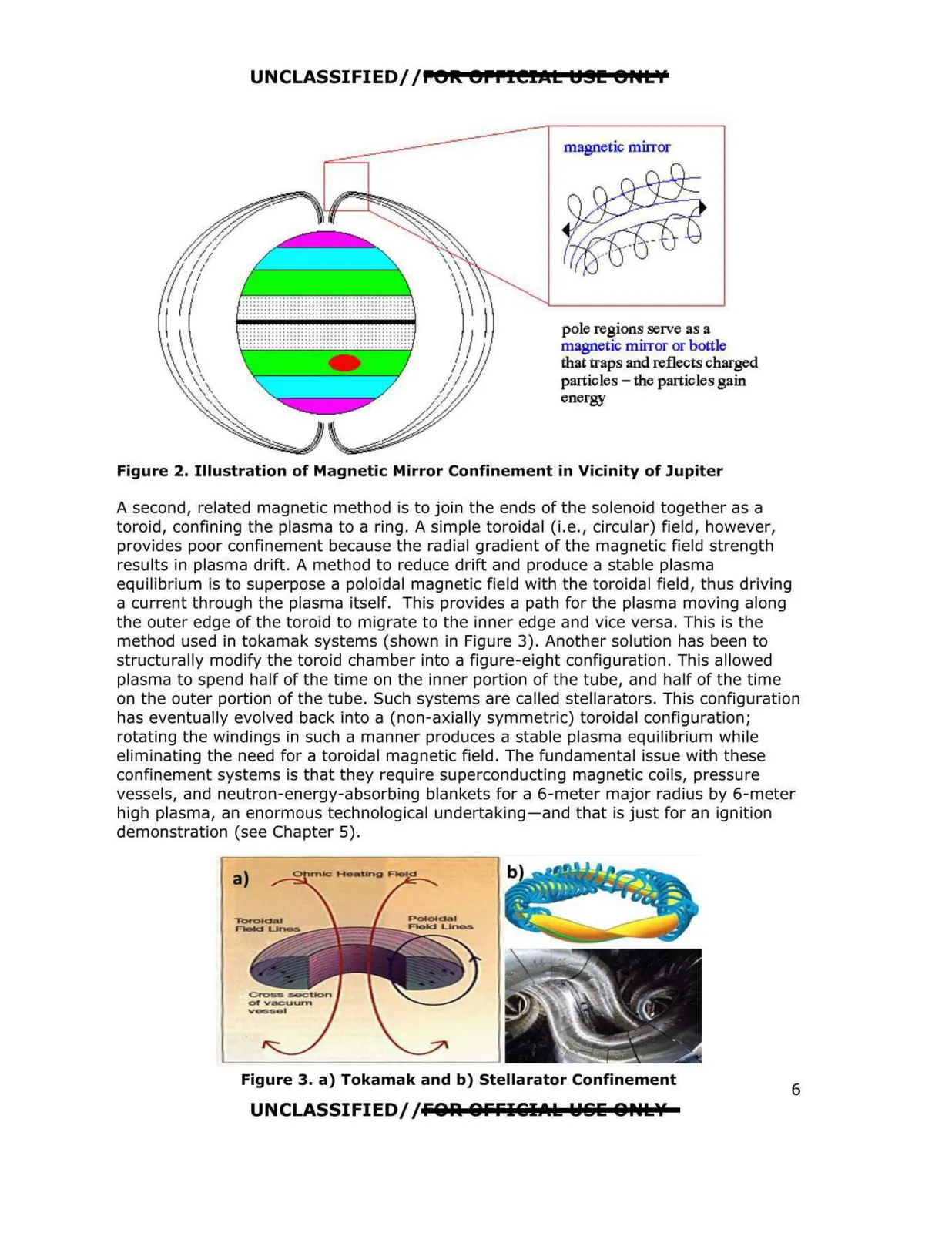
magnetic mirror
pole regions serve as a
magnetic mirror or bottle
that traps and reflects charged
particles - the particles gain
energy
Figure 2. Illustration of Magnetic Mirror Confinement in Vicinity of Jupiter
A second, related magnetic method is to join the ends of the solenoid together as a
toroid, confining the plasma to a ring. A simple toroidal (i.e., circular) field, however,
provides poor confinement because the radial gradient of the magnetic field strength
results in plasma drift. A method to reduce drift and produce a stable plasma
equilibrium is to superpose a poloidal magnetic field with the toroidal field, thus driving
a current through the plasma itself. This provides a path for the plasma moving along
the outer edge of the toroid to migrate to the inner edge and vice versa. This is the
method used in tokamak systems (shown in Figure 3). Another solution has been to
structurally modify the toroid chamber into a figure-eight configuration. This allowed
plasma to spend half of the time on the inner portion of the tube, and half of the time
on the outer portion of the tube. Such systems are called stellarators. This configuration
has eventually evolved back into a (non-axially symmetric) toroidal configuration;
rotating the windings in such a manner produces a stable plasma equilibrium while
eliminating the need for a toroidal magnetic field. The fundamental issue with these
confinement systems is that they require superconducting magnetic coils, pressure
vessels, and neutron-energy-absorbing blankets for a 6-meter major radius by 6-meter
high plasma, an enormous technological undertaking-and that is just for an ignition
demonstration (see Chapter 5).
Figure 3. a) Tokamak and b) Stellarator Confinement
UNCLASSIFIED//FOR OFFI&iIAk YS& &PtkY
6