AAWSAP DIRD, Aneutronic Fusion Propulsion II, November 2010
DOW-UAP-D146 · page 12 of 36
Text
This text came with the file. It may have mistakes. When the text and the image disagree, the image is right.
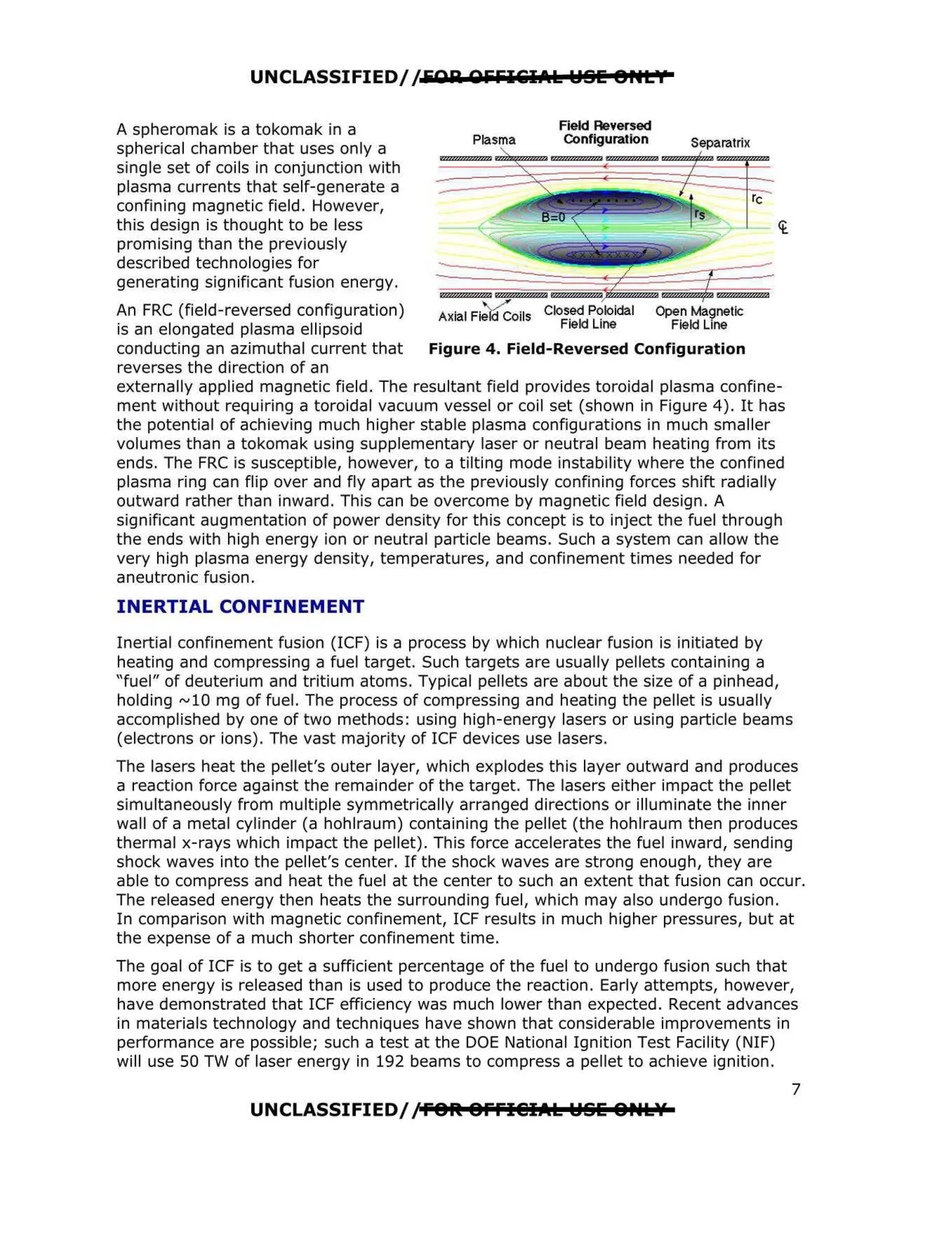
UNCLASSIFIED//FOR OFFI&ilAl l::181: 8HL'f Field Reversed A spheromak is a tokamak in a Plasma Configuration Separatrix spherical chamber that uses only a single set of coils in conjunction with plasma currents that self-generate a re confining magnetic field. However, this design is thought to be less promising than the previously described technologies for generating significant fusion energy. An FRC (field-reversed configuration) Axial Fi~oils Closed Pololdal Open Magnetic Field Line Field Line is an elongated plasma ellipsoid conducting an azimuthal current that Figure 4. Field-Reversed Configuration reverses the direction of an externally applied magnetic field. The resultant field provides toroidal plasma confine ment without requiring a toroidal vacuum vessel or coil set (shown in Figure 4 ). It has the potential of achieving much higher stable plasma configurations in much smaller volumes than a tokamak using supplementary laser or neutral beam heating from its ends. The FRC is susceptible, however, to a tilting mode instability where the confined plasma ring can flip over and fly apart as the previously confining forces shift radially outward rather than inward. This can be overcome by magnetic field design. A significant augmentation of power density for this concept is to inject the fuel through the ends with high energy ion or neutral particle beams. Such a system can allow the very high plasma energy density, temperatures, and confinement times needed for aneutronic fusion. INERTIAL CONFINEMENT Inertial confinement fusion (ICF) is a process by which nuclear fusion is initiated by heating and compressing a fuel target. Such targets are usually pellets containing a "fuel" of deuterium and tritium atoms. Typical pellets are about the size of a pinhead, holding ~10 mg of fuel. The process of compressing and heating the pellet is usually accomplished by one of two methods: using high-energy lasers or using particle beams (electrons or ions). The vast majority of ICF devices use lasers. The lasers heat the pellet's outer layer, which explodes this layer outward and produces a reaction force against the remainder of the target. The lasers either impact the pellet simultaneously from multiple symmetrically arranged directions or illuminate the inner wall of a metal cylinder (a hohlraum) containing the pellet (the hohlraum then produces thermal x-rays which impact the pellet). This force accelerates the fuel inward, sending shock waves into the pellet's center. If the shock waves are strong enough, they are able to compress and heat the fuel at the center to such an extent that fusion can occur. The released energy then heats the surrounding fuel, which may also undergo fusion. In comparison with magnetic confinement, ICF results in much higher pressures, but at the expense of a much shorter confinement time. The goal of ICF is to get a sufficient percentage of the fuel to undergo fusion such that more energy is released than is used to produce the reaction. Early attempts, however, have demonstrated that ICF efficiency was much lower than expected. Recent advances in materials technology and techniques have shown that considerable improvements in performance are possible; such a test at the DOE National Ignition Test Facility (NIF) will use 50 TW of laser energy in 192 beams to compress a pellet to achieve ignition. UNCLASSIFIED//fOR: 8ffl@IAl l::ISE OHl?f 7