AAWSAP DIRD, Aneutronic Fusion Propulsion II, November 2010
DOW-UAP-D146 · page 16 of 36
Text
This text came with the file. It may have mistakes. When the text and the image disagree, the image is right.
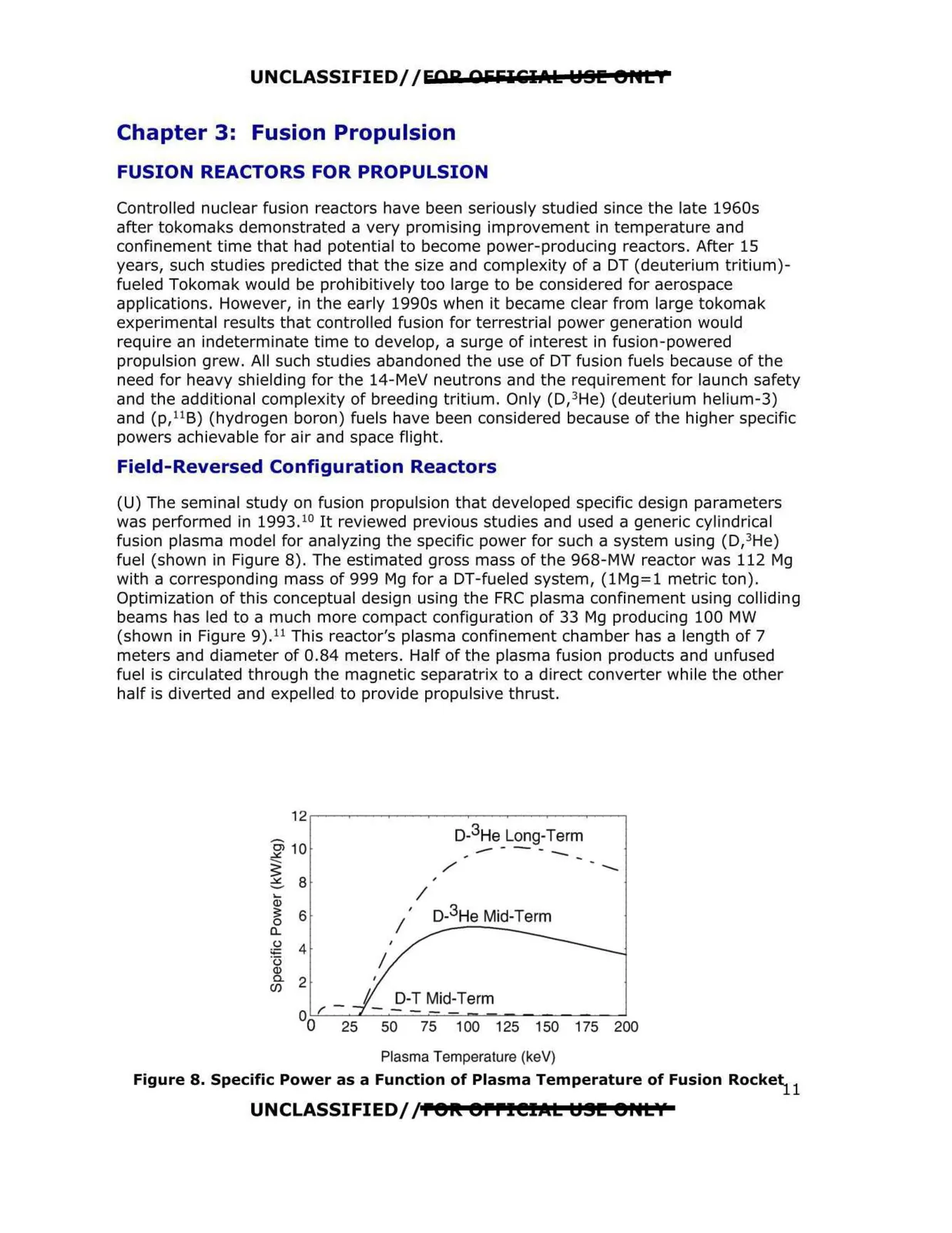
- - - UNCLASSIFIED//FOR 0551CIAk Y8l!! Of\lLI Chapter 3: Fusion Propulsion FUSION REACTORS FOR PROPULSION Controlled nuclear fusion reactors have been seriously studied since the late 1960s after tokomaks demonstrated a very promising improvement in temperature and confinement time that had potential to become power-producing reactors. After 15 years, such studies predicted that the size and complexity of a DT (deuterium tritium) fueled Tokamak would be prohibitively too large to be considered for aerospace applications. However, in the early 1990s when it became clear from large tokamak experimental results that controlled fusion for terrestrial power generation would require an indeterminate time to develop, a surge of interest in fusion-powered propulsion grew. All such studies abandoned the use of DT fusion fuels because of the need for heavy shielding for the 14-MeV neutrons and the requirement for launch safety and the additional complexity of breeding tritium. Only (D, 3He) (deuterium helium-3) and (p, 11B) (hydrogen boron) fuels have been considered because of the higher specific powers achievable for air and space flight. Field- Reversed Configuration Reactors (U) The seminal study on fusion propulsion that developed specific design parameters was performed in 1993. 10 It reviewed previous studies and used a generic cylindrical fusion plasma model for analyzing the specific power for such a system using (D,3He) fuel (shown in Figure 8). The estimated gross mass of the 968-MW reactor was 112 Mg with a corresponding mass of 999 Mg for a DT-fueled system, (lMg=l metric ton). Optimization of this conceptual design using the FRC plasma confinement using colliding beams has led to a much more compact configuration of 33 Mg producing 100 MW (shown in Figure 9). 11 This reactor's plasma confinement chamber has a length of 7 meters and diameter of 0.84 meters. Half of the plasma fusion products and unfused fuel is circulated through the magnetic separatrix to a direct converter while the other half is diverted and expelled to provide propulsive thrust. 12.---~---~-----~-~--, D-3He Long-Term cii 10 .--- - - .:.:. ~ / ~ 8 ... / Q) ~ ' D-3He Mid-Term 0 6 I c.. ;.-:; () 4 '<3 I Q) a. 2 Cl) /J D-T Mid-Term I' - - - 00 25 50 75 100 125 150 175 200 Plasma Temperature (keV) Figure 8. Specific Power as a Function of Plasma Temperature of Fusion Rocke\ 1 UNCLASSIFIED//FOR. orr1e1J1tt tl!H!! OHL'I"