AAWSAP DIRD, Aneutronic Fusion Propulsion II, November 2010
DOW-UAP-D146 · page 18 of 36
Text
This text came with the file. It may have mistakes. When the text and the image disagree, the image is right.
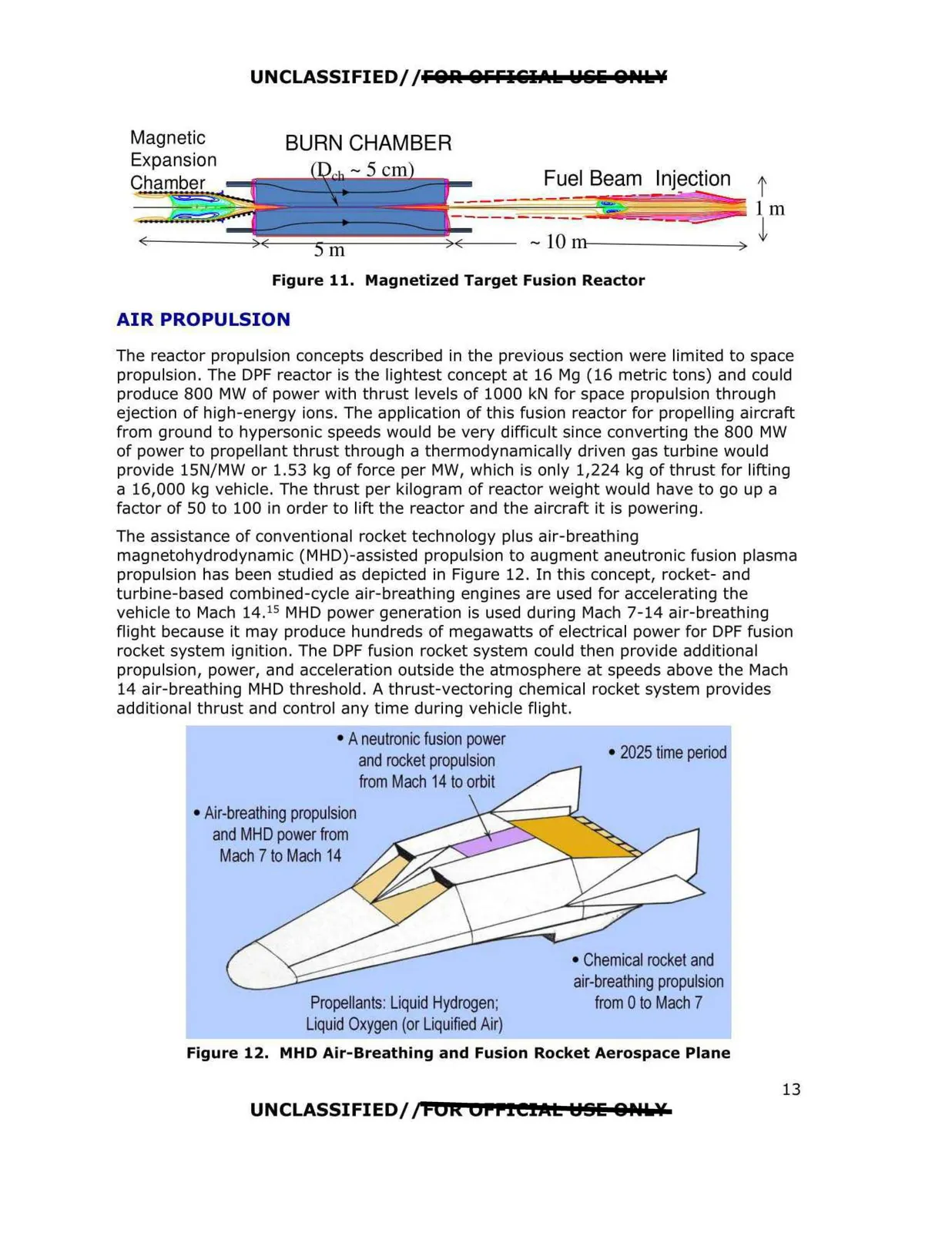
UNCLASSIFIED//FOR OFFI&il.t.k WIiii 8Plk\f Magnetic BURN CHAMBER Expansion . . . Chamber I . Fuel Beam lnjecti_~n t 'I I ~ - ----~ 1m ; - I < )( )( ~ 10 m ➔ Sm Figure 11. Magnetized Target Fusion Reactor AIR PROPULSION The reactor propulsion concepts described in the previous section were limited to space propulsion. The DPF reactor is the lightest concept at 16 Mg (16 metric tons) and could produce 800 MW of power with thrust levels of 1000 kN for space propulsion through ej ection of high-energy ions. The application of this fusion reactor for propelling aircraft from ground to hypersonic speeds would be very difficult since converting the 800 MW of power to propellant thrust through a thermodynamically driven gas turbine would provide lSN/MW or 1.53 kg of force per MW, which is only 1,224 kg of thrust for lifting a 16,000 kg vehicle. The thrust per kilogram of reactor weight would have to go up a factor of 50 to 100 in order to lift the reactor and the aircraft it is powering. The assistance of conventional rocket technology plus air-breathing magnetohydrodynamic (MHD)-assisted propulsion to augment aneutronic fusion plasma propulsion has been studied as depicted in Figure 12. In this concept, rocket- and turbine-based combined-cycle air-breathing engines are used for accelerating the vehicle to Mach 14.15 MHD power generation is used during Mach 7-14 air-breathing flight because it may produce hundreds of megawatts of electrical power for DPF fusion rocket system ignition. The DPF fusion rocket system could then provide additional propulsion, power, and acceleration outside the atmosphere at speeds above the Mach 14 air-breathing MHD threshold. A thrust-vectoring chemical rocket system provides additional thrust and control any time during vehicle flight. • Aneutronic fusion power • 2025 time period and rocket propulsion from Mach 14 to orbit • Air-breathing propulsion and MHD power from Mach 7to Mach 14 • Chemical rocket and air-breathing propulsion Propellants: Liquid Hydrogen; from Oto Mach 7 Liquid Oxygen (or Liquified Air) Figure 12. MHD Air-Breathing and Fusion Rocket Aerospace Plane UNCLASSIFIED/ JFOR OFFICIJlcL l:ISE 8Plk¥ 13