AAWSAP DIRD, Aneutronic Fusion Propulsion II, November 2010
DOW-UAP-D146 · page 24 of 36
Text
This text came with the file. It may have mistakes. When the text and the image disagree, the image is right.
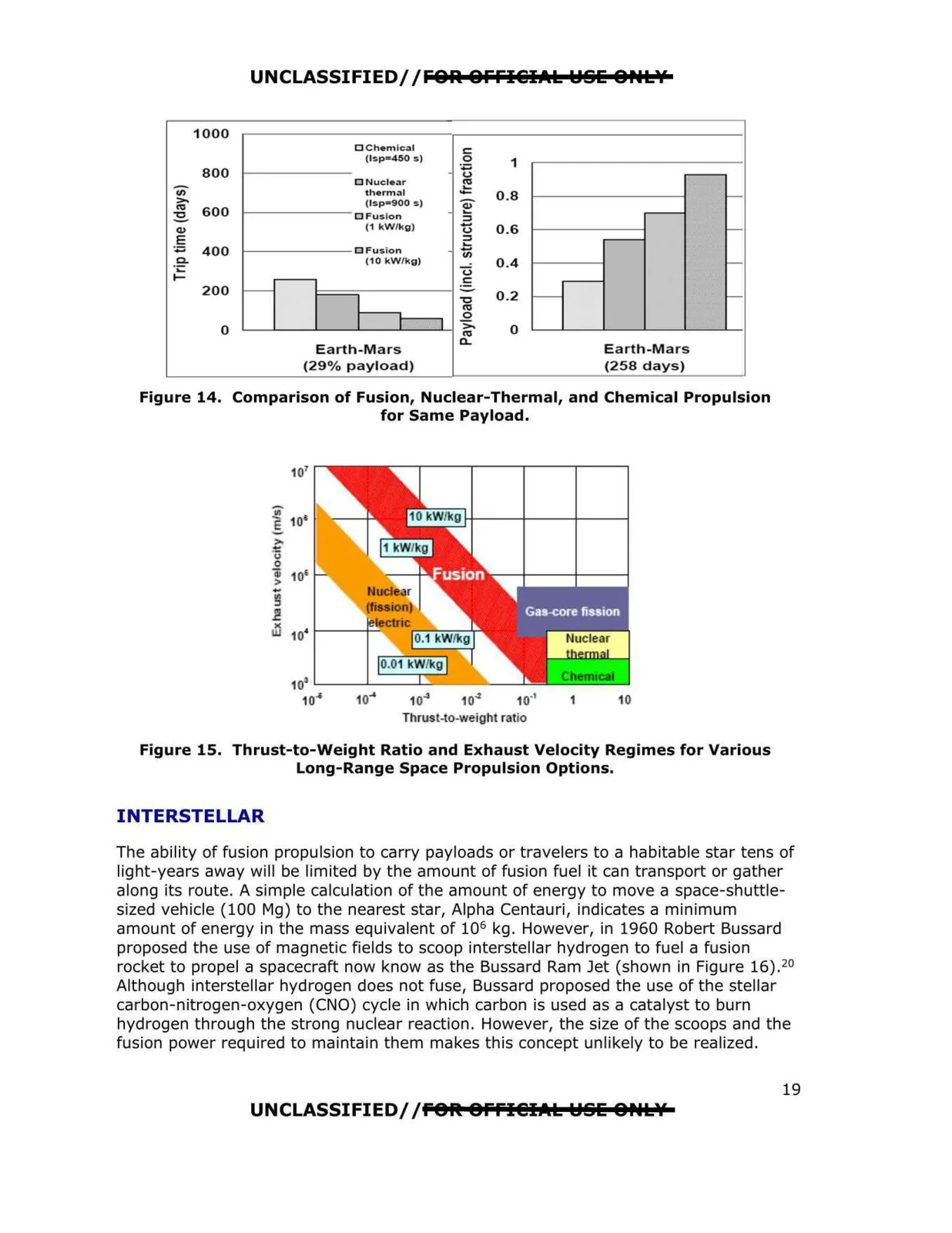
UNCLASSIFIED//FOR 8FFl&IAk l:ISE 8Hk¥ 1000 □ C h em i c:,I C (ls p=450 s) .2 1 800 - u - ONucle;a_r ff! en .... therm:al - 0.8 - >- (lsp-900 s) cu ff! 600 ~ □ Fu si on - .... - :::, a, (1 k W /kg) - u 0.6 - :E .s - 400 □ Fu si on - en a. (1 0 k W /kg ) 0 .4 f-- .... u ~ - ~ - 200 - ~ ,:i 0.2 ~ - ff! 0 0 >, 0 ff! Earth-Mars a.. Earth-Mars (29% payload) (258 days) Figure 14. Comparison of Fusion, Nuclear-Thermal, and Chemical Propulsion for Same Payload. 107 'iii' E 10• u 0 ].. 105 ~ 2 ,. 1o• 1-----i::.:;;; 10~ ,....__ __.____._____ __._ 10· 10 Thrust-to-weight ratio Figure 15. Thrust-to-Weight Ratio and Exhaust Velocity Regimes for Various Long-Range Space Propulsion Options. INTERSTELLAR The ability of fusion propulsion to carry payloads or travelers to a habitable star tens of light-years away will be limited by the amount of fusion fuel it can transport or gather along its route. A simple calculation of the amount of energy to move a space-shuttle sized veh icle (100 Mg) to the nearest star, Alpha Centauri, indicates a minimum amount of energy in the mass equivalent of 106 kg. However, in 1960 Robert Bussard proposed the use of magnetic fields to scoop interstellar hydrogen to fuel a fusion rocket to propel a spacecra~ now know as the Bussard Ram Jet (shown in Figure 16).20 Although interstellar hydrogen does not fuse, Bussard proposed the use of the stellar carbon-nitrogen-oxygen (CNO) cycle in which carbon is used as a catalyst to burn hydrogen through the strong nuclear reaction. However, the size of the scoops and the fusion power required to maintain them makes this concept unlikely to be realized. UNCLASSIFIED//fOfl Offl@IAk l:ISE 8HkY 19