AAWSAP DIRD, Aneutronic Fusion Propulsion II, November 2010
DOW-UAP-D146 · page 8 of 36
Text
This text came with the file. It may have mistakes. When the text and the image disagree, the image is right.
UNCLASSIFIED//FOA OFFl&IAk YSE 8HLV
Chapter 2: Fusion Plasma Physics
At the most basic level, nuclear fusion occurs by forcing atomic nuclei close enough so
that the attractive strong force (which binds nuclei together) overwhelms the very
powerful electromagnetic repulsion force. Under such circumstances the nuclei fuse
together to form a single nucleus, creating an atom of a different element (along with
byproducts such as radiation and neutrons). Because the strong force dominates over
such short-length scales ( ~10-15 meter, the diameter of a medium-sized nucleus), the
fusion of heavier nuclei are inherently more unstable, with smaller binding energies. For
light nuclei, the binding energies of the individual nuclei are significantly smaller than
that of the fused nucleus; it is the released energy of the fusion process (in the form of
high-energy photons or kinetic energy of nuclear products such as neutrons) that is
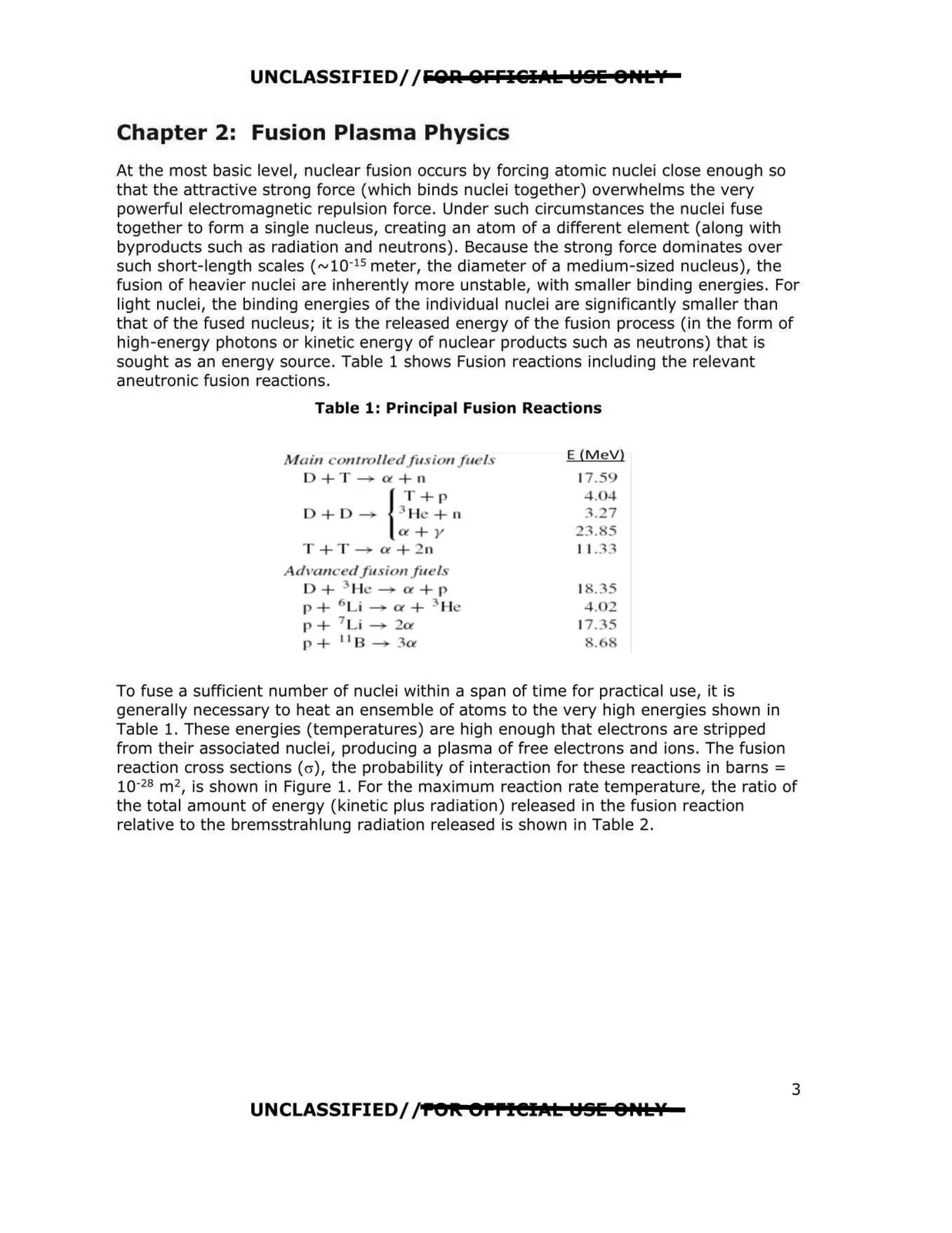
sought as an energy source. Table 1 shows Fusion reactions including the relevant
aneutronic fusion reactions.
Table 1: Principal Fusion Reactions
E (M eV)
Main
,,rro/1 d
I i 11 ue/
+T-a:+ n
17.5
T +p
{
+
3 H c + n
+y
T + T -
a:+_ n
d1•a,1 edfu i II fuel
+ ~, C--+
+ p
p+ L i-+ a,+
H
r>+7 i-
0"
r>+ II
-
30'
To fuse a sufficient number of nuclei within a span of time for practical use, it is
generally necessary to heat an ensemble of atoms to the very high energies shown in
Table 1. These energies (temperatures) are high enough that electrons are stripped
from their associated nuclei, producing a plasma of free electrons and ions. The fusion
reaction cross sections (cr), the probability of interaction for these reactions in barns =
10-28 m2, is shown in Figure 1. For the maximum reaction rate temperature, the ratio of
the total amount of energy (kinetic plus radiation) released in the fusion reaction
relative to the bremsstrahlung radiation released is shown in Table 2.
UNCLASSIFIED/ /POR. o,,1e1AL l:ISE 8Hk\S
3