AAWSAP DIRD, Aneutronic Fusion Propulsion II, November 2010
DOW-UAP-D146 · page 9 of 36
Text
This text came with the file. It may have mistakes. When the text and the image disagree, the image is right.
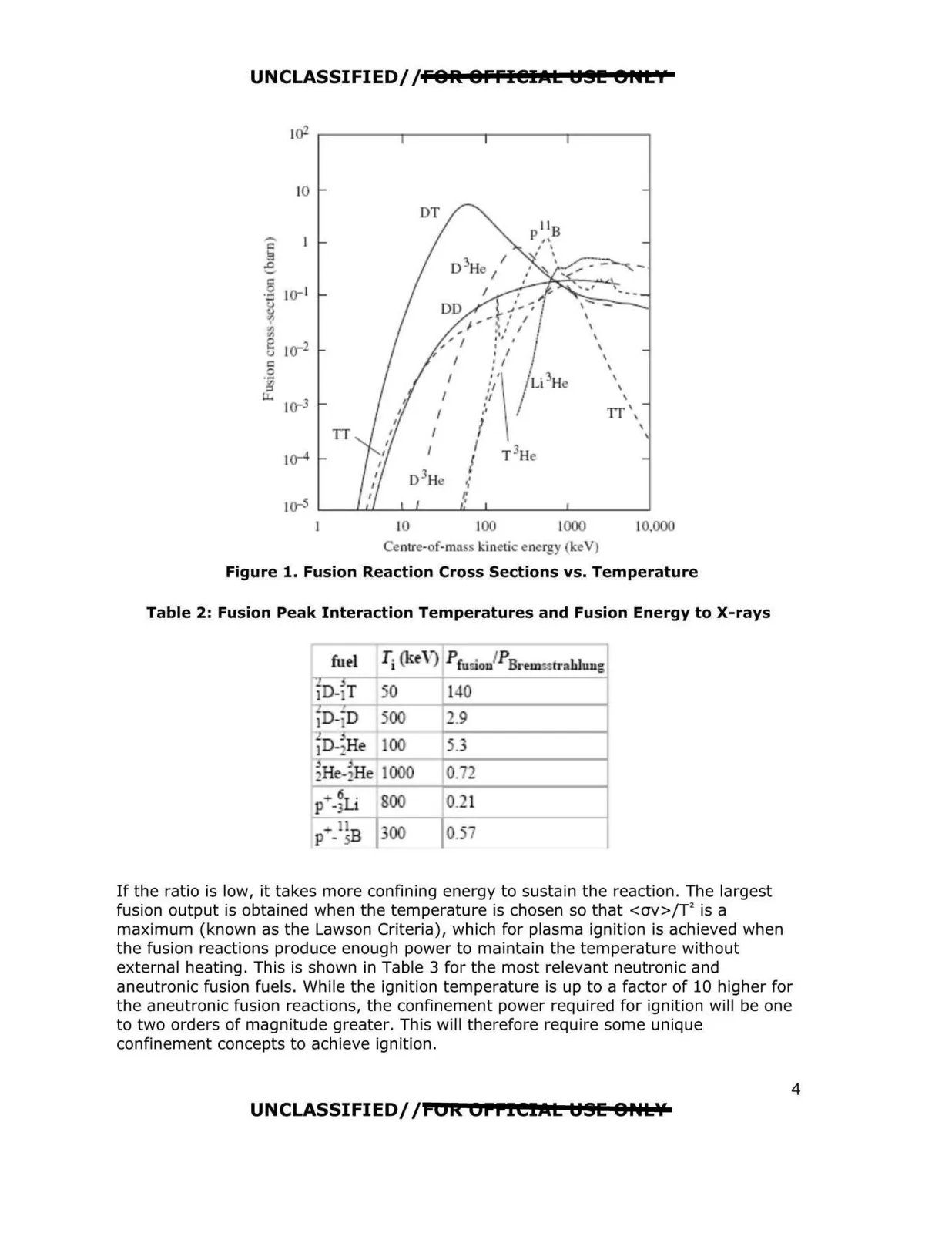
UNCLASSIFIED/ /FOR 8Ffl@IAL tl9I!!! er•t t 10 .... C ·::i ~ ~ 10-1 e 10-2 C -~ 0 u.. 10-J ' .:, \ \ \ TT ,, ~ I I \ TT \ I 1 10-S ~-~----~r, ~---~---- 1 10 JO. Figure 1. Fusion Reaction Cross Sections vs. Temperature Table 2: Fusion Peak Interaction Temperatures and Fusion Energy to X-rays fuel Ti (ke\ Pru ·oi PBre_ rr:ahlun• ' jD- T so 14-0 iD-D -oo __9 l - He 00 -.3 0 0. 0. 1 0 --,, . I If the ratio is low, it takes more confining energy to sustain the reaction. The largest fusion output is obtained when the temperature is chosen so that <crv>/T2 is a maximum (known as the Lawson Criteria), which for plasma ignition is achieved when the fusion reactions produce enough power to maintain the temperature without external heating. This is shown in Table 3 for the most relevant neutronic and aneutronic fusion fuels. While the ignition temperature is up to a factor of 10 higher for the aneutronic fusion reactions, the confinement power required for ignition will be one to two orders of magnitude greater. This will therefore require some unique confinement concepts to achieve ignition. UNCLASSIFIED// FOR OFFICIAL tl!H! OHL\! 4