AAWSAP DIRD, Ultracapacitors as Energy and Power Storage Devices, November 2010
DOW-UAP-D147 · page 10 of 34
Text
This text came with the file. It may have mistakes. When the text and the image disagree, the image is right.
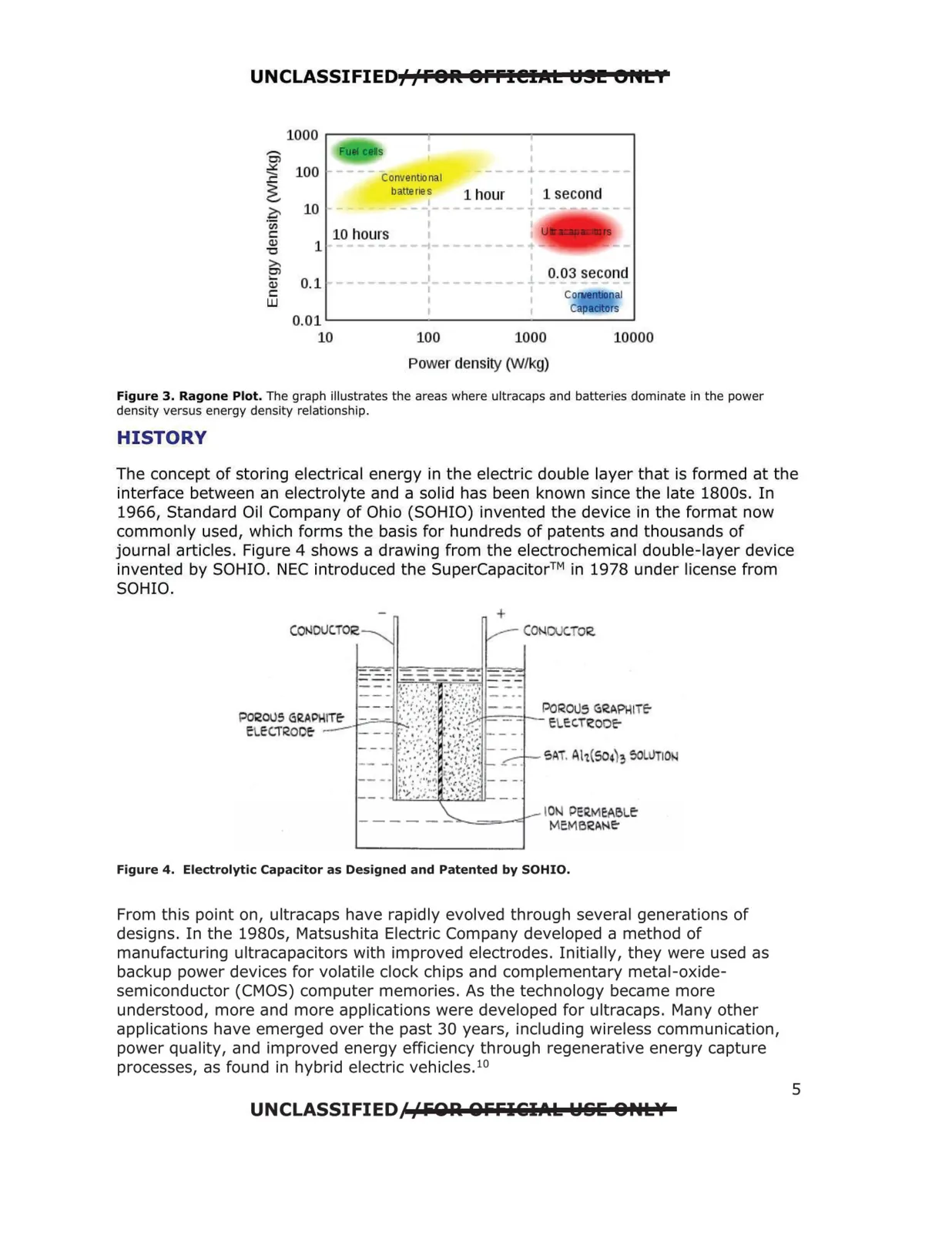
UNCLASSIFIED1/FOR 8ffl@IAL tt91! e"t I 1000 ....... ,...s C') ~ 100 Con~entmnal .c - battene s ~ 1 hour 1 second 10 C' "cii C: _,I I_________ 10 hours (I) "C 1 I >, ... Cl I 0.03 second (I) 0.1 -- '-------- C: w 0.01 .__ ________________, 10 100 1000 10000 Power density (W/kg) Figure 3. Ragone Plot. The graph illustrates the areas where ultracaps and batteries dominate in the power density versus energy density relationship. HISTORY The concept of storing electrical energy in the electric double layer that is formed at the interface between an electrolyte and a solid has been known since the late 1800s. In 1966, Standard Oil Company of Ohio (SOHIO) invented the device in the format now commonly used, which forms the basis for hundreds of patents and thousands of journal articles. Figure 4 shows a drawing from the electrochemical double-layer device invented by SOHIO. NEC introduced the SuperCapacitor™ in 1978 under license from SOHIO. CO UC. 0'2 Ole. SA . Alt(S04 3 50 10 lO PEQ.MEABLI:' Mct.162At-.lc- Figure 4. Electrolytic Capacitor as Designed and Patented by SOHIO. From this point on, ultracaps have rapidly evolved through several generations of designs. In the 1980s, Matsushita Electric Company developed a method of manufacturing ultracapacitors with improved electrodes. Initially, they were used as backup power devices for volatile clock chips and complementary metal-oxide semiconductor (CMOS) computer memories. As the technology became more understood, more and more applications were developed for ultracaps. Many other applications have emerged over the past 30 years, including wireless communication, power quality, and improved energy efficiency through regenerative energy capture processes, as found in hybrid electric vehicles.10 UNCLASSIFIEO/fFOA OFFI&I:.l.b YS& ONLY 5