AAWSAP DIRD, Ultracapacitors as Energy and Power Storage Devices, November 2010
DOW-UAP-D147 · page 9 of 34
Text
This text came with the file. It may have mistakes. When the text and the image disagree, the image is right.
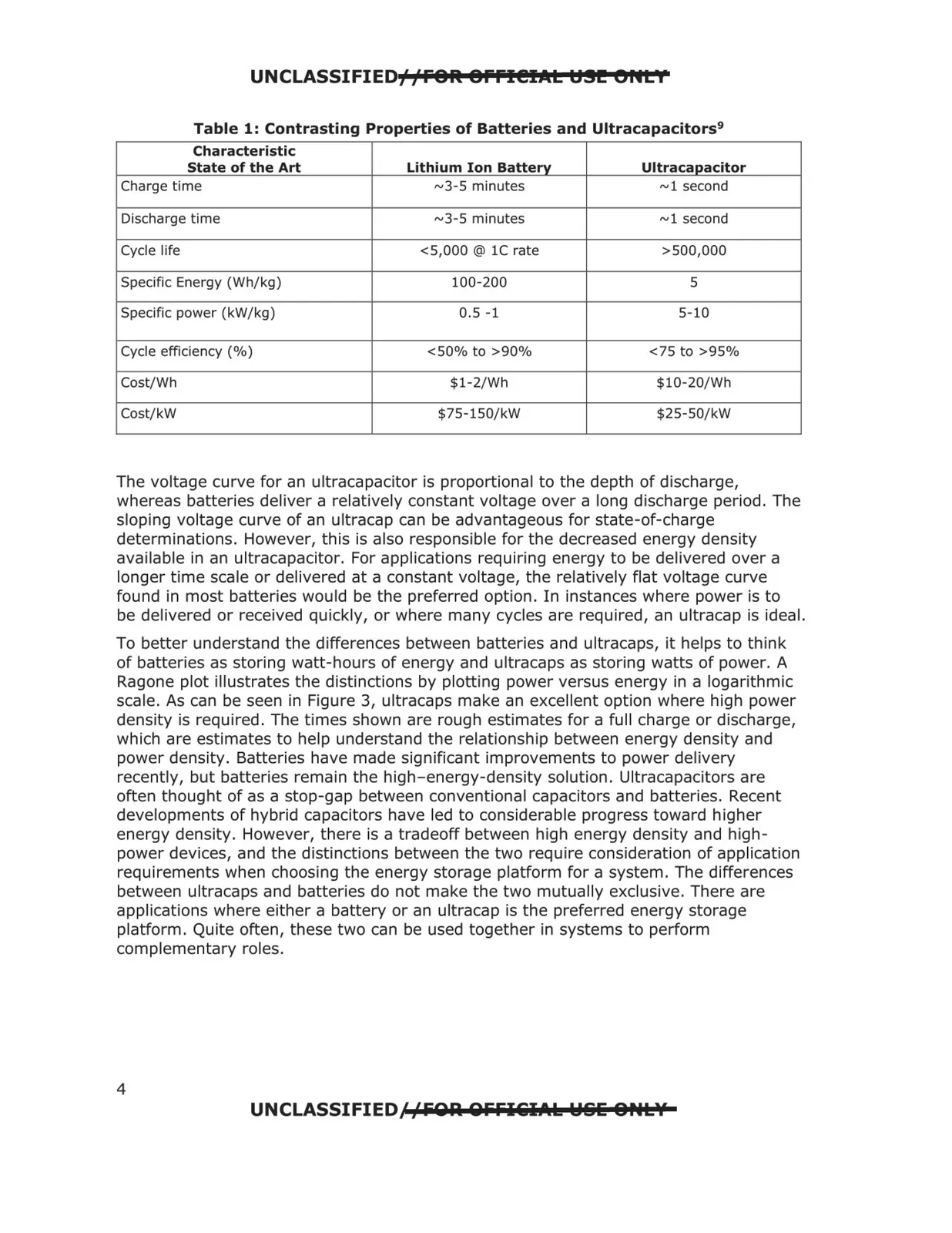
UNCLASSIFIED11FOR. 8FFl@IAL tt.!! e"t I Table 1: Contrasting Properties of Batteries and Ultracapacitors9 Characteristic State of the Art Lithium Ion Battery Ultra capacitor Charge time ~3-5 minutes "'1 second Discharge time ~3-5 minutes ~1 second Cycle life <5,000 @ 1C rate >500,000 Specific Energy (Wh/kg) 100-200 5 Specific power (kW/kg) 0.5 -1 5-10 Cycle efficiency (%) <50% to >90% <75 to >95% Cost/Wh $1-2/Wh $10-20/Wh Cost/kW $75-150/kW $25-50/kW The voltage curve for an ultracapacitor is proportional to the depth of discharge, whereas batteries deliver a relatively constant voltage over a long discharge period. The sloping voltage curve of an ultracap can be advantageous for state-of-charge determinations. However, this is also responsible for the decreased energy density available in an ultracapacitor. For applications requiring energy to be delivered over a longer time scale or delivered at a constant voltage, the relatively flat voltage curve found in most batteries would be the preferred option. In instances where power is to be delivered or received quickly, or where many cycles are required, an ultracap is ideal. To better understand the differences between batteries and ultracaps, it helps to think of batteries as storing watt-hours of energy and ultracaps as storing watts of power. A Ragone plot illustrates the distinctions by plotting power versus energy in a logarithmic scale. As can be seen in Figure 3, ultracaps make an excellent option where high power density is required. The times shown are rough estimates for a full charge or discharge, which are estimates to help understand the relationship between energy density and power density. Batteries have made significant improvements to power delivery recently, but batteries remain the high-energy-density solution . Ultracapacitors are often thought of as a stop-gap between conventional capacitors and batteries. Recent developments of hybrid capacitors have led to considerable progress toward higher energy density. However, there is a tradeoff between high energy density and high power devices, and the distinctions between the two require consideration of application requirements when choosing the energy storage platform for a system. The differences between ultracaps and batteries do not make the two mutually exclusive. There are applications where either a battery or an ultracap is the preferred energy storage platform. Quite often, these two can be used together in systems to perform complementary roles. UNCLASSIFIEO/;LFOA OFFI&il:.l.b YS& OrtLY 4