AAWSAP DIRD, Ultracapacitors as Energy and Power Storage Devices, November 2010
DOW-UAP-D147 · page 13 of 34
Text
This text came with the file. It may have mistakes. When the text and the image disagree, the image is right.
UNCLASSIFIED1/FOR 8ffl@IAL tt91! e"t I
Chapter 2: Materials Technology
The standard electrochemical capacitor is made of two electrodes, an electrolyte, and a
separator, packaged in either a metal container or a laminated pouch. Ultracapacitors
are often packaged in a fashion similar to a typical battery configuration. The separator
is an ultrathin material that allows ion transport but is electrically insulating. There are
several polymer separators on the market that have the desired porosity needed to
create fast ion transport. The electrodes are traditionally the same material in an
ultracapacitor-this is in stark contrast to a battery. Electrodes are typically carbon; this
is advantageous in making a cost-effective energy/power-storage device. Activated
carbon has a very high surface area, vital to storing energy in the electrical double
layer between the electrode and the electrolyte. This thin double layer is responsible for
the impressive high-power-storage capabilities of the ultracapacitor. The electrolyte's
resistivity and dielectric constant play a vital role in behavior of the double layer;
consequently, the choice of electrolyte impacts performance.
The earliest electrochemical capacitors were introduced 30+ years ago; they were
symmetric designs (two identical electrodes) in aqueous electrolyte. While these
electrolytes have excellent ionic conductivity, the operating cell voltage was limited to
~1.2 V/cell and these had a nominal cell rating of ~0.9 volts. In the second generation
of electrochemical capacitors, the use of organic electrolyte led to an increase of the
rated cell voltage from about 0.9 V/cell to 2.3-2.7 V/cell. Today, ultracapacitors using
an organic electrolyte are the most popular. 14
ELECTROLYTES
Initial ultracaps used aqueous electrolytes, saturated with Al2(SO4)3, or 30%
concentrations of H2SO4 or KOH. While these electrolytes have excellent ionic
conductivity, the operating voltage is limited to 1.2 volts using carbon electrodes.
Improvements to ultracapacitor performance were made by transitioning from aqueous
electrolytes to an organic medium. Organic electrolytes have lower ionic conductivity,
but the higher breakdown potential increases the nominal cell voltage. An increase in
cell voltage up to as high as 3 volts has been realized by use of an organic electrolyte.
These electrolytes are typically an ammonium salt dissolved in an organic solvent, such
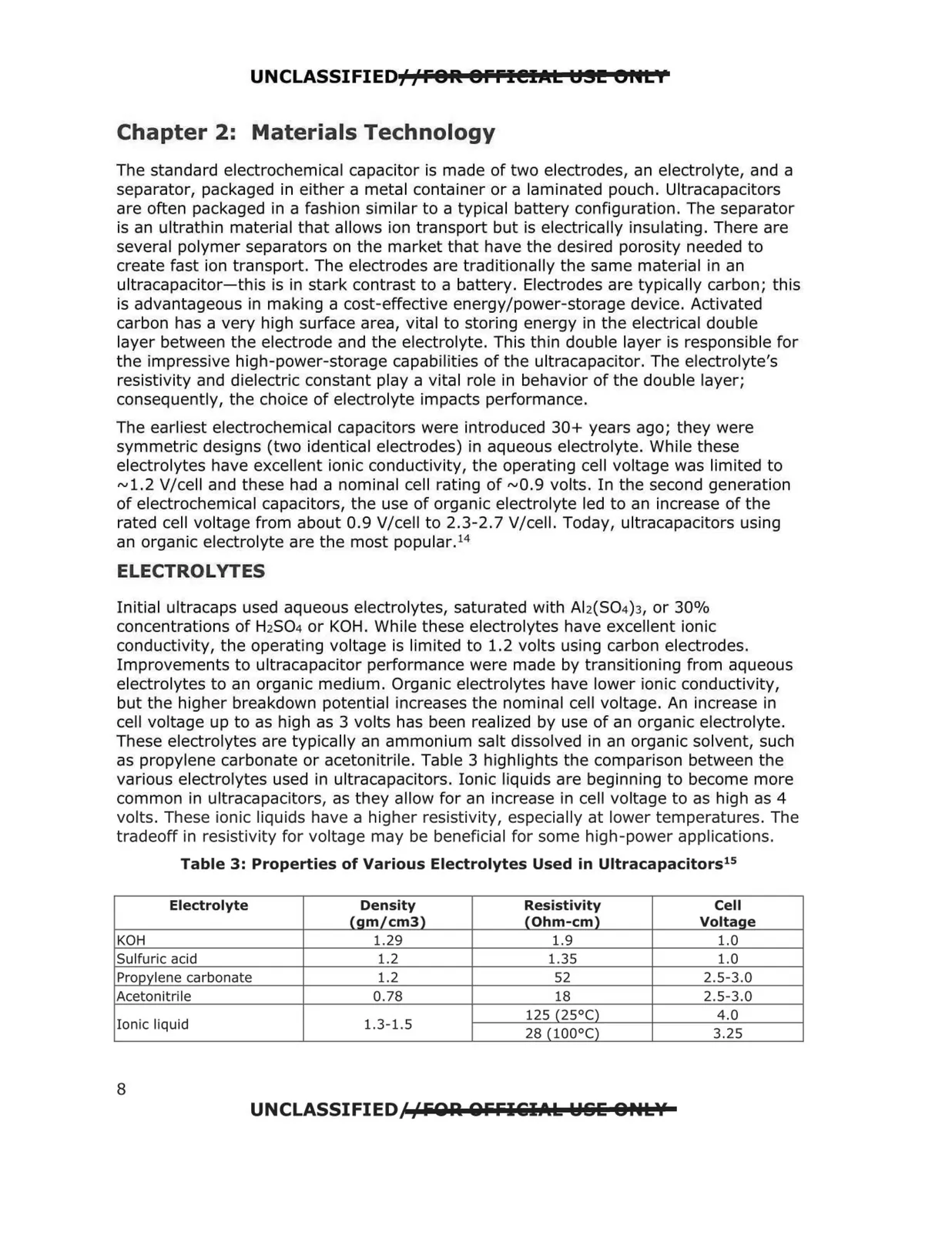
as propylene carbonate or acetonitrile. Table 3 highlights the comparison between the
various electrolytes used in ultracapacitors. Ionic liquids are beginning to become more
common in ultracapacitors, as they allow for an increase in cell voltage to as high as 4
volts. These ionic liquids have a higher resistivity, especially at lower temperatures. The
tradeoff in resistivity for voltage may be beneficial for some high-power applications.
Table 3: Properties of Various Electrolytes Used in Ultracapacitors15
Electrolyte
KOH
Sulfuric acid
Propylene carbonate
Acetonitrile
Ionic liquid
Density
(am/cm3)
1.29
1.2
1.2
0.78
1.3-1.5
Resistivity
(Ohm-cm)
1.9
1.35
52
18
125 (25°C)
28 (100°C)
Cell
Voltaae
1.0
1.0
2.5-3.0
2.5-3.0
4.0
3.25
UNCLASSIFIEO/fFOA OFFI&I:.l.b YS& ONLY
8