AAWSAP DIRD, Ultracapacitors as Energy and Power Storage Devices, November 2010
DOW-UAP-D147 · page 14 of 34
Text
This text came with the file. It may have mistakes. When the text and the image disagree, the image is right.
UNCLASSIFIED1fFOR 8ffl@IAL tt9! e"t I
ELECTRODES
Carbon has been the optimal electrode material for ultracapacitors since their
commercial introduction over 30 years ago. Pseudocapacitor systems use a combination
of a carbon electrode and a battery-like electrode, such as a conductive polymer or a
metal oxide. The hig h surface area of carbon makes it an extremely attractive option
for ultracap electrodes. Carbon chemistry is quite well known, and high surface area
and low cost ensures carbon's continued use for the near future. While carbon has been
used in electrochemical systems for many years, there are many nuances that make its
properties and performance vary significantly amongst the many types of carbon. The
use of a carbon electrode makes ultracaps affordable for use in many systems.
Activated carbon is readily available, can be made from many source materials, and is
inexpensive. Materials science activities for electrodes are focused on improving the
carbon electrodes and introducing alternative materials to create an asymmetric
electrode.
Types of carbon can include activated carbon, carbon cloth, aerogels, porous carbon,
carbon nanotubes, and graphene. The properties of carbon can change dramatically
based upon processing, having a major im pact to the porosity and active surface area.
Activated carbon has an extremely high surface area, is inexpensive, and is produced at
a global scale for use in a number of applications. For these reasons, activated carbon
is the traditional carbon of choice for ultracapacitor applications. Recent advances in
carbon materials development have led to a number of options for ultracapacitor
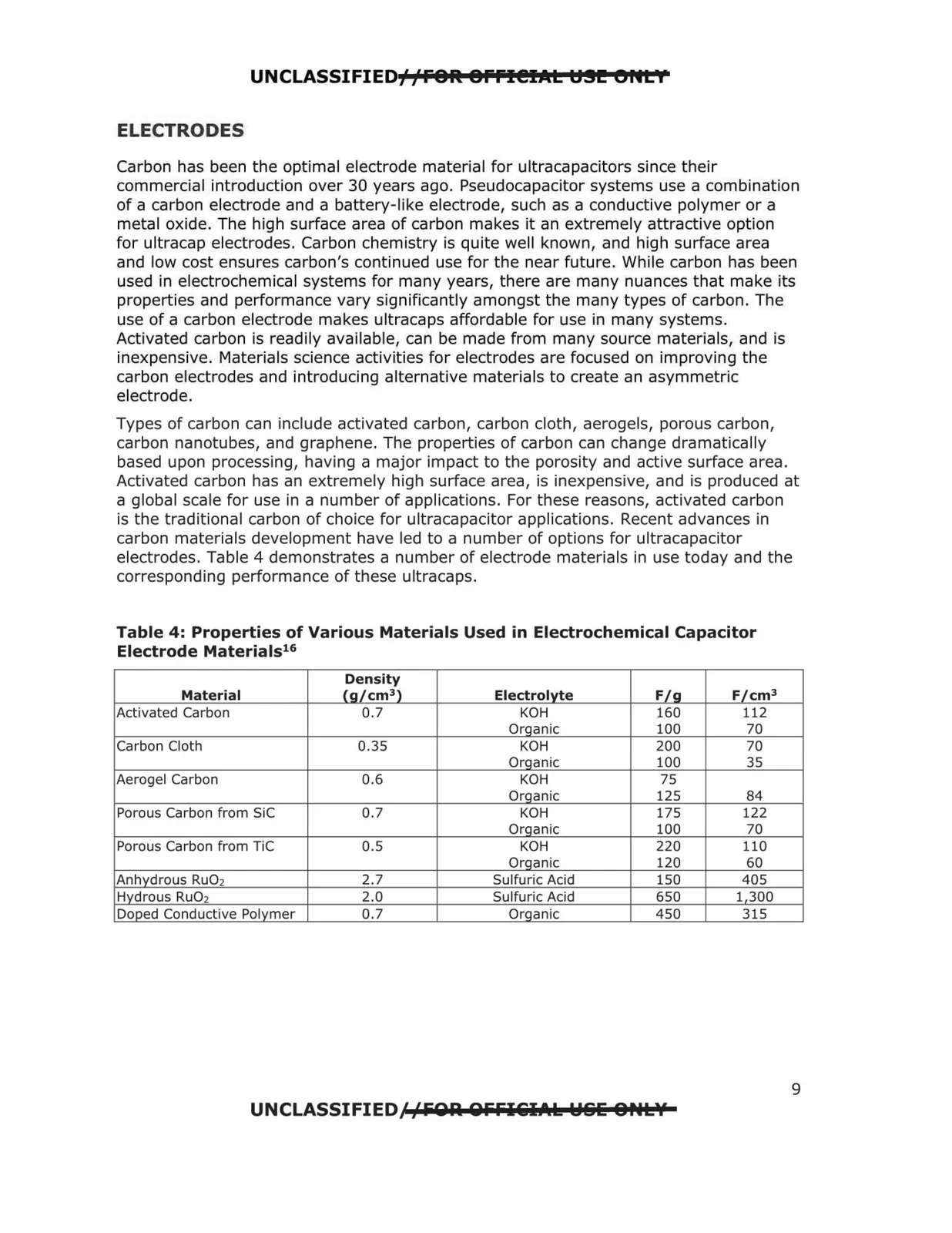
electrodes. Table 4 demonstrates a number of electrode materials in use today and the
corresponding performance of these ultracaps.
Table 4: Properties of Various Materials Used in Electrochemical Capacitor
Electrode Materials16
Material
Density
(g/cm3 )
Electrolyte
F/g
F/cm3
Activated Carbon
0.7
KOH
160
112
Oroanic
100
70
Carbon Cloth
0.35
KOH
200
70
Organic
100
35
Aerogel Carbon
0.6
KOH
Orqanic
75
125
84
Porous Carbon from SiC
0.7
KOH
175
122
Oroanic
100
70
Porous Carbon from TiC
0.5
KOH
220
110
Organic
120
60
Anhydrous RuO2
2.7
Sulfuric Acid
150
405
Hvdrous RuO2
2.0
Sulfuric Acid
650
1 300
Doped Conductive Polvmer
0.7
Orqanic
450
315
UNCLASSIFIEO/fFOA OFFI&I:.l.b YS& ONLY
9